
How to Treat Knee Pain with Dr. Tan's Balance Method: Six Meridians, Structure Matching, and When to Use the Opposite Knee
Two patients in one week at our clinic. Both have right knee pain. Both point to the knee when you ask where it hurts. In standard TCM, they might both get Stomach 35, Xiyan, Spleen 9, Galbladder 34 — a handful of local points around the knee. With the Balance Method, they get two completely different treatments. And both walk out with significant improvement.
Patient one: right knee, sharp pain at the inner edge of the kneecap. She rates it a 4 out of 10 — it's been there for weeks, worse on stairs. She points with one finger — medial border of the patella. That's Spleen. System 1 gives us Lung on the opposite side. But when we palpate Lung 5 on the elbow, we feel tendon. The pain on the knee is on bone — the hard edge of the kneecap. Tendon doesn't mirror bone well. So we switch: Stomach on the opposite knee, lateral side of the patella. Bone on bone. Clear ashi. One needle. "That pulling is gone." Structure matching matters as much as the system.
Patient two: right knee, 7 out of 10, deep pain through the whole joint. Back from a ski vacation — twisted the knee, it's swollen, hard to bend. Plus lower back pain on both sides at the lumbar area. Two problems, two locations. We run one matrix for everything. The knee has six meridians, so it gets the biggest matrix. Best combo: Lung, Heart, and Pericardium on the opposite elbow. Three needles. The knee bending improves immediately. Then we add the back treatment, checking the sides don't conflict. Six needles total for two locations.
Same joint. Different score. Different location, different complexity, different approach. The first patient needed one smart switch. The second needed a full matrix for six meridians plus a multi-location strategy. But both started with the same question: where exactly is the pain?
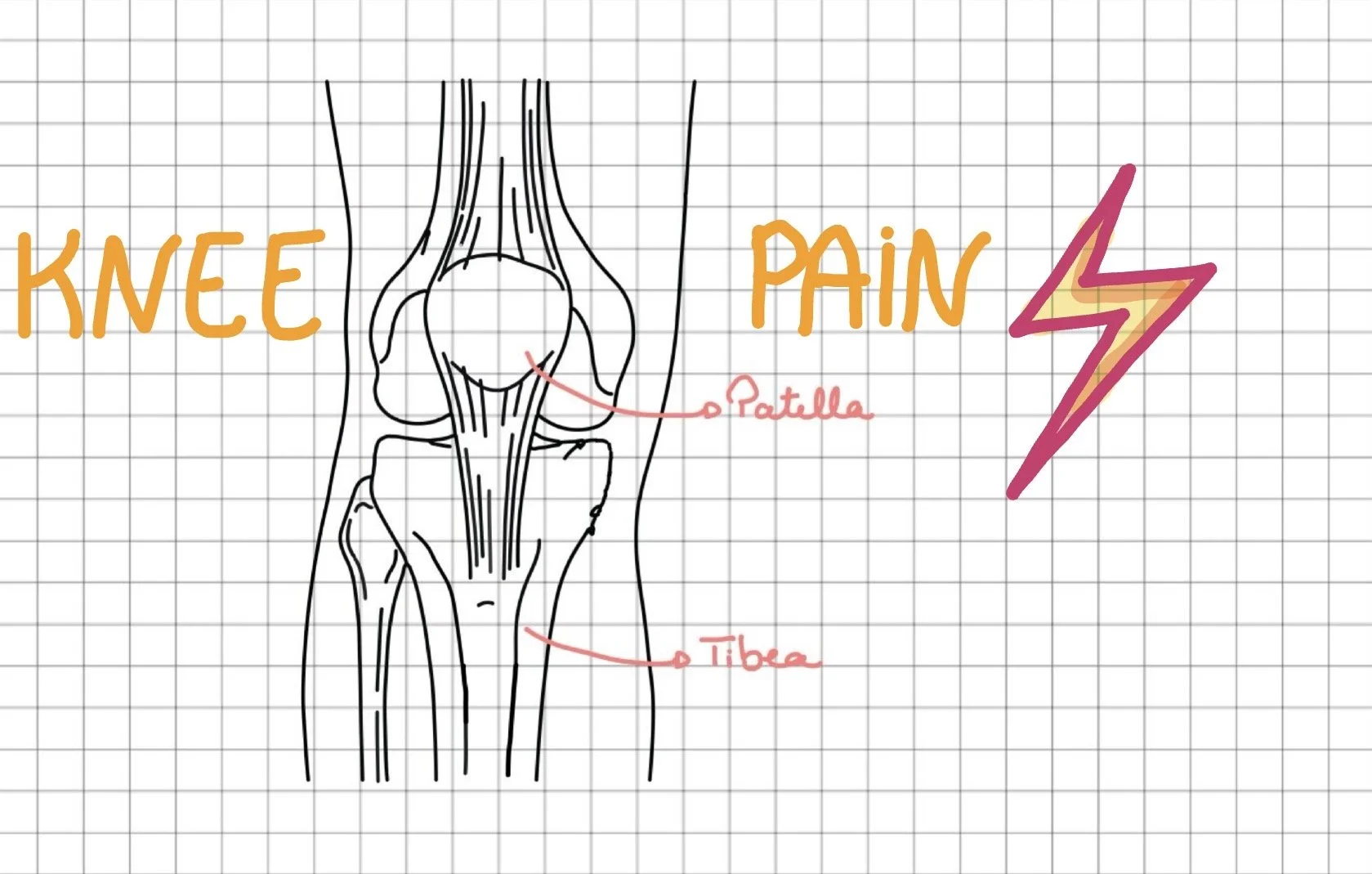
Source: Balancemethodnotebook
Why the Knee Is the Six-Meridian Joint
The knee is where all six leg meridians converge. Stomach, Gallbladder, and Urinary Bladder on the Yang side. Liver, Spleen, and Kidney on the Yin side. That's why "knee pain" tells you nothing. The patient has to point — and that one finger determines which of six possible treatments you give.
This is the same one-finger rule that applies everywhere, but the knee makes it critical because the channels are packed so closely together. The outer edge of the kneecap is Stomach. One centimeter forward and it's Galbladder. Around the back and it's Urinary Bladder. A patient who waves at "somewhere around the knee" gives you six possible treatments. A patient who puts one finger on one spot gives you one.
Step 1: Knee Pain Meridian Map
| Where the patient points | Meridian |
|---|---|
| Inner edge of the kneecap | Spleen |
| Outer edge of the kneecap | Stomach |
| Outer side of the knee, below the joint | Gallbladder |
| Back of the knee (the soft hollow) | Urinary Bladder |
| Inner side of the lower leg — soft groove behind shinbone | Spleen (below knee) |
| Inner side of the lower leg — the shinbone itself | Liver (below knee) |
| Inner side of the lower leg — the muscle behind Spleen | Kidney |
The one-finger rule is non-negotiable here. "Knee pain" tells you nothing. "Right here" — with one finger on the inner edge of the kneecap — tells you Spleen. That one answer determines the entire treatment.
The Liver-Spleen crossing at the knee
This is the detail that confuses most practitioners. Below the knee, Liver runs along the flat surface of the shinbone — it's bone. Spleen runs just behind the shinbone — it's the soft groove you feel when you palpate, almost empty. They sit side by side, Liver on the bone, Spleen behind it.
But they don't stay in that position forever. At the level of the knee, they cross. Above the knee, Spleen moves to the front and Liver goes more to the inside. Dr Tan, placed this crossing at the knee joint — not lower down at the ankle, as some schools teach. The logic: the crossing makes anatomical sense at a major joint, not in the middle of a straight bone.
In practice, this means: if the pain is on the inner side of the lower leg and you're not sure if it's Liver or Spleen, palpate. Bone = Liver. Soft groove behind the bone = Spleen. Muscle behind that = Kidney. The tissue tells you the meridian. If the pain is right at the knee where they cross and you truly can't tell, palpate for ashi on both treating meridians. The one with the strongest reactive point wins.
Step 2: Balancing the Knee Meridians
The treating meridian determines where you go. If your system gives you a hand meridian (LU, HT, PC, SI, LI, SJ), you mirror to the elbow — knee joint mirrors to elbow joint. If your system gives you a foot meridian (SP, ST, GB, UB, KID, LIV), you go to the opposite knee — same joint, opposite side. You can needle deep into the healthy knee to balance the sick knee. Both are valid. The system decides which one you use.
Check the matrix for the full system options. Here are the most common knee meridians with their treating meridians:
Step 2: Balancing Matrix
Distal treating meridians. System 2 & 4: Either Side - System 1, 3, 5: Opposite.
| Sick | System 1 Opposite |
System 2 Either side |
System 3 Opposite |
System 4 Either side |
System 5 Opposite |
|---|---|---|---|---|---|
| SP | LU | SI | ST | SJ | HT |
| ST | LI | PC | SP | PC | LI |
| GB | SJ | HT | LIV | HT | SJ |
| UB | SI | LU | KID | LU | SI |
| KID | HT | SJ | UB | LI | PC |
| LIV | PC | LI | GB | SI | LU |
Anatomical structure matching: when to override the system
This comes up with the knee more than any other joint, and it's one of the most practical things in the entire Balance Method.
Patient one from our opening: pain at the medial edge of the patella. That's Spleen. System 1 says Lung. You go to Lung 5 on the opposite elbow. You palpate. What do you feel? Tendon and soft tissue. But the pain on the knee sits on bone — the hard edge of the kneecap. The structures don't match.
The fix: use Stomach on the opposite knee instead. Lateral side of the kneecap. Now you're matching bone to bone. Same density, same hardness, better resonance. The system gave you the direction. The anatomy gave you the precision.
If you want to stay on Lung, you can — but you'd need to needle deep, all the way to the bone. That works, but in most cases the opposite kneecap gives you a cleaner, more comfortable treatment with a better ashi response.
For the same principle applied below the joint line — two Yin meridians, one System 3 pairing, and a bone that had to be reached without going deep — see our knee pain after squats case study.
For the complete projection system, see Mirroring and Imaging explained →
The Swollen Knee: Above and Below the Joint
When a knee is swollen, the pain doesn't sit in one spot — it spreads. The joint hurts, but the swelling pushes into the tissue above and below, creating discomfort beyond the joint line.
The approach: needle at the elbow joint for the main knee pain. Then palpate slightly above (toward the shoulder) and slightly below (toward the wrist) on the treating meridian for ashi. You don't need both — pick the side with the stronger response. And remember: what sits above the joint in the direct mirror sits below it in the reversed mirror. One projection misses the sweet spot? Flip it.
In our ski case: Heart 3 ashi deep in the elbow joint gave the main knee relief. One more needle slightly below on the Heart channel (toward the wrist) covered the lower swelling. Two needles, one meridian, and the patient could bend again.
Multi-Location: Knee + Lower Back
This is one of the most common combinations in any acupuncture practice. Patient comes in with a bad knee plus lower back pain. Two problems, two locations. The temptation is to build one massive matrix that covers everything at once. Don't. Take them separately. Start with the problem that has the most meridians — that gives you the biggest matrix and the most options for overlap.
The ski case: step by step
Patient back from ski vacation. Right knee swollen and painful, can't bend well. Plus lower back pain on both sides at the lumbar area. That's UrinarB bladder + Galllblader for the back, and all six leg meridians for the knee.
Step 1: Diagnose both. Back = Urinary Bladder, Gallbladder. Knee = Stomach, Galbladder, Urinary Bladder, Spleen, Liver, Kidney — the whole joint hurts.
Step 2: Matrix for the knee first (six meridians = biggest problem). Best combo: Lung + Heart + Pericardium on the opposite elbow. Three hand Yin meridians that cover all six knee meridians through the six systems.
Step 3: Check if the knee combo also covers the back. Heart balances Gallbladder directly. Lung balances Urinary Bladder on both sides. The three knee needles already address most of the lower back. If the back hurts on both sides, check which side your combo covers. Heart on the left (opposite to the right knee) balances both sides of the Gallbladder backpain.
Two locations. No needle anywhere near the knee or the back. That's the Balance Method.
This is the same multi-location logic explained in the back pain guide: take problems separately, start with the biggest matrix, and look for overlap.
Baker Cyst: Local Balance Within a Global Treatment
A patient comes in with a cold that won't clear plus a Baker cyst — a painful swelling behind the knee. Two different categories. The cold is a Global Balance case. The Baker cyst is a Local Balance case. The cold determines your Global pattern choice. The Baker cyst is a separate local addition.
The Baker cyst sits at the back of the knee — UB territory. You need to add a meridian that balances UB: Lung (both sides, System 2/4) or Kidney (opposite side, System 1). Which one gives better anatomical structure similarity for the soft hollow behind the knee? Check what's at the back of the elbow on each channel. Pick the better match.
If your chosen Global pattern already includes Lung or Kidney, you might cover the cyst without extra needles — just make sure you're at the right projection level. Elbow = knee. That's the key.
The Baker cyst has nothing to do with the Global problem. Don't confuse them. Don't let the cold influence your Baker cyst treatment or vice versa. Clear separation in your head — Global for the systemic issue, Local for the joint.
When the Pain Isn't There During the Session
A patient comes in for knee pain that's only bad at night or during specific activities. Right now, in your treatment room, it's barely there. How do you evaluate?
Look for subtler signs. Is the knee as flexible as the other one? Is there stiffness when bending? Sometimes the sick knee has slightly less range of motion than the healthy side — and that gives you something measurable to work with.
If there's truly nothing to find, treat the area the patient shows you and book a follow-up for the next day or two. Ask them to pay attention during the night and report back. You can't measure what you can't provoke — and that's OK. The follow-up tells you whether the treatment landed.
Using the Opposite Knee for Treatment When It Also Hurts
This comes up all the time. You want to use the opposite knee for treatment (mirror projection), but that knee also has some pain. Can you still use it?
Yes — as long as your needles don't go into the exact spot where the opposite knee hurts. If the pain on the treatment knee is much less intense than the main problem, it's fine.
Even better: treat the opposite knee pain first. Clear it. Confirm it's pain-free. Then use that knee to treat the main problem. Sometimes you have to think one step ahead — solve the smaller problem first so you can use that area as your treatment platform.
The Bone-on-Bone Conversation
Let's be honest. The Balance Method works — but it has limits. When the cartilage is gone and it's bone on bone, acupuncture can't rebuild what's missing. You'll get pain relief, often significant. But it's going to be hard to get a long-lasting, stable result. The structure is damaged, and no amount of meridian balancing fixes that.
This doesn't mean don't treat these patients. Many of them get meaningful improvement in pain and function. But be upfront about expectations. Tell them: "We can help with the pain and help you move better. We can't fix the structural damage. The goal is quality of life." Some of these patients become your most loyal long-term patients — coming every few weeks because the treatments genuinely help them function.
Same applies to a badly bulging disc, a torn meniscus that hasn't been repaired, or any severe anatomical deformation. You can manage the pain. You can't reverse the damage. Honesty builds trust.
Preventive Treatment
Something we do regularly in our clinic. The patient's knee pain is resolved — pain-free for daily life. But they know that hiking, running, or a ski trip will trigger it. So they come in before the activity.
You already know this patient. You know which meridian, which side, which projection worked. Repeat the same treatment preventively, strengthening the area before the stress hits. The patient goes hiking and comes back fine instead of coming back with a flare-up.
If the patient doesn't want a preventive treatment before the trip, tell them: "Schedule one for when you get back. Practical advice that patients appreciate.
Common Mistakes
1. Diagnosing "knee pain" instead of diagnosing the meridian
"Knee pain" isn't a diagnosis. Six meridians cross the knee. The patient has to point. Inner kneecap = Spleen. Outer kneecap = Stomach. Back of the knee = Urinary Bladder. Each one leads to a completely different treatment. Skip this step and you're guessing.
2. Ignoring anatomical structure matching
The medial patella edge is bone. Lung 5 is tendon. If you needle tendon for bone-level pain and wonder why it doesn't hold — this is why. Match the structure: bone to bone, tendon to tendon, soft to soft. When the standard system lands on the wrong tissue type, find a better match.
3. Running one matrix for knee + back at the same time
Don't. Take them separately. Start with the knee (six meridians = biggest matrix = most overlap options). Then check if your knee combo already covers the back. Add what's missing. One problem at a time.
4. Forgetting to clear the opposite knee first
If you want to treat the right knee by needling the left knee (mirror), and the left knee also hurts — treat the left knee pain first. Clear it, confirm it's pain-free, then use it. Think one step ahead.
5. Overpromising with structural damage
Bone on bone, torn meniscus, severe degeneration — the Balance Method can reduce pain and improve function, but it can't rebuild cartilage. Set honest expectations. These patients do well with maintenance, but they need to understand the goal is management, not cure.
Frequently Asked Questions
Can I use the opposite knee for treatment if that knee also hurts?
Yes — as long as your needles don't land on the exact spot where the other knee hurts. If that knee has much less pain than the main problem, it's fine. You can even treat the other knee first, clear the pain, and then use it for treatment. The key is to think one step ahead: solve the smaller problem first so you have a clean treatment platform for the bigger one.
The pain is only at night. During the session there's almost nothing. What do I do?
Look for what's still there. Is the knee stiffer than the other one? Is flexion slightly limited? Can you find ashi points even without active pain? Sometimes you find more subtle signs — not intense pain, but a discomfort or a tightness that you can measure and treat. If there's truly nothing, treat the area the patient points to and schedule a follow-up for the next day or two. Ask them to pay attention to the night pain. The follow-up tells you whether it worked.
Should I use Local or Global Balance for chronic knee pain?
Unlike headache, knee pain is usually a genuine local problem — something structural at the joint. Start with Local Balance. If the knee pain is part of a bigger picture — pain everywhere, rotating pain from one place to another, fatigue, or other systemic symptoms — then consider Global Balance. But for most knee cases, Local Balance is where you start and where you stay.
How do I choose between Lung and Kidney for a Baker cyst?
Both can balance UB. Lung works on both sides (System 2/4), Kidney works opposite side (System 1). The deciding factor is anatomical structure similarity. The back of the knee is a soft, hollow area. Check what the back of the elbow feels like on the Lung channel versus the Kidney channel. Which one matches that soft, hollow feeling? That's your answer. Same principle as our Patient 1 with the patella — match the tissue, not just the system.
My patient has bone-on-bone. Should I even treat them?
Yes — but be straight with them. You can't rebuild cartilage. What you can do is reduce pain, improve how they move, and decrease how much medication they need. Many bone-on-bone patients become your most loyal long-term patients, coming every few weeks because the treatments genuinely help them function. Set realistic expectations from the start and you build trust instead of disappointment.
Next Steps
The knee is where you learn that the Balance Method isn't just about systems and meridians — it's also about anatomy. Matching structure to structure is just as important as matching channel to channel. If you take one thing from this blog: when the standard treating point lands on the wrong tissue type, don't force it. Find a better match.
For the complete 1-2-3 framework, read the guides on meridian diagnosis, the six systems, and ashi palpation. For multi-location strategies, see the back pain and shoulder guides. Watch knee treatments in action on our needling demo page. For the deeper question of when to go Global, see our dedicated guide. To learn from Dr. Tan's direct disciples, explore Balance Method training programs worldwide.
For the complete clinical reference at your treatment table, the Balance Method Notebook has every projection chart and protocol you need. For Dr. Tan's original texts, see our book recommendations. And join our practitioner community to discuss knee cases with 7,000+ colleagues worldwide. New to the terminology? See the Balance Method Glossary for every core term in one place.
