
How to Treat Back Pain and Sciatica with Dr. Tan's Balance Method: The Million Dollar Combo, Projections & Global Balance
A patient comes back from a ski vacation. Lower back pain, bilateral, lumbar region — and a swollen right knee that's too painful to bend. Two separate problems, five or six meridians involved. According to the traditional TCM approach, this is considered a complex case. The treatment takes approximately 25 minutes, involving the local placement of 20 needles at the pain sites in the back and the knee.
In our acupuncture practice, we apply the 1-2-3 logic of the Balance Method to these complex cases. Our goal is to design a treatment that addresses both the back and the knee simultaneously, using the fewest needles possible for maximum efficiency.
In our acupuncture practice, we apply the 1-2-3 logic of the Balance Method to these complex cases. Our goal is to design a treatment that addresses both the back and the knee simultaneously, using the fewest needles possible for maximum efficiency.
That's the Balance Method approach to back pain. Not a fixed recipe, but a logical framework that adapts to each patient — whether they have simple lumbar stiffness or a complex multi-location presentation.
Step 1: Which Meridian Is Causing the Back Pain?
"Back pain" is not a diagnosis. The lower back is viewed as a region traversed by several distinct meridians, and each one demands a different treatment. The patient's one-finger answer determines everything.
Step 1: Back Pain Meridian Map
| Location | Meridian | Pain Character |
|---|---|---|
| Directly on the spine | Du Mai | Spinal |
| 1-3 cun lateral to spine | Urinary Bladder | Muscular, most common |
| Lateral, wrapping to side | Gallbladder | Radiating toward hip |
| Deep | Kidney | Deep ache and/or radiating to the front |
Most lower back pain involves Urinary Bladder — the muscles along the spine in the lower back between L2 and L5. If the pain wraps laterally toward the hip or shoots down the side of the leg, Gallbladder is involved too. If it sits right on the spine itself, that's Du Mai. And if the patient describes something deep and diffuse — "it's not on the surface, it's inside" — consider Kidney.
The most common clinical presentation is Urinary Bladder + Gallbladder combined: lower back pain that wraps slightly to the side. This is exactly the scenario that Dr. Tan's million dollar combo was designed for.
Sciatica: tracing the pain pathway
Sciatica is back pain that radiates into the leg. For the Balance Method, the critical question isn't "is it sciatica?" — it's "which path does the pain follow?"
When a patient says "it shoots down my leg," ask them to trace it with one finger. Watch carefully where the finger goes:
Sciatica: Pathway Diagnosis
| Pain travels... | Meridian | Typical Description |
|---|---|---|
| Down the back of the thigh → back of the calf | UB | "It goes straight down the back of my leg" |
| Down the side of the thigh → outside of the calf. | GB | "It runs along the outside of my leg" |
| Both back and outside | UB + GB | "It goes down the back and a bit to the side" |
| Down the inner thigh | KID or LIV | "It radiates to the inside of my leg" |
That trace tells you which meridian to balance. A patient whose sciatica runs down the back of the leg needs a UB treatment. A patient whose sciatica runs on the side needs a GB treatment. Both pathways? Treat both meridians — and this is where the million dollar combo covers everything at once.
Important distinction: not everything that radiates into the leg is true sciatica. Referred pain from trigger points in the leg muscles can mimic the pattern. The Balance Method treats the meridian pattern regardless of the underlying cause — but re-diagnosis after treatment will reveal whether the pain responds as a meridian problem or persists as a structural issue.
Step 2: Choosing the Balancing Meridian
Once you've identified the sick meridian, the six systems tell you which meridian to needle. For back pain, here are the key relationships (Check our matrix page for a quick reminder.):
Step 2: Balancing Options for Back Pain
| Sick Meridian | Treating Meridian | System | Side | Clinical Best For |
|---|---|---|---|---|
| UB | Lung | S2 / S4 | Both sides | Bilateral lumbar pain — saves needles |
| UB | Small Intestine | S1 / S5 | Opposite | Unilateral lumbar pain |
| UB | Kidney | S3 | Opposite | Unilateral lumbar — deep - radiating to the front |
| GB | Heart | S2 / S4 | Both sides | Bilateral lateral pain / sciatica — saves needles |
| GB | San Jiao | S1 / S5 | Opposite | Unilateral lateral pain / sciatica |
| GB | Liver | S3 | Opposite | Unilateral lateral pain / sciatica |
| Du Mai | Du Mai | S6 | Scalp | Midline spine pain |
Why bilateral changes your system choice
This is where many practitioners make a mistake. Systems 1, 3 and 5 require needling the opposite side — great for unilateral pain, but for bilateral back pain you'd need to needle both arms. Systems 2 and 4 allow either side, meaning a single Lung needle can affect UB on both sides of the back simultaneously.
Lung balances UB bilaterally. Heart balances GB bilaterally. That's why these two meridians form the foundation for treating most lumbar pain. The patient has bilateral pain → you use System 2/System 4 → you need fewer needles → less needles for the patient.
Step 3: Finding the Exact Point
You've diagnosed UB + GB and chosen Lung + Heart. Now: where on Lung and Heart do you needle?
This is where projection and ashi palpation come in.
The reversed puppet show for lumbar pain
In the puppet show image projected onto the arm, the navel line corresponds to the elbow. The lumbar spine (L2-L5) sits below the navel, so it projects onto the area just below the elbow — roughly between Lung 5 and Lung 6 on the inner forearm. This zone has good muscular tissue, matching the muscles of the back. Muscle for muscle — the anatomical structure similarity that gives the Balance Method its precision.
On the Heart channel, the same projection puts L2-L5 between Heart 3 and Heart 3.5. Palpate this area firmly, looking for the ashi point — the spot where the patient reacts with tenderness or a sharp sensation. That's your needle point.
The small metacarpal image
There's a second, more concentrated projection. The metacarpal bone between thumb and index finger can serve as a miniature body map: the knuckle represents the head, the base of the bone represents the lower body, and the mid-section corresponds to the lumbar spine. This is where Ling Gu (LI 4.5 area) and Da Bai (LI 3 area) sit — Master Tung's famous points for opposite-side sciatica and backpain, which in Balance Method terms work because they target the lumbar zone through a small, highly sensitive projection.
The small projection doesn't replace the large one — it complements it. Forearm points (large projection) give a big coverage in detail. Hand points act as a powerful 'needle-saving' option. Because a small projection on the hand can cover a large section of a meridian, we can treat the lumbar/side area with just a few concentrated points.
Dr. Tan's Million Dollar Combo
The combination of Lung + Heart on the forearm plus the Ling Gu combo on the hand is known in Balance Method training as Dr. Tan's million dollar combo for lower back pain. Here's the protocol:
The Million Dollar Combo Protocol
| Location | Points | Coverage |
|---|---|---|
| Forearm (Arm 1) | Lung 5-6 ashi + Heart 3-3.5 ashi | L2-L5 Area, UB & GB, bilateral coverage |
| Hand (Arm 2) | Ling Gu (Large Intestine 4.5 area) + Da Bai (Large Intestine 3 area) + Zhong Bai (San Jiao 3.5) + Small Intestine 4 | L2-L5 Area, Kid - GB |
*Rule: Ling Gu combo opposite to the most painful side.
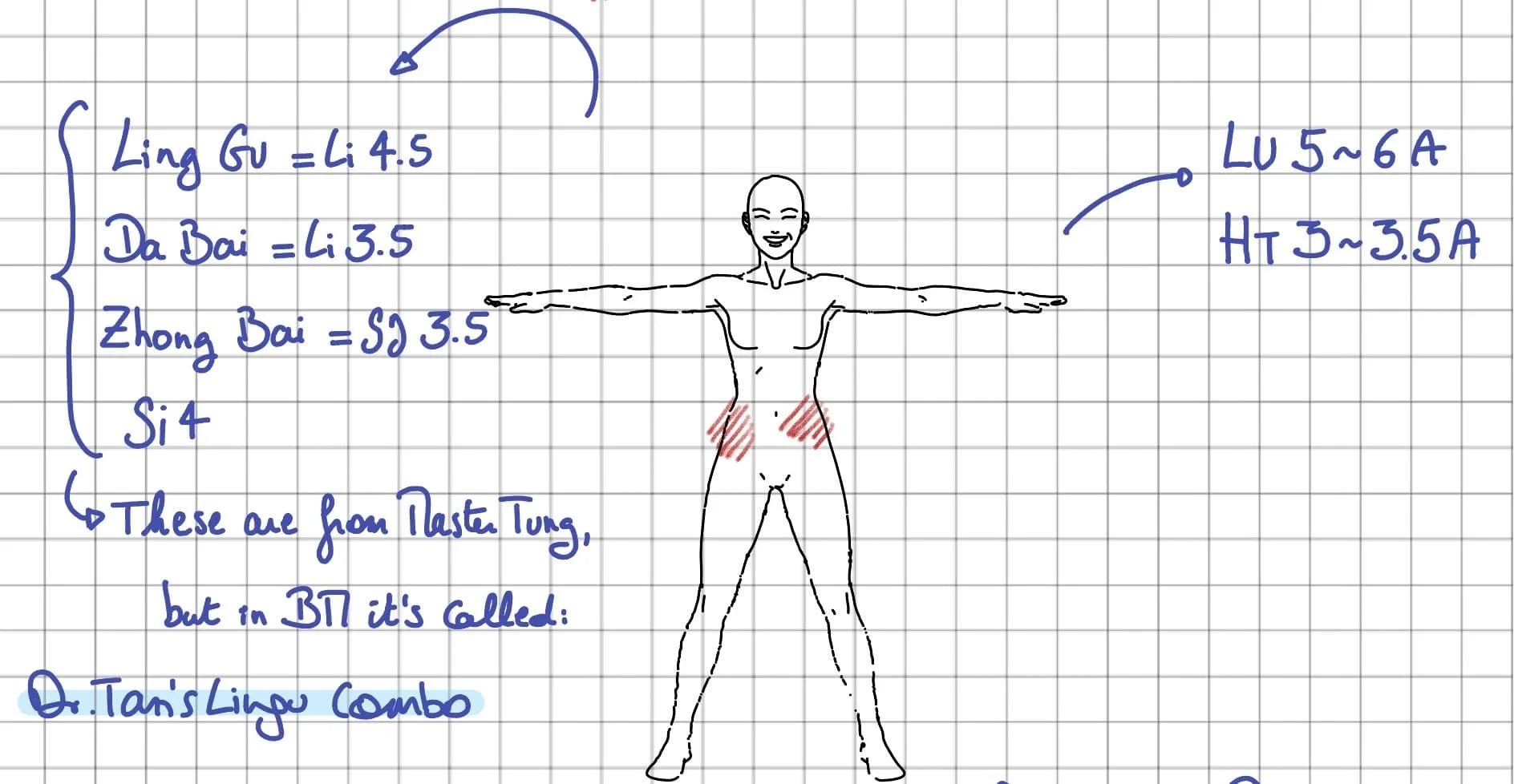
Dr. Tan’s 1 $ Million dollar Combo for lower back from the Balance Method Notebook.
The Ling Gu combo goes on the opposite side to the most painful side. If both sides are equally painful, put Lung + Heart on one arm and the Ling Gu combo on the other.
Why it's so powerful: large projection (forearm) treats the muscular component — ideal for the back muscles. The small projection (hand) provides highly sensitive points. Together: muscle + tendon + joint + bone. Whatever type of lumbar pain the patient has, this combo covers it.
What the combo does NOT cover
Two things: Du Mai (midline spine) and the sacroiliac joint (below L5). If after treatment the remaining pain has shifted to the midline, you're now dealing with Du Mai. If it's shifted to the very low back near the sacrum, you're dealing with the SI joint. Both need separate treatment — don't force the million dollar combo to do something it wasn't designed for.
Download the Million Dollar Combo (Free PDF).
Three lower back cases, worked out step by step, in a clean printable sheet you can keep beside the treatment table.
- Three real cases — a gardening strain, an L4-L5 disc herniation and spinal stenosis
- The full combo composition for each case, exactly as it was needled
- The reasoning behind every step, with the outcome at the table
No spam. Unsubscribe anytime.
The Feedback Loop: Why Back Pain Shifts After Treatment
This is something that surprises practitioners new to the Balance Method. You needle the million dollar combo, the patient stands up, bends forward, and says: "The pain is much better... but now I feel it here." And they point to a different spot — often the midline spine, or the SI joint area, or a spot further down the leg.
This is not a treatment failure. This is the feedback loop in action. The original pain was a combination of multiple meridians, and your treatment resolved the UB + GB component. What's left is a different meridian — Du Mai, or Kidney, or a more specific GB segment. You've peeled away the first layer and revealed the next one.
The protocol: re-diagnose immediately. Ask the patient to point with one finger to the remaining pain. Identify the new meridian. If it's Du Mai, add a scalp needle. If it's shifted to pure GB on one side, add a Heart needle . This iterative process — treat, retest, re-diagnose, treat the remainder — is what makes Balance Method treatments progressively precise. Most back pain resolves in two or three iterations within a single session.
Du Mai: When the Pain Is Right on the Spine
Midline spinal pain is Du Mai territory, and Du Mai is special in the Balance Method. It has limited balancing options — essentially only System 6* (same channel, different location) . The practical solution is a scalp projection.
Imagine a small person lying on top of the patient's head, with their spine running along Du Mai on the scalp. The landmarks:
*You can also balance the Du Mai with the Ren Mai by considering ASS (Anatomical Structural Similarity), for example through an advanced projection on the sternum.
Du Mai: Scalp Projection Map
| Scalp Landmark | → | Corresponds to |
|---|---|---|
| Frontal hairline | → | C1 (top of cervical spine) |
| Sideburns crossing Du Mai | → | C7 / T1 transition zone |
| Du 20 (Crown) | → | Approximately L2 (Lumbar) |
| Occipital protuberance | → | Coccyx / Tailbone |
*Pro-tip: For lumbar Du Mai pain, palpate for ashi points between Du 20 and the occipital protuberance.
Note: that reverse projections also apply to the scalp.
For lumbar Du Mai pain, you palpate between Du 20 and the occipital protuberance, looking for ashi. Because everyone's head shape is different, palpation is essential — the landmarks are guides, but the ashi reaction tells you the exact point.
The Sacroiliac Joint Trap
The sacroiliac (SI) joint sits below L5 — lower than what the million dollar combo covers. This is a common clinical trap: you treat lumbar pain beautifully with Lung + Heart + Ling Gu, the patient's L2-L5 pain disappears, but they point to a residual ache at the very base of the spine near the sacrum.
In the puppet show image, the coccyx and pubic area correspond to the shoulder joint — the most distal landmark. So SI joint pain projects onto the area near the shoulder, not the forearm. Specific treatment protocols for the sacroiliac joint are covered in the advanced training. The key takeaway: recognize that SI joint pain is a separate zone from L2-L5, and don't expect the million dollar combo to cover it.
When Back Pain Is Everywhere: Global Balance
Some patients don't have a clean lumbar problem. They have pain across the entire back — upper, middle, and lower. Or fibromyalgia with diffuse back involvement. Or chronic back pain that aggravates with fatigue, recurring even after local treatments have temporarily resolved the issue.
This is when you switch from Local Balance to Global Balance. Instead of targeting specific meridians, you treat the Tai Yang family — the group of patterns that governs the entire posterior body.
Tai Yang Patterns + 4 Magical Meridian for Back Pain
| Pattern | 4 Meridians | Constitution | Clinical Best For |
|---|---|---|---|
| Shao Yin Tai Yang | HT · KID · SI · UB | Deficiency (KID) | Fatigue + chronic weakness |
| Tai Yin Tai Yang | LU · SP · SI · UB | Neutral (SP) | General back pain |
| Lung - Liver Tai Yang | LU · LIV · SI · UB | Excess (LIV) | Tension-type, stress-related |
| 4 Magical Meridian for Lower Backpain | LI · KID · LU · UB | Deficiency (KID) | Fatigue + chronic weakness |
All three Tai Yang patterns include SI and UB — the Tai Yang pair covering the entire back. Choose between them based on constitution: a tired, deficient patient with weak lower back gets the Kidney pattern. A tense, stressed patient gets the Liver pattern. Unclear or neutral gets the Spleen pattern.
Global Balance patterns also treat conditions like fibromyalgia, rheumatoid arthritis, chronic fatigue with back involvement, and kidney organ dysfunction with back pain expression. They're the right tool when Local Balance keeps working temporarily but the pain always returns.
Clinical Decision Tree
Clinical Decision Tree
| Situation | → | Approach |
|---|---|---|
| Lumbar + lateral / sciatica (UB + GB) | → | Million Dollar Combo |
| Midline spine pain (Du Mai) | → | Scalp Projection |
| Pain everywhere / Chronic recurring | → | Global Balance Pattern |
| Remaining pain shifts location | → | Re-diagnose & Peel Layers |
Quick Reference: Back Pain & Sciatica
The complete clinical framework for lumbar and chronic back conditions.
Step 1: Meridian Diagnosis
| Location / Pathway | Meridian | Character |
|---|---|---|
| Midline / On the spine | Du Mai | Sharp, vertebral pain |
| 1-3 cun lateral | UB | Muscular, most common |
| Lateral / Radiating to hip | GB | Shooting down side of leg |
| Deep / Inside the back | KID | Deep ache, radiating to the front |
Step 2: Balancing Options
| Sick | Treating | System | Best For |
|---|---|---|---|
| UB | LU | S2 / S4 | Bilateral lumbar pain |
| GB | HT | S2 / S4 | Lateral pain / Sciatica |
| Du Mai | Du Mai | S6 | Midline spine pain |
Dr. Tan's 1 Million Dollar $ Combo (L2-L5 area)
- Arm 1: LU 5-6 ashi + HT 3-3.5 ashi (either side).
- Arm 2: Ling Gu (LI 4.5 area) + Da Bai (LI 3.5 area) + Zhong Bai (SJ 3.5) + SI 4.
- Side Rule: Ling Gu combo opposite to the most painful side.
- Tissue: Muscle (forearm) + Tendon/Bone (hand) = Full coverage.
- Note: Does NOT cover Du Mai midline or Sacrum below L5.
Clinical Decision Matrix
| Unilateral lumbar pain (UB only) | → | LU (either side) - Kid - SI on opposite side |
| Lumbar + Sciatica (UB + GB) | → | Million Dollar Combo |
| Pain Everywhere / Fibromyalgia | → | Global Balance: Tai Yang family |
| Chronic / constitution recurring despite Local Balance | → | Switch to Global Balance |
Back Global Patterns
| Shao Yin Tai Yang | HT · KID · SI · UB | Chronic weakness / Fatigue |
| Tai Yin Tai Yang | LU · SP · SI · UB | General chronic back pain / Neutral |
| Lung Liver Tai Yang | LU · LIV · SI · UB | Tension / Stress-related pain |
| 4 MM Lower Back Pain | LU · Kid · LI · UB | General chronic back pain |
From Insight to Mastery: Your Deep Dive into the Balance Method
Get the Balance Method NotebookFrequently Asked Questions
What if the back pain doesn't respond to the million dollar combo?
Re-diagnose. The most common reason for poor response is incorrect meridian identification. If you've treated UB but the pain is actually on Kidney (deeper) or Du Mai (midline) or the SI joint (lower than L5), the combo won't fully work. Ask the patient to show exactly where the remaining pain is — the answer usually reveals a different meridian than what you initially diagnosed.
Can I combine this with local needling?
Prioritize the distal approach over local treatment. One of the foundational principles of Balance Method training is that local needling adds unnecessary complexity when distal points provide the solution.
Does this work for disc herniation?
The Balance Method treats the pain pattern. A disc herniation that causes UB/GB pain responds to the same meridian logic — the treatment targets the meridian expression regardless of what's compressing the nerve. Many patients with confirmed disc herniations experience significant pain relief. However, structural damage remains, and pain relief doesn't mean the disc is healed. Patients should understand both the potential and the limitation.
When should I switch from Local to Global Balance for back pain?
Three signals: the pain keeps coming back after local treatments. The pain is across the whole back rather than specific. Or the patient has systemic symptoms alongside the back pain (fatigue, sleep issues (shen problems), digestive problems). Any of these suggests a Global Balance approach — the Back global balance patterns — will be more effective than repeated local treatments.
Next Steps
Back pain is the perfect condition to experience the Balance Method firsthand. The logic is clean, the results are often dramatic, and the feedback loop teaches you more about the method than any textbook can. If you're new to the Balance Method, start here — the million dollar combo alone will change how you treat the most common complaint in your clinic.
For the complete framework behind this treatment, read the guides on meridian diagnosis (Step 1), the six systems (Step 2), and ashi palpation (Step 3). For a deeper understanding of when to use Global Balance for chronic conditions, see our dedicated guide.
Watch needling demonstrations on our needling demo page. For the complete clinical reference at your treatment table, the Balance Method Notebook has every projection chart and protocol you need. And join our practitioner community to discuss back pain cases with 7,000+ colleagues worldwide. New to the terminology? See the Balance Method Glossary for every core term in one place. For this combo applied to a real patient, a multi-meridian lower back case study.
