
Global Balance vs Local Balance in the Balance Method: When and How to Treat the Whole Body
A patient comes in with chronic sinus problems: blocked nose, tearing eyes, post-nasal drip, itchy throat. You diagnose the sick meridians — Stomach and Large Intestine, based on where the symptoms express. You could balance those two meridians with a standard local approach: Lung and Spleen on the opposite side, find your ashi points, needle, and the nose unblocks. Often within minutes.
But here's what happens next. The nose unblocks during treatment — then blocks again. The right side clears, the left side closes. After a few days, the whole pattern returns. You treat again, it resolves, it comes back. You're treating the expression of the symptom, not the underlying dysfunction that's producing it.
Now imagine the same patient, same diagnosis — but this time you design a Global Balance. You treat all four limbs, alternating Yin and Yang in a specific geometric pattern that creates both movement and stability across the entire meridian system. The nose unblocks, the eyes stop tearing — and the underlying allergy or immune dysfunction that's been driving the symptoms begins to shift. The results last longer. The pattern breaks.
That's the difference between Local Balance and Global Balance. And knowing when to use each one is what separates a practitioner who treats symptoms from one who treats the person.
What Local Balance Actually Means
A critical clarification first: in the Balance Method, "local" does not mean local needling.
You never needle at the site of pain. Local Balance means balancing one specific sick meridian with one treating meridian — using the six systems (the complete matrix), a projection, and ashi palpation. The needles go on the arms and legs, far from the problem. What's "local" is the scope of the treatment: you're targeting one specific meridian and its expression.
Local Balance is the foundation of everything covered in the first three steps of Dr. Tan's Acupuncture 1, 2, 3. It's what you use for the vast majority of musculoskeletal conditions: a shoulder pain on the Small Intestine channel, knee pain on the Gallbladder, wrist pain on the Lung. One sick meridian, one balancing meridian, one clear clinical result.
It works. It produces instant results. And for localized pain problems, it's often all you need.
When Local Balance Is the Right Choice
Use Local Balance when the patient has a clearly localized problem on one or more specific meridians. The pain is in one place. The patient can point to it with one finger. There's no underlying systemic dysfunction driving the symptom — or at least, none that you need to address in this treatment.
Example: a patient took a bad fall and has acute elbow pain on the Large Intestine channel. That's a local problem with a clear mechanical cause. A Local Balance — Stomach channel on the opposite knee, mirror projection, ashi palpation — handles it efficiently. There's no reason to involve all four limbs.
What Global Balance Is — and Why It Exists
Global Balance is a fundamentally different treatment strategy. Instead of balancing one meridian against one other, you create a geometric pattern across all four limbs that addresses the functioning of the body as a whole.
Three Indications for Global Balance
You use Global Balance in 3 situations:
1.Internal or functional disorders.
The respiratory system isn't working properly. The digestion is off. There are cardiological symptoms, urinary dysfunction, gynecological problems, circulatory issues. These aren't localized meridian problems — they're functional problems of the whole body that express at a specific location. Treating just the local expression gives temporary relief. Treating the underlying dysfunction gives lasting change.
The research on internal conditions is still early, but it exists — a University of Edinburgh trial on chronic pelvic pain, plus case reports on migraine and insomnia. We've pulled it together, honestly weighed, on our research page.
2.Pain that is everywhere or rotating.
The patient doesn't have one clear pain location. The whole back hurts. Or it's a shoulder today, a knee tomorrow, cervical pain next week. When pain rotates or covers broad areas of the body, a Local Balance can't catch it — you need a Global approach that addresses whatever is driving the pattern.
3. Shen Disorders.
For deep-rooted issues like chronic anxiety, severe insomnia, panic attacks, or brain fog. A disturbed Shen means the mind is unanchored or overstimulated. Local points only offer temporary relief, while a Global Balance treats the root cause to permanently calm and stabilize consciousness.
Local Balance vs Global Balance
| Aspect | Local Balance | Global Balance |
|---|---|---|
| When to use | Clear, localized pain | Internal/functional disorders, rotating pain |
| Treatment Goal | Symptom expression on a specific meridian | Underlying body dysfunction |
| Limb Usage | 1-2 limbs (Contralateral or Ipsilateral) | All 4 limbs — always |
| Yin/Yang Rule | No polarity requirement | Strict Yin-Yang alternation |
| Complexity | Selected Meridian Pairing (Affected + Balancing) | 4 or more (Geometric Pattern) |
Global balance is not "better" than local balance. It's for a different clinical situation. Use the right tool for the right problem.
How Global Balance Works: Dynamic + Static
The design of a Global Balance is built on two principles that must both be present in every treatment. This is what makes it fundamentally different from simply "using more needles."
Dynamic Balance: The Alternation of Yin and Yang
In a Global Balance, you assign a Yin or Yang polarity to each limb. The rule: Yin and Yang must alternate across the four limbs. If the right arm is Yin, the right leg must be Yang. The left arm must be Yang. The left leg must be Yin. The diagonals always share the same polarity — and neighboring limbs always have opposite polarity.
This creates what Dr. Tan described as a "dance" — Yin, Yang, Yin, Yang — around the body. The alternation generates movement, because Yin and Yang attract each other. You're creating a continuous flow of energy across all four limbs instead of targeting a single channel.
The practical consequence: you can never needle the same points bilaterally in a Global Balance. If the right arm gets Yin meridians, the left arm must get Yang meridians. And on any single limb, you can only needle either Yin or Yang — never both.
Static Balance: The Truss Structures
Dynamic balance gives you movement. But a body also needs structure — something stable. The static balance comes from the systems: whenever two meridians in your pattern balance each other through a system, they create a "bar" of stability. Think of it as a structural beam connecting two points in your treatment.
These bars can run in three directions: horizontal (across the arms or across the legs — created by System 3), diagonal (connecting an arm to the opposite leg — created by Systems 1 and 5), or vertical (connecting an arm to the leg on the same side — created by Systems 2 and 4).
The combination of bars creates what's called a truss structure — the geometric skeleton of your Global Balance. There are four possible truss structures (A, B, C, D), each with different stability properties. Truss D, with bars in all six directions, is the most stable — but requires more than four meridians and belongs to advanced practice. Most clinical Global Balances use truss A, B, or C, which are achievable with four meridians.
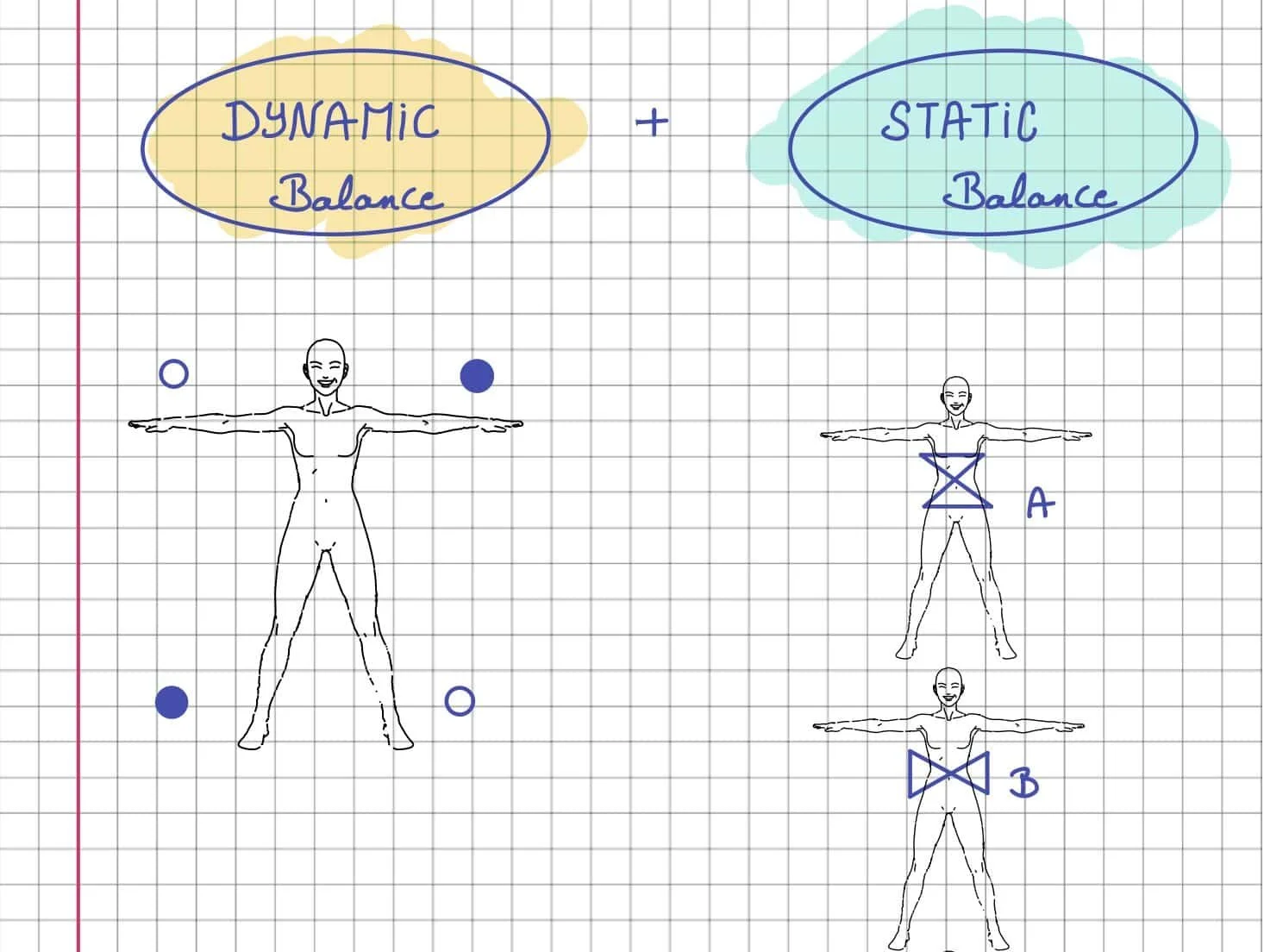
Dynamic Balance and Static Balance from the Balance Method Notebook by Laurence Meyfroodt
Designing a Global Balance: The Clinical Process
The process follows the same 1-2-3 steps as any Balance Method treatment — but Step 2 expands to include the dynamic and static balance design.
Step 1: Diagnose the Sick Meridians
Exactly the same as Local Balance. Where does the problem express? The sinus patient has symptoms on the eyes, nose, and throat — for example Stomach and Large Intestine territory. You don't need to diagnose whether it's wind-cold, wind-heat, dampness attacking the lung, or any other TCM pattern. You care about where, not what.
Step 2: Build the Pattern
This is where Global Balance diverges from Local. You start by inviting the sick meridians into the treatment — using System 6 (same meridian). Place Stomach on one limb, Large Intestine on another. Because Stomach is a foot Yang meridian and Large Intestine is a hand Yang meridian, the dynamic balance immediately dictates where they can go and what polarity the remaining two limbs must have.
Then you look at the relationship between your two sick meridians. Do they balance each other through any system? Stomach and Large Intestine balance each other through Systems 1 and 5 — that gives you a diagonal bar. Now you choose a truss structure (A, B, or C) and solve for the remaining two meridians. Each truss structure leads you to a specific four-meridian pattern with a name — like Tai yin Yang Ming, or Jue yin Yang Ming.
Step 3: Find the Points
With your four meridians set — one on each limb — you apply projections and ashi palpation exactly as in Local Balance. The eye symptoms project to the elbow/knee level (Big Head Image, eye line). The nose projects below the eye line. The throat projects at the wrist/ankle level. Each symptom location gets mapped onto the treating meridians on all four limbs.
Why Global Balance Produces Different Results
When you treat the sinus patient with just Lung and Large Intestine — a Local Balance — the nose unblocks. You get a clear, measurable result. But you're only treating the expression of the symptom. The underlying allergy, the immune dysfunction, the constitutional weakness that's producing the sinus problems — those are untouched.
A Global Balance addresses the functional layer. By engaging all four limbs in a geometric pattern with both movement (dynamic) and structure (static), you're treating the body's ability to function — not just one meridian's ability to flow. That's why the results from Global Balance tend to be more durable: you're not just clearing the traffic jam, you're fixing the road that keeps causing it.
This doesn't mean Global Balance always replaces Local Balance. If you just do Local Balance for a functional problem, the patient will still get results. It's not wrong. But it may take significantly more treatments, and the problem is more likely to recur. If you address the underlying dysfunction from the start with a Global Balance, you typically need fewer treatments overall and the results hold longer.
Each Pattern Has a Clinical Specialty
Not all Global Balance patterns treat the same conditions. Each four-meridian pattern has a natural orientation based on which meridians it contains — and that determines what it's best suited for.
Front, Side, or Back
The meridians in your pattern determine which part of the body the treatment addresses most strongly. Tai Yin and Yang Ming are frontal meridians. Shao Yang runs along the sides. Tai Yang covers the back. A pattern containing Tai Yin and Yang Ming is naturally oriented toward frontal problems — face, chest, abdomen. A pattern with Tai Yang addresses the back, occiput, and posterior body.
For every main body area — front, side, or back — there are typically three Global Balance patterns available, each associated with a different Yin foot meridian: Spleen, Liver, or Kidney.
Constitution: Deficiency, Neutral, or Excess
Within those three patterns per body area, each one is further oriented by constitution. The pattern with Kidney tends toward deficiency conditions. The pattern with Liver tends toward excess. The pattern with Spleen tends toward neutral. This gives you a clinical refinement: a patient with chronic sinus problems who is constitutionally cold and depleted may respond better to the Kidney-containing pattern, while an excess-type patient with acute inflammation may do better with the Liver-containing pattern.
Constitution is not the only selection criterion — the location and nature of the symptoms, the specific meridians involved, and practical considerations all play a role. But it gives you a powerful additional filter when choosing between patterns that could all work for the same condition.
Dr. Tan's 8 Magical Points (+1)
Among all Global Balance patterns, one stands above the rest in Dr. Tan's teaching: the pattern known as the 8 Magical Points. This is a specific Global Balance that Dr. Tan considered so effective for such a wide range of conditions that he later added a ninth point — Heart 5, the Luo-connecting point — to strengthen its Shen (spirit/emotional) component.
The 8+1 pattern became the most widely used Global Balance in Balance Method practice worldwide. It addresses both physical and emotional aspects, and practitioners who use it regularly report consistent results across internal conditions, chronic pain, and emotional disorders.
Dr. Tan was so proud of this pattern's clinical impact that its inscribed on his tombstone alongside the Strategy of Twelve Magical Points — the two contributions he felt defined his legacy. They are engraved in golden letters in Taiwan.
The specific point combinations and design of the 8+1 pattern are taught in training programs and documented in the Balance Method Notebook.
The Decision: Local or Global?
Before Step 2 of every treatment, you now have an additional question to answer: should this be a Local Balance or a Global Balance?
The decision is usually clear:
Clinical Decision Matrix
| Situation | Approach |
|---|---|
| Acute, clearly localized pain | Local Balance |
| Mechanical injury — fall, sprain, strain | Local Balance |
| Respiratory, digestive, gynecological, urinary, cardiological dysfunction | Global Balance |
| Pain that rotates or covers broad areas | Global Balance |
| Chronic recurring pain after local treatments | Global Balance |
| Localized pain AND systemic symptoms (e.g., back pain + insomnia) | Global Balance |
If you're unsure, don't overthink it. The patient will not explode. Do what you think is best at this moment. You can always adjust at the next treatment. A Local Balance for a global problem will still give results — it just may take more treatments, and the symptoms are more likely to return.
The most important thing is not to assume that Global Balance is "better" or "more advanced" than Local Balance. It's a different tool for a different situation. Using a Global Balance for a simple acute elbow injury is like using a sledgehammer for a thumbtack. Global balance is for global problems. Local balance is for local problems.
Combining Both in Practice
Real clinical practice often involves both approaches across a treatment series. A patient presents with chronic low back pain that keeps recurring. You start with a Local Balance — Urinary Bladder sick meridian, treat via a system, get an immediate pain reduction. But after several treatments, the pain keeps returning.
That's your signal: there's likely an underlying functional imbalance driving the recurring pattern. You switch to a Global Balance targeting the back (Tai Yang). The dynamic and static balance work on the deeper dysfunction while still addressing the back pain. The patient's results start holding longer between treatments.
Alot of patients who present with what looks like a local problem will actually have a local expression of a deeper functional issue — especially if you ask the right questions. Do they also have sleep problems? Digestive issues? Fatigue? If so, a Global Balance may be more appropriate from the start.
Quick Reference Card: Local vs Global Balance
Choosing the right strategy for internal vs localized conditions.
When to Use Which
| Clinical Situation | → | Approach |
|---|---|---|
| Clear localized pain | → | Local Balance |
| Internal / functional disorder | → | Global Balance |
| Pain everywhere or rotating | → | Global Balance |
| Chronic recurring pain after local treatments | → | Switch to Global |
| Not sure | → | Start Local, switch to Global if results don't hold |
Global Balance Design Rules
- Dynamic balance: Yin-Yang alternation across all 4 limbs.
- Static balance: Meridians must balance each other through systems (creating "bars").
- Diagonals: Same polarity (both Yin or both Yang).
- Neighbors: Opposite polarity.
- No bilateral needling: Never the same points on both sides.
- One polarity per limb: Only Yin OR Yang meridians on any single limb.
Pattern Selection by Constitution
| Constitution | Yin Foot Meridian | Orientation |
|---|---|---|
| Deficiency | Kidney | Deeper, constitutional strengthening |
| Neutral | Spleen | Balanced, middle-ground approach |
| Excess | Liver | Clearing, resolving excess |
Complete Global Balance patterns with truss structure diagrams for every body region:
Get the Balance Method NotebookFrequently Asked Questions
Can I add local needling to a Global Balance?
Points added for local symptoms — like specific ashi points for the nose or eyes — are additions on top of the Global Balance. They don't belong to the geometric pattern itself. The four-meridian pattern on all four limbs creates the Global Balance. Any extra points for specific symptoms are supplementary and follow the same projection and ashi logic from Local Balance practice.
Is Global Balance more effective than Local Balance?
Not inherently. A Global Balance for a simple acute injury is unnecessary. A Local Balance for a chronic internal dysfunction is insufficient. The effectiveness depends entirely on matching the approach to the clinical situation. Think of it as scope: Local Balance targets one meridian's problem, Global Balance targets the body's functional capacity. Use the scope that fits.
What about conditions that can't be localized — like insomnia or high blood pressure?
These are treated with Global Balance, but they require a different approach for Step 3 (point selection) because there's no specific body location to project onto. This falls into advanced Balance Method practice where point selection uses different relationships rather than anatomical projections. It's covered in advanced training programs.
How do I know which four-meridian pattern to use?
Start with the sick meridians (Step 1). Invite them into the pattern using System 6. Use the system relationship between them to determine the first "bar" of stability. Then choose a truss structure (A, B, or C) and solve for the remaining meridians. The combination of body location (front, side, back) and constitution (deficiency, neutral, excess) helps you select between the available patterns. The full design process is systematic — not intuitive — and becomes fluent with practice.
Next Steps
Global Balance opens a new dimension in your Balance Method practice. Where Local Balance handles the "where does it hurt?" cases with precision and speed, Global Balance lets you ask "why does it keep happening?" — and treat the answer.
Together with the six systems, the projection techniques, and ashi palpation, you now have the complete clinical framework that Dr. Tan developed: diagnose the problem, choose the approach (local or global), select the meridians, project the location, find the ashi point, and treat with anatomical precision.
For the complete set of Global Balance patterns with truss structure diagrams, clinical protocols organized by body region and constitution, and the 8+1 Magical Points configuration, the Balance Method Notebook is your reference. For the foundational theory behind Global Balance design, explore the books collection — particularly Dr. Tan's Strategy of Twelve Magical Points.
Watch Global Balance treatments demonstrated step by step on our needling demo page. And join our practitioner community of 7,000+ members to discuss pattern selection, share clinical results, and learn from practitioners applying Global Balance across a wide range of conditions. New to the terminology? See the Balance Method Glossary for every core term in one place.
