
The 6 Balance Method Systems Explained: How Dr. Tan's Point Selection Logic Works
A patient walks in with scapular pain that hasn't responded to anything in three years. You assess the area: Small Intestine meridian. You check your systems. System 4 says: Small Intestine's clock opposite is Liver. You palpate along the Liver channel at the ankle, find a reactive ashi point on the tibia, insert one or more needles — and the patient's face changes. For the first time in years, the pain drops significantly.
That wasn't intuition. That wasn't guesswork. That was a system — one of six that Dr. Richard Teh-Fu Tan built into his Balance Method.
Each system describes a specific, logical relationship between meridians — rooted in the I Ching, the Ba Gua, and the Chinese clock. Together, they give you multiple strategic options for treating any condition, with built-in clinical feedback that tells you in real-time whether your selection is working.
This guide walks you through all six: the principle behind each one, the meridian pairs, clinical examples, and practical guidance on choosing the right system. It's designed to orient you — not to replace hands-on training, but to give you a map so you can study and practice with clarity.
The Foundation: Why Six Systems?
Before diving into the individual systems, it helps to understand the architecture.
Dr. Tan's insight was that the twelve main meridians don't exist in isolation — they're connected through multiple types of relationships. Some share the same Chinese name. Some sit opposite each other on the Chinese clock. Some are linked through the Ba Gua trigrams in ways that have been mapped for over 2,000 years.
Each of these relationship types became a "system." And because they represent different kinds of connections, they give you different clinical options for the same problem. If System 1 doesn't produce an immediate result for your patient, System 2 offers a completely different meridian relationship to try. Then System 3. And so on.
This is the practical power of having six systems: you're never stuck with only one option. The built-in redundancy means there's almost always a pathway to balance — you just need to find the right one for this patient, at this moment.
The Roots: Ba Gua and Chinese Clock
Systems 1, 2, and 3 are derived from the Ba Gua — the eight trigrams of the I Ching. About 2,000 years ago, Chinese scholars assigned the twelve regular meridians (plus Du Mai and Ren Mai) to specific trigrams, following logical criteria based on Yin-Yang polarity, anatomical position, and the flow of qi. The way those trigrams relate to each other — through symmetry, opposition, and complementarity — produces the first three balancing systems.
Systems 4 and 5 come from the Chinese clock — the 24-hour cycle of qi flow through the meridians. By mapping which meridians sit opposite each other or next to each other on this clock, two more sets of balancing relationships emerge.
System 6 is the simplest: the meridian treats itself.
Different roots, different relationships, same goal: find the most effective balancing meridian for the patient in front of you.
All 6 Systems at a Glance
| System | Name | Based On | Polarity | Limb | Side |
|---|---|---|---|---|---|
| 1 | Same Chinese Name | Ba Gua | Yin ⟷ Yin, Yang ⟷ Yang | Hand ⟷ Foot | Opposite |
| 2 | Branching Meridians | Ba Gua | Yin ⟷ Yang | Hand ⟷ Foot | Either |
| 3 | Interior-Exterior | Fu Xi circular Ba Gua | Yin ⟷ Yang | Hand ⟷ Hand, Foot ⟷ Foot | Opposite |
| 4 | Chinese Clock Opposite | Chinese clock | Yin ⟷ Yang | Hand ⟷ Foot | Either |
| 5 | Chinese Clock Neighbor | Chinese clock | Yin ⟷ Yin, Yang ⟷ Yang | Hand ⟷ Foot | Opposite |
| 6 | Same Meridian | Direct | Same channel | Same channel | Either |
These six systems aren't arbitrary. A 2013 University of Hamburg paper traced the same six symmetrical patterns back to the classical Chinese writings and worked them out mathematically — confirming the logic Dr. Tan built the method on.
See how the research confirms the six systems →
System 1: Same Chinese Meridian Name
The Principle
System 1 is often the first system practitioners learn, and for good reason — its logic is built directly into the meridian names most acupuncturists already know.
Each of the twelve regular meridians carries a Chinese name describing its Yin-Yang quality and position: Tai Yang, Shao Yang, Yang Ming, Tai Yin, Shao Yin, or Jue Yin. And each name appears exactly twice — once for a Hand meridian and once for a Foot meridian.
System 1 pairs meridians that share the same Chinese name. That's the entire principle.
The Pairs
System 1
| Chinese Name | Hand Meridian | Relation | Foot Meridian |
|---|---|---|---|
| Tai Yang | Small Intestine | ⟷ | Urinary Bladder |
| Shao Yang | San Jiao | ⟷ | Gallbladder |
| Yang Ming | Large Intestine | ⟷ | Stomach |
| Tai Yin | Lung | ⟷ | Spleen |
| Shao Yin | Heart | ⟷ | Kidney |
| Jue Yin | Pericardium | ⟷ | Liver |
In practice: if the Gallbladder (Foot Shao Yang) is the sick meridian, you treat it with San Jiao (Hand Shao Yang). If the Lung (Hand Tai Yin) has a problem, you use Spleen (Foot Tai Yin). The names tell you everything.
The Ba Gua Logic
This isn't arbitrary. In the Ba Gua meridian assignment, each trigram holds one Hand and one Foot meridian that share the same Chinese name. These trigrams sit in Yin-Yang symmetry across a central axis — meaning the meridians within them have a deep energetic correspondence. System 1 expresses this symmetry clinically.
Clinical Example
A patient presents with lateral knee pain. The primary area of discomfort runs along the Gallbladder channel — Foot Shao Yang. Using System 1, you select the balancing meridian: San Jiao (Hand Shao Yang). Since the problem is in the knee (a major joint), you project to the corresponding major joint on the hand — the wrist. You palpate for ashi points along the San Jiao channel near the wrist, needle on the opposite side, and retest the patient's knee immediately.
Key Characteristics
Yin ⟷ Yin, Yang ⟷ Yang
Hand ⟷ Foot
Needle: OPPOSITE side
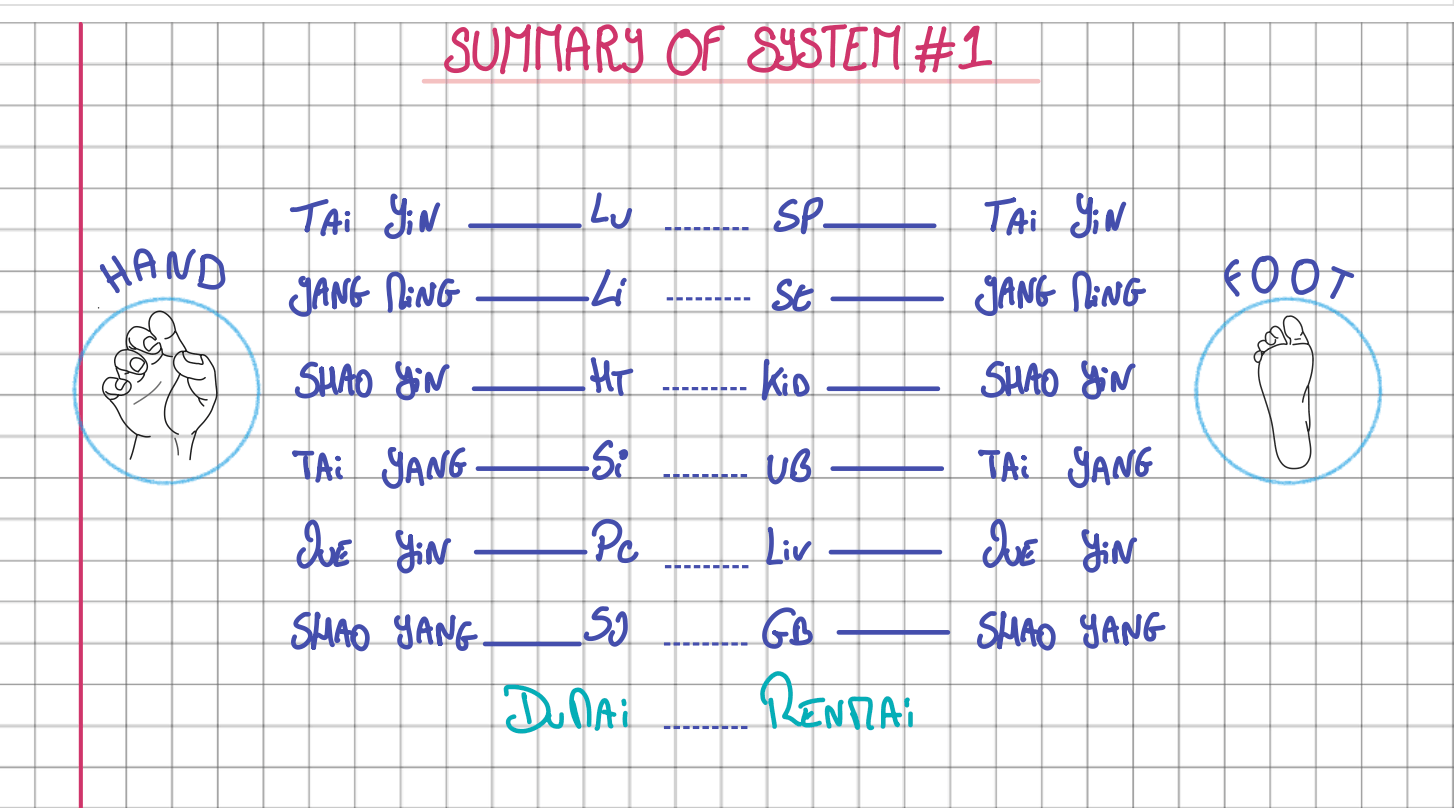
System 1 from The Balance Method notebook by Laurence Meyfroodt
System 2: Branching Meridians
The Principle
Where System 1 pairs meridians with the same Chinese name, System 2 pairs meridians whose names are Yin-Yang opposites within the Ba Gua hexagram structure.
When the six System 1 pairs are projected into a hexagram (a six-line I Ching figure), something remarkable emerges: a hexagram called Shui Huo Ji Ji — Water above Fire. This is considered one of the most balanced and auspicious hexagrams in the I Ching, representing mutual nourishment and cyclical harmony.
Within this hexagram, each line (Yao) of the upper trigram is the exact Yin-Yang opposite of the corresponding line in the lower trigram. These opposing lines represent the System 2 balancing pairs.
A quick tip to remember: we also call this system the Almost Same Name meridian.
The Pairs
System 2: Branching meridians
| Meridian Pair A | Relation | Meridian Pair B |
|---|---|---|
| Gallbladder (Foot Shao Yang) | ⟷ | Heart (Hand Shao Yin) |
| San Jiao (Hand Shao Yang) | ⟷ | Kidney (Foot Shao Yin) |
| Liver (Foot Jue Yin) | ⟷ | Large Intestine (Hand Yang Ming) |
| Pericardium (Hand Jue Yin) | ⟷ | Stomach (Foot Yang Ming) |
| Small Intestine (Hand Tai Yang) | ⟷ | Spleen (Foot Tai Yin) |
| Urinary Bladder (Foot Tai Yang) | ⟷ | Lung (Hand Tai Yin) |
In practice: Gallbladder (Shao Yang) can be balanced by Heart (Shao Yin). Stomach (Yang Ming) can be balanced by Pericardium (Jue Yin).
Clinical Example
A patient has pain along the anterior lower leg — along the Stomach meridian (Foot Yang Ming). System 1 would direct you to Large Intestine (Hand Yang Ming), which is a valid choice. But what if you've tried that and the result is only partial? System 2 offers an alternative: Pericardium (Hand Jue Yin). You palpate for ashi points on the Pericardium channel on the forearm, using a mirror projection of the lower leg onto the forearm. Because System 2 allows either side, you can choose whichever arm provides the most reactive ashi points.
This is the clinical value of having multiple systems — when one pathway gives a partial result, another system opens a fresh option.
Key Characteristics
Yin ⟷ Yang (opposite polarity)
Hand ⟷ Foot
Needle: EITHER side
System 3: Interior-Exterior
The Principle
System 3 uses a different Ba Gua arrangement — the Fu Xi circular sequence — and a different method of assigning meridians to trigrams. During the Song Dynasty (roughly 1,000 years ago), scholars developed an alternative meridian-trigram assignment by placing a human figure inside the circular Ba Gua and mapping meridians based on anatomical position and functional correspondence.
The balancing principle is static balance: trigrams on directly opposite sides of the Fu Xi circle are perfect Yin-Yang complements. The meridians assigned to opposing trigrams balance each other.
The Pairs
This system produces what many TCM practitioners recognize as Biao-Li (Interior-Exterior) relationships.
System 3: Interior-Exterior
| Pair # | Meridians |
|---|---|
| 1 | Spleen ⟷ Stomach |
| 2 | Lung ⟷ Large Intestine |
| 3 | Heart ⟷ Small Intestine |
| 4 | Pericardium ⟷ San Jiao |
| 5 | Kidney ⟷ Urinary Bladder |
| 6 | Liver ⟷ Gallbladder |
If you're thinking "I already knew Interior-Exterior pairs" — you're right. But understanding them through the Ba Gua reveals why they work, and how they connect to the other systems. It also clarifies the clinical characteristic that's unique to System 3: it pairs Hand with Hand and Foot with Foot, unlike Systems 1 and 2.
Clinical Example
A patient reports pain along the inner forearm — running along the Heart channel (Hand Shao Yin). Using System 3, the balancing meridian is Small Intestine (Hand Tai Yang) — the Biao-Li partner. Since both are Hand meridians, you stay on the hand and needle Small Intestine on the outer forearm, opposite side. The anatomical correspondence is close: inner forearm maps naturally to outer forearm.
System 3 is particularly intuitive for extremity problems because the treating meridian is anatomically adjacent to the sick meridian — just on the other side of the arm or leg.
Key Characteristics
Yin ⟷ Yang
Hand ⟷ Hand, Foot ⟷ Foot (different from Systems 1 and 2)
Needle: OPPOSITE side
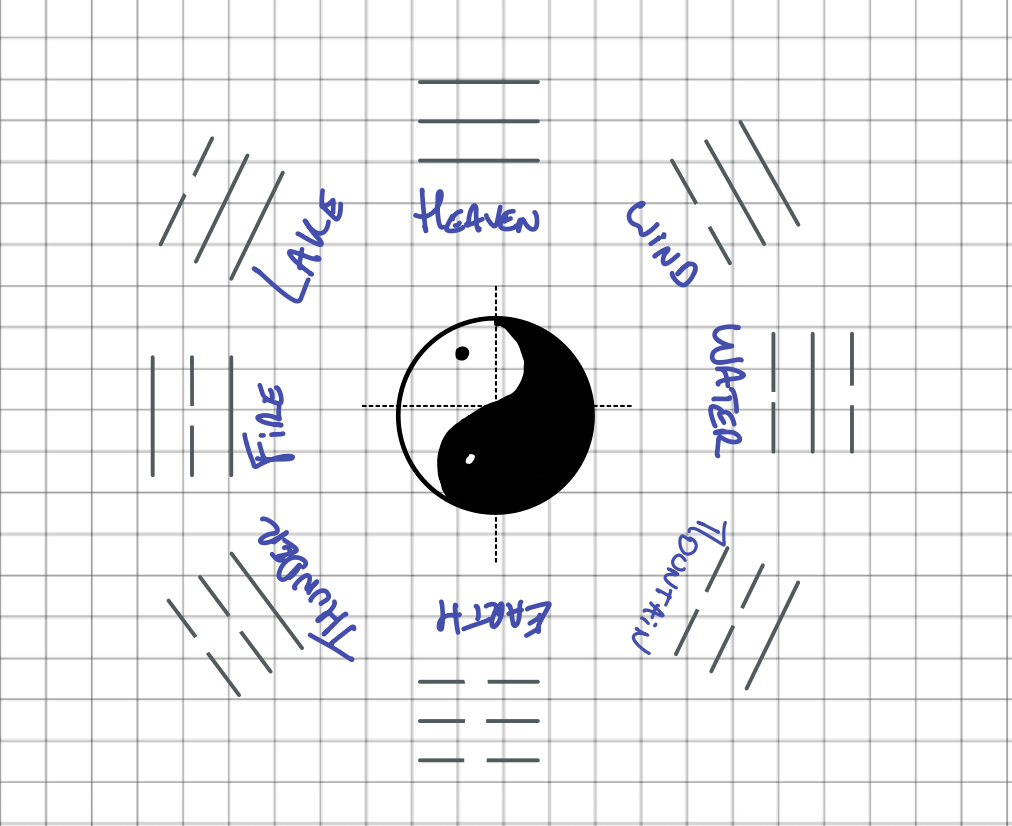
System 3 from The Balance Method notebook by Laurence Meyfroodt
System 4: Chinese Clock Opposite
The Principle
Systems 4 and 5 move away from the Ba Gua entirely and use the Chinese meridian clock as their foundation. Each meridian governs a two-hour window in the 24-hour qi cycle. System 4 pairs meridians that sit directly across from each other on this clock.
One important clarification: System 4 is based on the clock's spatial arrangement, not on timing. You don't need to treat during specific hours. These relationships work around the clock, every day.
The Pairs:
System 4: Clock Opposite
| Meridian | Relation | Clock Opposite |
|---|---|---|
| Lung | ⟷ | Urinary Bladder |
| Large Intestine | ⟷ | Kidney |
| Stomach | ⟷ | Pericardium |
| Spleen | ⟷ | San Jiao |
| Heart | ⟷ | Gallbladder |
| Small Intestine | ⟷ | Liver |
Clinical Example
Scapular pain is one of the most well-known applications of System 4 in the Balance Method world. The scapula region is primarily Small Intestine territory. System 4 tells you that Liver is the clock opposite of Small Intestine. Because the scapula is on the trunk, you use an image projection to map it onto the lower leg along the Liver channel. The bone of the tibia corresponds to the bone of the scapula — giving you a precise, anatomically logical treatment approach.
Many practitioners who have used this combination report that it consistently produces strong results, especially for chronic or post-surgical scapular pain. It's one of the pairings that makes new Balance Method students realize the depth of these systems.
Key Characteristics
Yin ⟷ Yang
Hand ⟷ Foot
Needle: EITHER side
System 5: Chinese Clock Neighbor
The Principle
System 5 also uses the Chinese clock, but instead of pairing opposites, it pairs neighbors — specifically, the adjacent meridian that shares the same Yin-Yang polarity.
Each meridian on the clock has two neighbors: one with the same polarity and one with opposite polarity. Choosing the opposite-polarity neighbor gives you the Biao-Li relationship (System 3). System 5 uses the same-polarity neighbor — creating a unique set of balancing relationships.
The Pairs:
System 5: Clock Neighbor
| Meridian | Relation | Same-Polarity Neighbor |
|---|---|---|
| Spleen | ⟷ | Heart |
| Kidney | ⟷ | Pericardium |
| Liver | ⟷ | Lung |
| Stomach | ⟷ | Large Intestine |
| Gallbladder | ⟷ | San Jiao |
| Urinary Bladder | ⟷ | Small Intestine |
The Multi-System Advantage
System 5 is often taught alongside a clinical insight that demonstrates the real power of combining systems. Consider a patient with shoulder joint pain — an area where up to five meridians converge (Pericardium, Lung, Large Intestine, San Jiao, and Small Intestine).
A single treating meridian can potentially balance four of these five, each through a different system — through System 1, System 2, System 4, and System 5 respectively. That's four different meridian relationships all pointing to the same treating channel. This kind of multi-system convergence means fewer needles and broader coverage. (The specific meridian that achieves this and the exact protocols are covered in the Balance Method Notebook and in training programs.)
Key Characteristics
Yin ⟷ Yin, Yang ⟷ Yang
Hand ⟷ Foot
Needle: OPPOSITE side
System 6: Same Meridian
The Principle
The simplest system: if a meridian has a problem, you needle that same meridian — but never at the location of the problem. You use mirroring, imaging, and projection techniques to find a treatment point on the same channel that's far from the affected area.
Clinical Example
A patient has a very specific headache right at the medial corner of the eye — Urinary Bladder territory. Using System 6, you stay on the Urinary Bladder channel and project the head onto the foot using an image. The eye level corresponds roughly to the metatarsophalangeal joint area, so you palpate for ashi points on UB around that zone.
System 6 is especially useful as a fine-tuning tool. After a broader treatment with Systems 1-5, the patient might say: "Most of the pain is gone, but there's still this one small spot." System 6 lets you target that residual spot with precision because the projection stays on the same meridian — the anatomical mapping is as direct as it gets.
Key Characteristics
Yin ⟷ Yin, Yang ⟷ Yang (same channel)
Hand ⟷ Hand, Foot ⟷ Foot (same channel)
Needle: EITHER side
How to Choose the Right System
This is where the theory meets the treatment table. Six systems means multiple valid options for every patient — so how do you decide?
Step 1: Meridian Diagnosis
Everything starts here. Before thinking about systems, you must identify exactly which meridian is affected. Not the Western diagnosis ("sciatica"), not the organ pattern ("Liver Qi stagnation") — the specific channel pathway where the pain or problem sits.
Lateral knee pain? That's Gallbladder channel. Pain along the inner forearm? Heart channel. Scapular pain? Small Intestine territory.
If your meridian diagnosis is wrong, no system will save the treatment. If it's right, almost any system can work. This step comes first because it determines everything that follows.
Step 2: Meridian Balance
Now you look at your six systems and ask: which balancing meridian gives me the best treatment option for this specific patient?
Each system points you to a different treating meridian. For a Gallbladder problem, System 1 gives you San Jiao, System 2 gives you Heart, System 3 gives you Liver, System 4 gives you Heart again, System 5 gives you San Jiao again, and System 6 gives you Gallbladder itself. In practice, that's three distinct treating meridians to choose from: San Jiao, Heart, and Liver.
So how do you decide between them? This is where Dr. Tan's clinical genius comes in. The key factor is anatomical structure similarity — matching the tissue type at your needling location to the tissue type at the patient's problem area.
Step 3: Point Selection — Find the points
Once you've chosen your balancing meridian, the final step is finding the exact needling location. This involves two decisions: the projection format and the ashi point.
The balancing meridian your system suggests is the zone — the ashi point within that zone is the target. Always palpate carefully. The most reactive ashi point confirms you're in the right location. If you can't find a clear ashi point on the meridian from System 1, that itself is a signal: try the meridian from System 2 or 4 instead.
Needle your selected points and immediately retest the patient. Ask them to move. Ask them to press the painful area. If there's significant improvement — stay the course. If the result is partial, you have options: add points along the same meridian to broaden coverage, switch to a different system entirely, or combine two systems to cover multiple sick meridians simultaneously.
A Scenario: Working Through the Systems
Imagine a patient with lateral ankle pain — primarily along the Gallbladder channel (Foot Shao Yang). Your options:
Scenario: Lateral Ankle Pain (Foot Shao Yang)
| System | Balancing Meridian | Side | Projection |
|---|---|---|---|
| System 1 | San Jiao (Hand Shao Yang) | Opposite | Mirror: ankle → wrist |
| System 2 | Heart (Hand Shao Yin) | Either | Mirror: ankle → wrist |
| System 3 | Liver (Foot Jue Yin) | Opposite | Same limb, medial side |
| System 4 | Heart (Hand Shao Yin) | Either | Mirror: ankle → wrist |
| System 5 | San Jiao (Hand Shao Yang) | Opposite | Mirror: ankle → wrist |
| System 6 | Gallbladder (Foot Shao Yang) | Either | Same meridian, other location |
Notice that Systems 1 and 5 both point to San Jiao, and Systems 2 and 4 both point to Heart — this is the overlap at work. In practice, you have three distinct treating meridians: San Jiao, Heart, and Liver (plus Gallbladder itself via System 6). Start with whichever gives you the most palpable ashi points, then adjust based on the patient's response.
The Odd/Even Memory Aid
Dr. Tan built a useful pattern into the numbering: odd systems (1, 3, 5) → needle OPPOSITE side. Even systems (2, 4, 6) → needle EITHER side. This is consistent and deliberate. Once you know it, you'll never second-guess which side to needle.
Understanding the Overlaps
One of the things that makes learning the six systems less overwhelming than it first appears: there's significant overlap between them.
System 4 partially overlaps with System 2. Half of the System 4 pairs — the ones involving the three Foot Yang meridians — are identical to System 2 pairs. You only need to learn three new pairs to complete System 4.
System 5 partially overlaps with System 1. Half of the System 5 pairs — again involving the three Foot Yang meridians — are the same as System 1. Only three new pairs to add.
The unique pairs in both cases involve the three Foot Yin meridians (Spleen, Liver, Kidney). Once you understand how these three relate to the Hand meridians in Systems 4 and 5, you've essentially completed the full picture.
What You Actually Need to Memorize
System 3 is the Biao-Li relationship most practitioners already know. System 6 is self-evident. The total amount of genuine memorization is far less than six complete systems suggest. The rest is logic.
Quick Reference Card: All 6 Systems
The definitive Balance Method guide. Hand/Foot and Chinese names fully detailed.
System 1 — Same Chinese Name
| Small Intestine (Hand Tai Yang) ⟷ Urinary Bladder (Foot Tai Yang) | Yin ⟷ Yin Yang ⟷ Yang Hand ⟷ Foot OPPOSITE |
| San Jiao (Hand Shao Yang) ⟷ Gallbladder (Foot Shao Yang) | |
| Large Intestine (Hand Yang Ming) ⟷ Stomach (Foot Yang Ming) | |
| Lung (Hand Tai Yin) ⟷ Spleen (Foot Tai Yin) | |
| Heart (Hand Shao Yin) ⟷ Kidney (Foot Shao Yin) | |
| Pericardium (Hand Jue Yin) ⟷ Liver (Foot Jue Yin) |
System 2 — Branching meridians
| Gallbladder (Foot Shao Yang) — Heart (Hand Shao Yin) | Yin ⟷ Yang Hand ⟷ Foot EITHER |
| San Jiao (Hand Shao Yang) — Kidney (Foot Shao Yin) | |
| Liver (Foot Jue Yin) — Large Intestine (Hand Yang Ming) | |
| Pericardium (Hand Jue Yin) — Stomach (Foot Yang Ming) | |
| Small Intestine (Hand Tai Yang) — Spleen (Foot Tai Yin) | |
| Urinary Bladder (Foot Tai Yang) — Lung (Hand Tai Yin) |
System 3 — Interior-Exterior (Biao-Li)
| Spleen (Foot Tai Yin) ⟷ Stomach (Foot Yang Ming) | Yin ⟷ Yang Hand-Hand Foot-Foot OPPOSITE |
| Lung (Hand Tai Yin) ⟷ Large Intestine (Hand Yang Ming) | |
| Heart (Hand Shao Yin) ⟷ Small Intestine (Hand Tai Yang) | |
| Pericardium (Hand Jue Yin) ⟷ San Jiao (Hand Shao Yang) | |
| Kidney (Foot Shao Yin) ⟷ Urinary Bladder (Foot Tai Yang) | |
| Liver (Foot Jue Yin) ⟷ Gallbladder (Foot Shao Yang) |
System 4 — Clock Opposite
| Lung (Hand Tai Yin) ⟷ Urinary Bladder (Foot Tai Yang) | Yin ⟷ Yang Hand ⟷ Foot EITHER |
| Large Intestine (Hand Yang Ming) ⟷ Kidney (Foot Shao Yin) | |
| Stomach (Foot Yang Ming) ⟷ Pericardium (Hand Jue Yin) | |
| Spleen (Foot Tai Yin) ⟷ San Jiao (Hand Shao Yang) | |
| Heart (Hand Shao Yin) ⟷ Gallbladder (Foot Shao Yang) | |
| Small Intestine (Hand Tai Yang) ⟷ Liver (Foot Jue Yin) |
System 5 — Clock Neighbor
| Spleen (Foot Tai Yin) ⟷ Heart (Hand Shao Yin) | Same Polarity Hand ⟷ Foot OPPOSITE |
| Kidney (Foot Shao Yin) ⟷ Pericardium (Hand Jue Yin) | |
| Liver (Foot Jue Yin) ⟷ Lung (Hand Tai Yin) | |
| Stomach (Foot Yang Ming) ⟷ Large Intestine (Hand Yang Ming) | |
| Gallbladder (Foot Shao Yang) ⟷ San Jiao (Hand Shao Yang) | |
| Urinary Bladder (Foot Tai Yang) ⟷ Small Intestine (Hand Tai Yang) |
System 6 — Same Meridian
Stay on the same channel (e.g., Stomach to Stomach). Use Mirror/Image projections to find distant treatment points. EITHER side.
Need visual charts for every variant?
Get the Balance Method NotebookPrefer all six systems on a single page? Download the free Balance Method chart PDF and keep it beside your treatment table.
Next Steps
This overview gives you the structural understanding of all six systems. But understanding the systems and using them clinically are two different things. The bridge between theory and practice is built through hands-on experience: palpating ashi points, learning projection techniques, and treating real patients with real-time feedback.
The Balance Method Notebook provides visual charts of all systems, meridian relationship diagrams, and clinical protocols organized by condition — designed as a practical desk reference you'll use every day in practice. For the foundational text in Dr. Tan's own words, start with Acupuncture 1,2,3 — available in our books collection.
When you're ready to see the systems in action, our needling demonstrations show step-by-step reasoning from diagnosis to point selection with real patient feedback. And training programs offer supervised practice where the systems truly come alive.
The six systems are the engine of Balance Method. They transform point selection from intuition into logic — while leaving room for the clinical artistry that makes each treatment unique. Learn them step by step, practice them case by case, and let your patients' immediate feedback be your best teacher.
Questions about the systems or Balance Method in general? Check our FAQ or join the community where 7,000+ practitioners discuss cases and system choices daily.
New to the terminology? See the Balance Method Glossary for every core term in one place.
