
How to Treat Headache and Migraine with Dr. Tan's Balance Method: Local vs Global, Meridian Diagnosis, and When to Switch
Two patients in one week at our clinic. Both have a right-sided temporal headache. Both rate it a 4 out of 10. Same location, same intensity. In standard TCM, they might get the same treatment — GB 20, Tai Yang, LIV 3. With the Balance Method, they get two completely different approaches. And both get lasting results — but only because we chose the right level for each one.
Patient one: first-time headache. She caught a cold, slept badly for three nights, and now has pressure at the right temple. Gallbladder territory. System 2: Heart balances Gallbladder. We needle Heart 8 area ashi on the opposite hand — direct head-hand image, the knuckle joint (metacarpophalangeal joint) is the eye line, the pain is at eye level. One needle. "That pressure just lifted." She comes back one week later for something else. The headache never returned. Local Balance. Done.
Patient two: same right temple, same 4 out of 10. But she gets this headache every month, two days before her period. It always sits at the temple, sometimes wraps to behind the eye. She also mentions mood swings, bloating, jaw tension. This isn't a headache problem. This is a hormonal pattern expressing through the Gallbladder channel. Local Balance would reduce the pain on the table — and it would be back next month. We go Global Balance: Spleen Heart Shao Yang. The headache is the loudest symptom. It's not the root.
Same location. Same pain level. Different pattern, different approach, different depth of treatment. The first patient needed one meridian and one system. The second needed a Global Balance pattern that addresses the cycle driving the headache. But both started with the same Step 1: where is the pain?
Why Headache Is Different from Other Pain Complaints
With a knee problem or a shoulder problem, the logic is straightforward. Pain in one spot, diagnose the meridian, balance it, done. Headache is different. In Balance Method thinking, headache is almost always a warning signal from the body. Even when it sits in just one spot, it usually means something deeper is off balance — and the head is where the body chooses to express it.
That's why, for most recurring headaches, we default to Global Balance. Not because Local Balance doesn't work — it does, and it gives immediate relief. But if the headache keeps coming back after two or three local treatments, the body is telling you: this isn't a local problem. Switch.
The practical rule in our clinic: first-time headache with a clear trigger (cold, dehydration, poor sleep, screen fatigue or local trauma)? Local Balance. Recurring headache — weekly, monthly, stress-triggered, or tied to the hormonal cycle? Global Balance from the start.
There's even a published case report applying the Balance Method to migraine, insomnia and depression in a single patient. One case isn't proof — but it's documented in a peer-reviewed journal, and you can read the breakdown on our research page.
Step 1: Which Meridian Is Causing the Headache?
"Headache" isn't a diagnosis. The head has multiple meridians running across it, and the location tells you which one is sick. Ask the patient to point. That finger determines everything.
The logic is the same sun-exposure principle from meridian geography. The top and back of the head get the most sun — Tai Yang (Urinary Bladder) and Shao Yang (Gallbladder) territory. The sides are Shao Yang (Gallbladder, San Jiao). The forehead and face are less exposed — Yang Ming (Stomach). And the midline of the scalp from front to back is Du Mai.
Zones overlap. A headache at the back-and-side involves both UB and GB. That's normal. Treat the dominant one first, re-evaluate, then treat what's left. Don't try to run a combined matrix for both at once — take them separately.
Step 1: Headache Meridian Map
| Where the patient points | Meridian | Common Presentation |
|---|---|---|
| Temple / side of head | GB, SJ | One-sided pressure or throbbing at the temple |
| Back of head (occiput) | UB | Pain climbing from neck, tightness |
| Forehead / above eyes | UB, ST, GB | Frontal pressure, heaviness above eyebrows |
| Behind the eyes | GB | Deep pressure behind the eyes, often bilateral |
| Top of the head (Vertex) | UB, GB, DU | Pressure or stabbing at the crown (Most Yang area) |
| Midline (Front to back) | DU (Du Mai) | Pain running strictly along the midline of the scalp |
| Whole side of body | GB, SJ | Side headache plus neck/shoulder tightness (same side) |
The one-finger rule is non-negotiable here. "Headache" tells you nothing. "Right here" — with one finger on the temple — tells you Gallbladder. That one answer determines the entire treatment.
Step 2: Balancing the Headache Meridians
Once you've identified the sick meridian, the six systems tell you where to needle. For headache, work through the matrix the same way you would for any pain complaint — you can get the matrix chart as a PDF and keep it at the table.
Step 2: Balancing Options Matrix
The complete clinical matrix for distal headache treatment. Select your treating meridian based on the identified sick meridian zone.
| Sick Meridian | System 1 | System 2 | System 3 | System 4 | System 5 |
|---|---|---|---|---|---|
| GB (Shao Yang) | SJ | HT | LIV | HT | SJ |
| UB (Tai Yang) | SI | LU | KID | LU | SI |
| ST (Yang Ming) | LI | PC | SP | PC | LI |
| SJ (Shao Yang) | GB | KID | PC | SP | GB |
| DU (Du Mai) | Use System 6 (DU balances DU) or System 1 (Ren balances DU ex. Sternum projection) — Palpate local ashi along the midline scalp | ||||
Clinical Protocol: Always retest the patient's Range of Motion or pain level after every needle.
For headache on both sides, Systems 2 and 4 save needles — one Heart needle affects GB on both sides. For headache on one side, System 1, 3 or 5 on the opposite side. Same logic as the back pain guide: both-sides problem → choose a system that covers both sides from one limb.
Projection: finding the exact point
For headache, you project the head onto the hand or arm. Two sizes:
Small image (hand image): The knuckle joint (metacarpophalangeal joint) is the eye line. Above the knuckle = upper head. Fingertips = top of head (or chin in reversed). This is what we used for Patient 1 above.
Big image (head-arm or head-leg): The elbow or knee is the eye line. Above = upper head and top of the head. Below = lower face. More room to palpate for ashi. If the small image doesn't get the results or a small spot is left, switch to the big image — you expand the projection and almost always find the ashi point that finishes the job.
For the complete projection system, see Mirroring and Imaging explained .
Global Balance: Which Pattern for Which Headache
When you go Global, the headache location determines the pattern group. The patient's constitution narrows it to one pattern.
Side headaches (Gallbladder territory)
Three options, one for each constitution:
Global Balance Strategy: Pattern Selection
If the side headache also involves the occiput (UB), add Kidney or Lung opposite/either side to cover the UB component — or choose a pattern that already includes Kidney. The main headache determines the group. The secondary involvement gets a small addition.
Back-of-head headaches (Urinary Bladder territory)
Same Tai Yang patterns we use for chronic back pain:
Global Balance: Back-of-Head Patterns
Shaoyin Tai Yang
KID + HT + UB + SI
For patients with fatigue. Use when the back of the head feels heavy and tired, often accompanied by a weak pulse or low energy.
LIV-LU Tai Yang
LU + LIV + UB + SI
For severe tightness and rigidity. The combination of Liver and Lung provides a powerful balance to open the occipital zone.
Tai Yin Tai Yang
SP + LU + UB + SI
A reliable foundation for chronic back-of-head tension when no clear constitutional excess or deficiency is present.
Frontal headaches (UB / ST territory)
Check which frontal Global pattern includes a meridian that can balance UB. Tai Yin Yang Ming has Lung — Lung balances UB on both sides. KP Yang Ming has Kidney — Kidney balances UB on the opposite side. For a central frontal headache, either can work. Use constitution to narrow it.
The Multi-Layer Headache: A Clinical Example
This type of case shows up in our clinic regularly. A woman comes in after being sick for a few weeks. Blocked nose, one ear feels clogged, and a headache behind both eyes — plus a dull ache along her jaw radiating into the teeth. We ask what's bothering her the most right now. She points behind her eyes.
We map the problem. Behind the eyes = Gallbladder, both sides. The jaw = Large Intestine and Stomach. The blocked ear could involve GB, SI, ST, and SJ — all four pass through the ear area. But the headache is the priority. That's where we start.
Treatment: System 2 — Heart balances Gallbladder. Reverse head-hand image, Heart channel, opposite side. Palpate at knuckle level (eye line). Clear ashi.
Result: the headache behind the eyes drops significantly after one needle. We re-evaluate. The remaining discomfort has shifted — she points below the temple, toward the jaw and teeth. That's a different meridian. The GB component is mostly resolved. What's left is the LI/ST zone that was there all along, masked by the stronger headache.
This is the feedback loop. You peeled the first layer. The body showed you the next one. From here, you either re-diagnose and treat the jaw meridian, or leave it for the follow-up if the main complaint is resolved.
Two things worth noting. When sinuses have been blocked for weeks, the treatment often opens things up — the ear may start to unblock, and the patient sometimes needs to blow their nose during retention. Good sign. And the headache tends to resolve faster and hold longer than the ear blockage, because the ear has accumulated congestion that needs physical time to drain.
Sinus Headache + Side Headache: Two Problems, One Treatment
Common scenario: sneezing, tearing eyes, and a side headache. The sinus symptoms call for a frontal Global Balance. But can that pattern also handle the side headache?
Only if it includes a meridian that balances Gallbladder. Jue Yin Yang Ming has Liver — and Liver balances Gallbladder by Yin-Yang pairing. Needle Liver opposite to the headache side, and you cover both the Global frontal problem and the GB headache in one treatment.
There's an elegant detail. The Liver 8 area by the reversed big image corresponds to above eye level — where the headache sits. By the direct big image, Liver 6 corresponds to nose level — where the sinus component sits. One meridian, two set of points, two problems covered.
If your chosen pattern doesn't include Liver, add it. Tai Yin Yang Ming has no Liver → add Liver opposite to the headache side. The Global pattern is your foundation. You extend it minimally to cover what's left.
Headache and the Hormonal Cycle
Side headaches that appear around ovulation or menstruation deserve their own pattern. The Spleen Heart Shao Yang (SP + HT + GB + SJ) is specifically indicated for side headache with neutral constitution — and for side headache tied to the hormonal cycle. This comes up a lot.
In our practice, we see it weekly. A female patient reports temporal migraine that follows her cycle — two days before her period, lasting through day two. She also mentions mood swings, bloating, breast tenderness. This isn't a local GB problem. It's a hormonal imbalance expressing through the Shao Yang. Global Balance addresses both the headache and the underlying pattern.
The Headache That Waves During Retention
This catches many practitioners off guard. You needle. The headache drops. During retention, the patient says: "It's coming back." Two minutes later: "It's gone again." Then: "It's back."
Completely normal. Happens a lot with headaches specifically. We describe it to patients as a small negotiation between the treatment and the body — the body pushes back before it settles. The waves almost always resolve by the end of retention.
Don't add needles. Don't change strategy. Let it cook. If the patient reports waves, it actually means the needles are engaging the problem. A needle that does nothing produces no waves.
Evaluating Progress Over Multiple Treatments
Headache is a complaint where patients easily underestimate their own progress. Track three things — and ask about each one specifically:
Evaluating Treatment Progress
Patients often underestimate their progress. Use these specific metrics to track the clinical evolution of the headache pattern.
| What to track | Clinical Question | Success Indicator |
|---|---|---|
| Intensity | "From 0 to 10, how bad is it right now?" | Score (VAS) drops consistently between treatments. |
| Frequency | "How often do you get headaches?" | Episodes become less frequent (e.g., daily to weekly). |
| Recovery | "How long does it last? Does medication help?" | Duration shortens and medication becomes effective again. |
Clinical Note: If a patient says the headache is "the same," ask specifically about medication and duration. Often, a 3-day migraine that now lasts 1 day is significant clinical progress.
Be careful: some patients tell you "my headache is the same" — but when you ask specifically, they say "actually, last time it lasted one day instead of three" or "the medication actually worked this time." That's real progress. If you don't ask the specific questions, you miss it.
Common Mistakes in Headache Treatment
1. Treating every headache as Local Balance
The headache goes away on the table. It returns next week. You do the same local treatment again. If it keeps returning after two or three treatments, the body is asking for Global Balance. Switch.
2. Running one matrix analysis for two overlapping meridians
A headache at the back-and-side involves UB and GB. Don't try to find one system that balances both at once. Treat the dominant one first. Re-evaluate. Treat what's left. Take them separately — one problem at a time.
3. Staying on the small image when precision is insufficient
The puppet show is precise for eye-level headaches. But for top-of-head pain, or when you can't pinpoint the remaining pain, switch to the big image. More surface area, more room to find the ashi.
4. Adding needles when the headache waves during retention
The waves are normal. They're not a sign the treatment is failing. Don't panic. Let the retention do its work.
5. Skipping constitution assessment for Global Balance
For side headaches alone, there are three pattern options — excess, deficient, and neutral/hormonal. Thirty seconds of assessment changes your pattern selection completely.
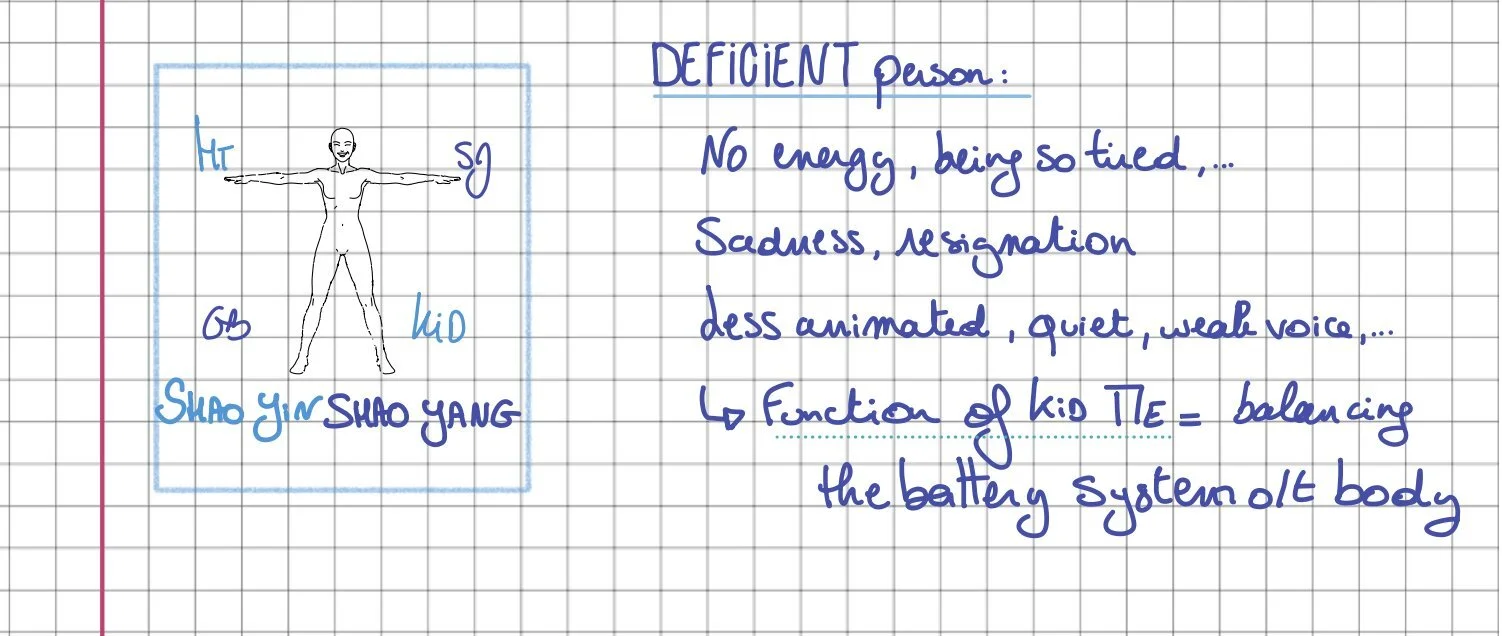
Image from the Balance Method Notebook by Laurence Meyfroodt
Quick Reference: Headache & Migraine
1. Diagnose by Location
| Temple / Side of head | → | GB / SJ (Shao Yang) |
| Back of head / Occiput | → | UB (Tai Yang) |
| Forehead / Above eyes | → | GB / ST / UB (Yang Ming / Tai Yang) |
| Top of head (Vertex) | → | UB / GB / DU |
| Midline of scalp | → | Du Mai (System 6) |
2. Strategic Choice
LOCAL BALANCE: Acute onset, first-time triggers, or external factors.
GLOBAL BALANCE: Chronic, recurring, stress-triggered, or hormonal migraines.
3. Balancing (Full Local Matrix)
| Sick | System 1 | System 2 | System 3 | System 4 | System 5 |
|---|---|---|---|---|---|
| GB | SJ | HT | LIV | HT | SJ |
| UB | SI | LU | KID | LU | SI |
| ST | LI | PC | SP | PC | LI |
| SJ | GB | KID | PC | SP | GB |
| DU | System 6: DU balances DU (Midline Projection) or System1 REN balances DU (sternum projection) | ||||
4. Constitutional Patterns
| Side (Excess) | Jue Yin Shao Yang (PC+LIV+GB+SJ) |
| Hormonal / Side | Spleen Heart Shao Yang (SP+HT+GB+SJ) |
| Occipital (Excess) | LIV-LU Tai Yang (LU+LIV+UB+SI) |
| Occipital (Deficient) | Shaoyin Tai Yang (KID+HT+UB+SI) |
Frequently Asked Questions
Can I do Local Balance for migraine?
You can, and you'll get immediate relief on the table. But migraine is almost always recurring — and recurring means Global. If you only do Local, the migraine keeps returning. Start with Global Balance. If the patient has an active headache during the session, you can add local points on top of your Global pattern — for example, a needle at the correct projection level on a meridian that's already part of your pattern.
What if the headache involves two meridians — like UB and GB at the back-and-side?
Treat the dominant one first. Ask which area is more painful. Needle for that meridian, re-evaluate. Often 50–80% resolves and the remaining pain shifts to the other meridian. Then treat that one. Don't try to build one combined analysis for both — take them separately, one problem at a time.
The headache keeps coming back. What am I doing wrong?
Probably nothing — you're just using the wrong level. If Local Balance resolves the headache on the table but it returns within days, the problem isn't your point selection. The problem is that the headache is a symptom of something deeper. Switch to Global Balance. Treat the pattern, not the spot.
Which pattern is best for menstrual migraine?
Spleen Heart Shao Yang (SP + HT + GB + SJ). Specifically indicated for side headache with neutral constitution and for side headache related to the hormonal cycle. This combination comes up frequently — many female patients report temporal headache that follows their menstrual pattern.
Some patients respond better to certain systems. How do I know which works best?
You don't — not until you try. Some patients respond better to System 2 for headache and better to System 3 for something else. You can't predict this in advance. If System 2 gives 50% relief, try System 1 or 4 next time. Over time, you learn each patient's response pattern.
Next Steps
Headache is the condition that teaches you the most about the difference between treating a spot and treating a body. If you take one thing from this blog: the first question isn't "which system should I use?" — it's "is this local or global?" Get that right and everything else follows.
For the complete 1-2-3 framework, read the guides on meridian diagnosis, the six systems, and ashi palpation. For a deeper understanding of when to use Global Balance, see our dedicated guide. Watch Balance Method treatments in action on our needling demo page. To learn from Dr. Tan's direct disciples, explore Balance Method training programs worldwide.
For the complete clinical reference at your treatment table, the Balance Method Notebook has every projection chart and protocol you need. For Dr. Tan's original texts, see our book recommendations. And join our practitioner community to discuss headache cases with 7,000+ colleagues worldwide. New to the terminology? See the Balance Method Glossary for every core term in one place.
