
How to Treat Shoulder Pain and Frozen Shoulder with Dr. Tan's Balance Method: The Million Dollar Combo
Two patients in one afternoon at our clinic. Both have shoulder pain. Both rate it a 6 out of 10. One on the right, one on the left. In standard TCM, they might receive the same treatment — LI 15, SJ 14, GB 21, maybe some local ashi. With the Balance Method, they get two completely different treatments. And both walk out pain-free.
Patient one: right shoulder, pain when lifting the arm to the side. She points to the outer side of the shoulder — that's Large Intestine territory. One meridian, clear diagnosis. System 1 gives us Stomach on the opposite side. Two needles on the left ankle — Stomach 41 area, into the tendon and joint, palpated for ashi. "Can you lift your arm again?" The pain drops from 6 to 1. One more needle slightly higher on the Stomach channel and it's gone. Three needles, no needle anywhere near the shoulder.
Patient two: left shoulder and neck, constant tightness that doesn't change with movement. Too much computer work. He points to a broad zone where the neck meets the shoulder — not one spot, the whole area. That zone involves five meridians at once: UB, GB, SI, LI, and SJ. This is where the million dollar combo comes in. Kidney and Heart on the opposite side can balance all five through the matrix. A few needles — Kidney 7 area ashi on the right ankle, Heart 6 area ashi on the right wrist. The broad tension shrinks to a small spot. One more needle towards Kidney 3 and the remaining tension resolves.
Same joint. Same pain level. Different complexity, different approach, same result. The first patient needed one meridian and one system. The second needed matrix analysis and the million dollar combo. But both followed the same logic: identify which channel is involved, choose the treating meridian, needle at a distance, and test the result. That logic is the 1-2-3 system, and for the shoulder, Step 1 is everything.
Why the Shoulder Is the Ultimate Step 1 Test
The shoulder is where meridian diagnosis matters most. No other joint has as many meridians crossing through such a small area. A patient who says "shoulder pain" could have a problem on any of five or six different channels — and each one leads to a completely different treatment. If you get Step 1 wrong on the shoulder, nothing else will work.
Shoulder Pain Meridian Map
| Location (One-Finger Rule) | Meridian | Common Presentation |
|---|---|---|
| Outer side (deltoid) | Large Intestine | Pain lifting arm to side or overhead |
| Back of shoulder | Small Intestine | Pain reaching behind the back |
| Top of shoulder (trapezius) | Gallbladder / San Jiao | Tension, stress-related, desk work |
| Front of the shoulder | Lung | Pain lifting arm forward |
| Armpit area | Heart | Deep ache with rotation |
| Inner side | Pericardium | Pain with rotation |
The one-finger rule is non-negotiable here. "Shoulder pain" tells you nothing. "Right here" — with one finger on the outer side of the shoulder — tells you Large Intestine. That one answer determines the entire treatment.
You might wonder: why Kidney and Heart for shoulder pain? These Yin channels don't run across the shoulder itself. But they don't need to — they balance the Yang channels that do. Kidney balances Urinary Bladder, San Jiao, Large Intestine and even Pericard and Heart through the six systems. Heart balances Gallbladder and Small Intestine. That's why our second patient's broad, multi-meridian neck-shoulder tension resolved with just Kidney + Heart on the opposite side.
Step 2: Balancing the Shoulder Meridians
Once you've identified which meridian is involved, the six systems tell you where to needle. The shoulder is a hand-level problem (all arm meridians pass through it), so your treating meridians will typically be on the foot — the opposite limb.
Step 2: Balancing Options Matrix
The verified clinical matrix for distal shoulder treatment. Select your treating meridian based on the identified sick meridian.
| Sick Meridian | System 1 | System 2 | System 3 | System 4 | System 5 |
|---|---|---|---|---|---|
| LI (Large Intestine) | ST | LIV | LU | KID | ST |
| SI (Small Intestine) | UB | SP | HT | LIV | UB |
| SJ (San Jiao) | GB | KID | PC | SP | GB |
| LU (Lung) | SP | UB | LI | UB | LIV |
| HT (Heart) | KID | GB | SI | GB | SP |
| PC (Pericardium) | LIV | ST | SJ | ST | KID |
Clinical Rule: Always retest movement after a few needles to confirm balance.
Most shoulder pain is on one side, which means System 1,3,5 (opposite side) or system 2 , 4 and 6 (either side) works well. For example: the patient has right LI shoulder pain → you needle Stomach on the left leg. Clean, simple, effective.
For shoulder tension on both sides — common in desk workers with trapezius pain left and right — Systems 2 , 4 and 6 allow either side, giving you coverage on both sides with fewer needles. This is the same logic explained in the back pain guide: when the problem is on both sides, choose a system that treats both sides from one limb.
Step 3: Projection and Point Location
The shoulder joint is the furthest landmark in the puppet show image. In the mirror projection (arm ↔ leg), the shoulder corresponds to the hip. This is your starting framework — but in practice, the reversed version is often more useful.
Mirror projection: shoulder → hip
For shoulder pain at the joint level, the direct mirror gives you: shoulder maps to hip. If the sick meridian is Large Intestine on the shoulder, you palpate the Stomach channel near the hip on the opposite leg — looking for the ashi point in that zone.
But many practitioners find the hip area impractical — the patient is clothed, the area is hard to access, and ashi points in the hip region are often less reactive. That's when you switch to the reversed mirror.
Reversed mirror: shoulder → ankle / shoulder → wrist
In the reversed mirror, the elbow/knee stays fixed, but the shoulder swaps to the far end — mapping to the ankle and foot area. This works better for shoulder treatment for three reasons: the ankle is always accessible (shoes off, done), the tissue is closer to the surface so ashi points are easier to find, and the area is rich in tendons — matching the tendon-heavy shoulder.
This is exactly how both patients from our clinic were treated. The first patient got Stomach 41 at the ankle — a reversed mirror where the shoulder maps to the ankle instead of the hip. The second patient got Kidney 7 area Ashi on the ankle and Heart 7 area ashi on the wrist — the million dollar combo uses the same reversal principle, projecting the neck-shoulder zone onto the wrist and ankle area.
Tissue matching for the shoulder
The shoulder has a lot going on — tendons (rotator cuff), muscle (deltoid, trapezius), the joint capsule, and bone. Your needle depth must match the tissue where the patient feels the problem:
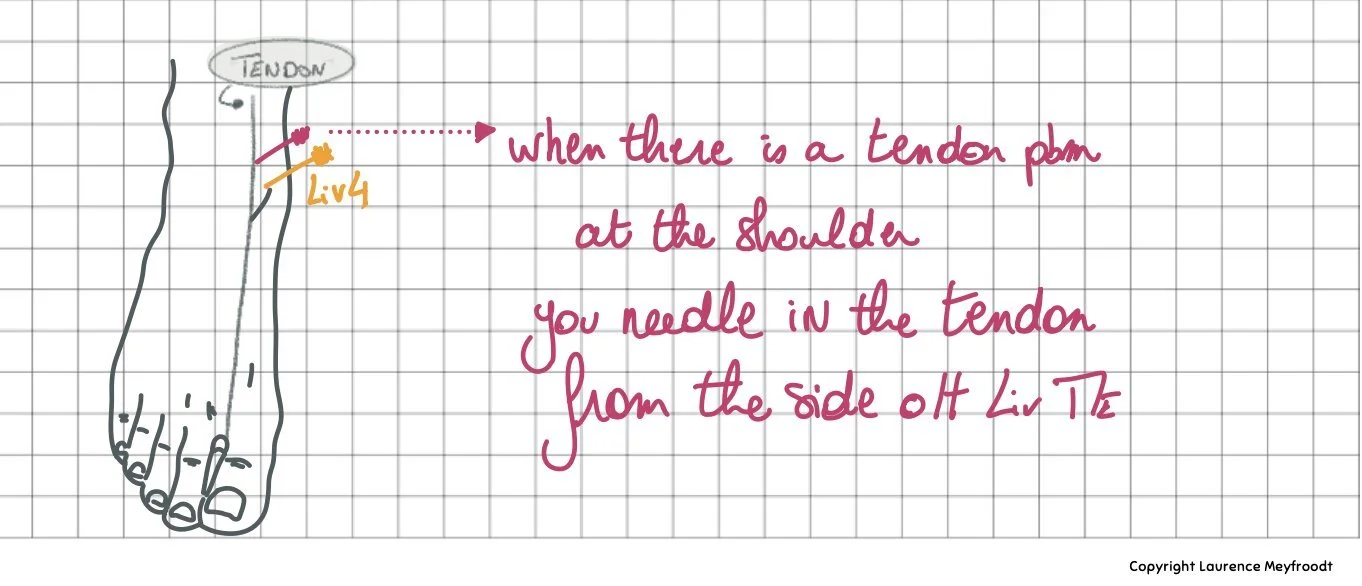
Image from the Balance Method notebook.
Step 3 — Tissue Matching
| Patient Describes | Target Depth | |
|---|---|---|
| "Muscle tightness and soreness" | → | Into the muscle body |
| "Sharp with movement (tendon)" | → | Catch the tendon |
| "Deep in the joint / Bone ache" | → | Needline in the joint / Needle the bone |
With our first patient, the needling was needling was into the tendon and joint on the Stomach channel at the ankle — because the shoulder pain was sharp with specific movements, pointing to tendon involvement. With the second patient, the needling was into the muscle/tendon on Kidney and Heart — because the tension was a mix of muscle and tendon, typical of overworked computer posture.
The Feedback Loop: How Shoulder Pain Reveals Itself Layer by Layer
Shoulder treatment in the Balance Method almost never ends with one needle. The pattern is consistent: needle → retest → the pain shifts → re-diagnose → needle the next layer. This is not a failure — it's the method working exactly as designed.
Take our first patient from earlier. Here's what happened step by step:
Before treatment: right shoulder pain, 6/10, outer side, pain when lifting the arm.
After two Stomach needles at the ankle: pain drops to 1/10. She lifts her arm again — almost no pain. One more needle slightly higher on the Stomach channel targets the remaining spot. Done.
With the second patient, a broader process: constant neck-shoulder tension → Kidney 7 area + Heart 6 area on the opposite side → the broad tension shrinks to a small spot → one more needle at Kidney 3 area resolves it.
This is why needling away from the shoulder is so powerful. If you had placed needles in the shoulder itself, you couldn't ask the patient to move and retest. You couldn't watch the pain shift. You couldn't identify the second layer. Needling at a distance keeps the shoulder free so you can retest after every needle — and each retest gives you new diagnostic information that makes the next needle more precise than the last.
Dr. Tan's Million Dollar Combo for Neck & Shoulder
There's one shoulder presentation so common that Dr. Tan gave it its own name: the million dollar combo for neck and shoulder pain. Why "million dollar"? Because if you can treat the tight, stiff, burning neck-shoulder zone that desk workers, computer users, and stressed-out patients all share, you can help at least 40% of the population. That's a million dollar skill.
The problem zone is the upper trapezius area — where the neck meets the shoulder — and it involves five meridians simultaneously: Urinary Bladder, Gallbladder, Small Intestine, Large Intestine, and San Jiao. All five cross through this compact zone, which is why it's such a complex area to diagnose and why simple recipe treatments often fail.
The matrix analysis
With five sick meridians, you need matrix analysis — and it goes fastest with the free printable Balance Method chart in front of you. List all five, map their balancing options across the six systems, and look for the treating meridian that appears in the most rows. The result:
Kidney shows up four times — balancing UB, LI, SJ and PC. That covers four of the six sick meridians with one treating meridian. The two remaining unbalanced meridians are GB and SI. Looking at those two rows: Heart appears in both. And so does Liver.
This gives you two options:
Million Dollar Combo: Neck & Shoulder
KIDNEY + HEART
KID 3–7 ashi (ankle) + HT 7–5 ashi (wrist). Covers all 5 neck-shoulder meridians.
KIDNEY + LIVER
KID 3–7 ashi + LIV 4–4.5 ashi. All needles placed on one leg (medial side).
Always Opposite Side (Sys 1,3,5). Essential for the classic neck-shoulder zone.
Both options use System 1, 2 and 3 , which requires needling on the opposite side. The practical difference: Option A puts needles on two different limbs (one arm, one leg — both opposite to the painful side). Option B puts everything on one leg (Kidney and Liver both run on the inner side of the leg), which some practitioners prefer for simplicity.
The projection
The neck-shoulder zone is on the trunk/neck level. Using the direct puppet show image: the neck corresponds to the wrist/ankle area, and the upper shoulder area projects just below that. So:
On Heart: palpate from Heart 7 (wrist = neck level) toward Heart 5, looking for ashi. The area just above the wrist covers the neck-to-upper-shoulder zone.
On Kidney: palpate from Kidney 3 (ankle = neck level) toward Kidney 7, looking for ashi. If the pain extends high toward the skull, start from Kidney 4 ashi instead.
On Liver (if using Option B): palpate Liver 4 to Liver 4.5 ashi.
Why this is "quick and dirty"
Dr. Tan called this the "quick and dirty" approach — not because it's imprecise, but because the thinking has already been done for you. Instead of running the full matrix analysis for every neck-shoulder patient, you memorize: Kidney + Heart or Kidney + Liver. When a patient walks in with that classic desk-worker neck-shoulder tension, you go straight to these combinations. The matrix analysis is already solved — you just apply it.
This is what separates the Balance Method from recipe-based acupuncture. The million dollar combo isn't a recipe — it's the result of a matrix analysis that happens to come up the same way every time for this specific pain pattern. You understand why it works, which means you can adapt it when the patient's presentation doesn't perfectly match the pattern.
Frozen Shoulder: A Different Challenge
Frozen shoulder (adhesive capsulitis) is fundamentally different from regular shoulder pain. It's not a single meridian problem — it's the entire joint capsule that has become inflamed and restricted. All movements are limited, not just one. That makes the standard Balance Method approach harder, and treatment takes longer than usual.
What the Balance Method can do: reduce pain, improve range of motion per direction, and accelerate recovery. What it can't do: resolve a frozen shoulder in one or two sessions the way acute shoulder pain often resolves. Frozen shoulder is slow by nature — the capsule needs time to heal.
Practical approach
Test each movement direction separately: abduction (arm to the side), flexion (arm forward), external rotation (hand behind the head), internal rotation (hand behind the back). Each direction corresponds to different meridians crossing the shoulder. The most restricted direction tells you which meridian to treat first. Balance it, needle, retest. If one direction improves, move to the next most restricted. Over multiple sessions, the range gradually increases.
A 2017 double-blinded trial in Pain Medicine tested distal needling for frozen shoulder in 60 patients — and found a real reduction in pain over placebo. It's the strongest study we have on the principle this whole approach rests on. Read the full breakdown on our research page →
Common Mistakes in Shoulder Treatment
1. Treating "shoulder pain" without identifying the meridian
The number one error. Five or six meridians cross the shoulder — treating the wrong one gives zero result. Both our patients had "shoulder pain at 6/10" and received completely different treatments. Always ask for one finger. Always identify the specific channel before moving to Step 2.
2. Defaulting to the direct mirror when the reversed version is more practical
Shoulder → hip is correct in theory but hard to do in practice. The reversed mirror (shoulder → ankle or Shoulder → wrist ) gives you easier access, more reactive ashi points, and better tissue matching for the tendon-heavy shoulder. Both our shoulder patients were treated with the reversed approach — and the results speak for themselves.
3. Not retesting after needling
Shoulder pain shifts after treatment. The first few needles resolves the primary layer and reveals a secondary layer on a different meridian. Both our patients showed this: broad pain → first needles → pain shifts to a smaller, different spot → one more needle resolves it. If you don't retest, you miss the second layer entirely.
4. Needling too many points at once
With both shoulder patients, we started with a few needles — not twelve. Retest, find the remaining pain, add one more. More needles doesn't always mean complete resolution; sometimes a reduction of at least 50% is a perfect start. More needles at once means you can't tell which one is working, and you lose the diagnostic precision that makes the feedback loop so powerful.
5. Expecting frozen shoulder to behave like acute shoulder pain
Frozen shoulder involves the entire joint capsule — it's not a meridian-specific problem. The Balance Method can help you enormously with pain and range of motion, but the capsule needs time to heal. Expect more sessions with gradual progress. Set realistic expectations for yourself and the patient.
Quick Reference: Shoulder Pain
The complete clinical framework for meridian-specific diagnosis and distal balancing of the shoulder joint.
Step 1: Meridian Diagnosis
| Location (One-Finger Rule) | Sick Meridian | Presentation |
|---|---|---|
| Outer side (Deltoid area) | LI | Pain lifting arm to side |
| Back of the shoulder | SI | Pain reaching behind back |
| Top of shoulder (Trapezius) | GB / SJ | Stress-related tension |
| Front of the shoulder | LU | Pain lifting arm forward |
| Armpit | HT / PC | Armpit pain and pain lifting the arm. |
Step 2: Balancing Options Matrix
| Sick | Sys 1 |
Sys 2 |
Sys 3 |
Sys 4 |
Sys 5 |
|---|---|---|---|---|---|
| LI | ST | LIV | LU | KID | ST |
| SI | UB | SP | HT | LIV | UB |
| SJ | GB | KID | PC | SP | GB |
| LU | SP | UB | LI | UB | LIV |
| HT | KID | GB | SI | GB | SP |
| GB | SJ | HT | LIV | HT | SJ |
The Million Dollar Combo (Neck & Shoulder)
KIDNEY + HEART
- KID 3-7 ashi (Ankle)
- HT 7-5 ashi (Wrist)
- Balances: UB, GB, SI, LI, SJ
KIDNEY + LIVER
- KID 3-7 ashi (Ankle)
- LIV 4-4.5 ashi (Ankle)
- Balances: UB, GB, SI, LI, SJ, LU
- Needling on same leg
Step 3: Clinical Decision
| Sharp pain with movement (Tendons/Muscles) | → | Reversed Mirror (Ankle - Wrist) - Catch Tendon / Muscle - Retest |
| Deep joint ache / Frozen shoulder | → | Needle Bone/Joint - Retest |
Frequently Asked Questions
Should I needle the opposite arm or the leg?
Both work. For shoulder pain on the outer, back, or top of the shoulder (LI, SI, SJ,GB), needling the opposite leg via System 1 or system 3 often gives excellent results — as we saw with our first patient using Stomach on the ankle for LI shoulder pain. For broad neck-shoulder tension involving multiple meridians, the million dollar combo (Kidney + Heart or Kidney + Liver) covers several sick channels at once. The choice depends on which system gives you the best tissue match and the most reactive ashi.
What about neck-shoulder pain that involves both areas?
Diagnose each area separately. The neck and shoulder often involve different meridians even though they feel connected to the patient. Treat the more painful area first, retest, and check if the neck component resolves along with the shoulder — often it does, because the same meridian runs through both areas. If a residual neck component remains, it's likely on a different meridian that needs separate treatment.
Can I use this for post-surgical shoulder pain?
Yes. The Balance Method treats the meridian pattern, not the structural cause. Post-surgical shoulder pain still follows meridian geography — the scar tissue, inflammation, and residual tension sit on specific channels. Diagnose by location, balance, and project as usual. Post-surgical patients often respond especially well to distal treatment because you're not touching the sensitive surgical area.
When should I switch from local to Global Balance for shoulder problems?
Three signals: the shoulder pain keeps coming back after each treatment, the tension is part of a broader pattern (both shoulders plus neck plus upper back), or the patient has systemic symptoms alongside the shoulder complaint (sleep issues, stress, fatigue). Any of these suggests the shoulder is an expression of a larger imbalance that Global Balance addresses more effectively than repeated local treatments.
Next Steps
The shoulder is the joint that teaches you the most about Balance Method diagnosis. If you can correctly identify which of five or six meridians is causing the pain, choose the right system, and use the feedback loop to treat layer by layer, you can treat any joint in the body. The precision the shoulder demands transfers to everything else.
For the complete 1-2-3 framework, read the guides on meridian diagnosis, the six systems, and ashi palpation. For the Balance Method approach to back pain and sciatica, see our clinical guide. Watch needling demonstrations on our needling demo page.
For the complete clinical reference at your treatment table, the Balance Method Notebook has every projection chart and protocol you need. And join our practitioner community to discuss shoulder cases with 7,000+ colleagues worldwide. New to the terminology? See the Balance Method Glossary for every core term in one place.
