
How to Treat Jumper's Knee with Dr. Tan's Balance Method: A Needling Depth Case Study
What do you do when the ache sits inside the knee joint rather than on it? This case is about the axis you cannot draw: map the meridians that cross the painful area, balance them from the opposite arm, then match the needle to the depth of the complaint instead of the surface it points at.
A 35-year-old man comes to our clinic with left knee pain from rope skipping, the presentation most of us know as jumper's knee. It flares after training and stays sore for days afterwards. He rates it 6 out of 10. Let's map it.
When a knee complaint sits in the joint itself, you read the meridians crossing it before you decide anything else. Here three of them ran straight through the painful area, and all three of them mattered.
Patient Profile
| Age & sport | 35-year-old male, rope skipping |
| Complaint | Left knee pain, a jumper's knee presentation |
| Meridians involved | Liver, Stomach and Spleen, all crossing the knee |
| Pain level | 6/10, lingering for days after training |
| Depth | Medium deep, inside the joint rather than on the surface |
| Context | Repetitive load from his training |
Why Jumper's Knee Is a Depth Case
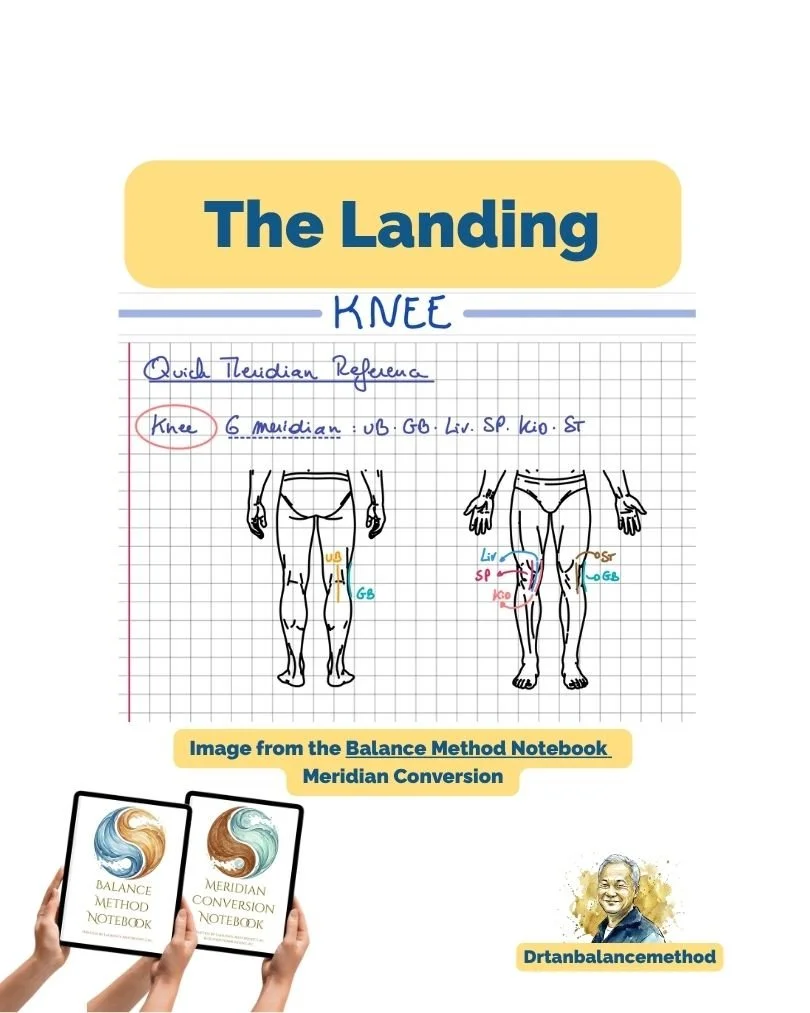
Three meridians cross the painful area. Liver (LIV) at LIV 8.3, right in the knee joint. Stomach (ST) at ST 35. Spleen (SP) at SP 9.5. That is a complete map, and it is the part every practitioner is trained to produce.
Here's the temptation: draw that map, pick the balancing meridian for each line, needle the opposite side and call the case handled. It won't be enough. A map has two axes and a complaint has three. The two you can draw on the skin tell you which meridian is involved and where along it. The third tells you how far in, and no drawing carries it.
This is a different question from the tissue match. Tendon for tendon and bone for bone is established technique and tells you what you are aiming at; the third axis tells you how far in the patient feels it. Our knee guide already flags the consequence in passing: stay on an arm meridian for a complaint that is not on the surface, and depth is what makes the point work. This case applies that from the first needle rather than as a fallback.
Jumper's knee from a jumping sport is Local Balance territory. Map the meridians. Pick a system for each. Treat the opposite side, palpate for the ashi, and match the depth. That is the framework this case runs on.
The Treatment
Step 1: Map the pain
Left knee. Three meridians in the painful area: Liver at LIV 8.3, right in the knee joint, Stomach at ST 35, and Spleen at SP 9.5. Each one gets its own sick-meridian reading, not one averaged impression of a painful knee.
Then the reading that does not go on a drawing. The ache does not sit on the surface of the knee, it sits inside the joint. Medium deep. That belongs in the map as much as the point numbers do.
Step 2: Pick the systems
Local Balance. Liver is balanced by Large Intestine (LI) through System 2, the branching meridians: hand Yang Ming for foot Jue Yin. Stomach is balanced by Large Intestine through System 1, same Chinese meridian name, Yang Ming for Yang Ming. Spleen goes to Lung (LU) through System 1, Tai Yin for Tai Yin.
Two of the three sick meridians hand us the same balancing meridian by two different routes. That is not a conflict to resolve. It is a confirmation, and it also decided the side: System 1 asks for the opposite side, System 2 allows either, so taking the opposite side throughout put the entire treatment on one arm.
Step 3: Needle
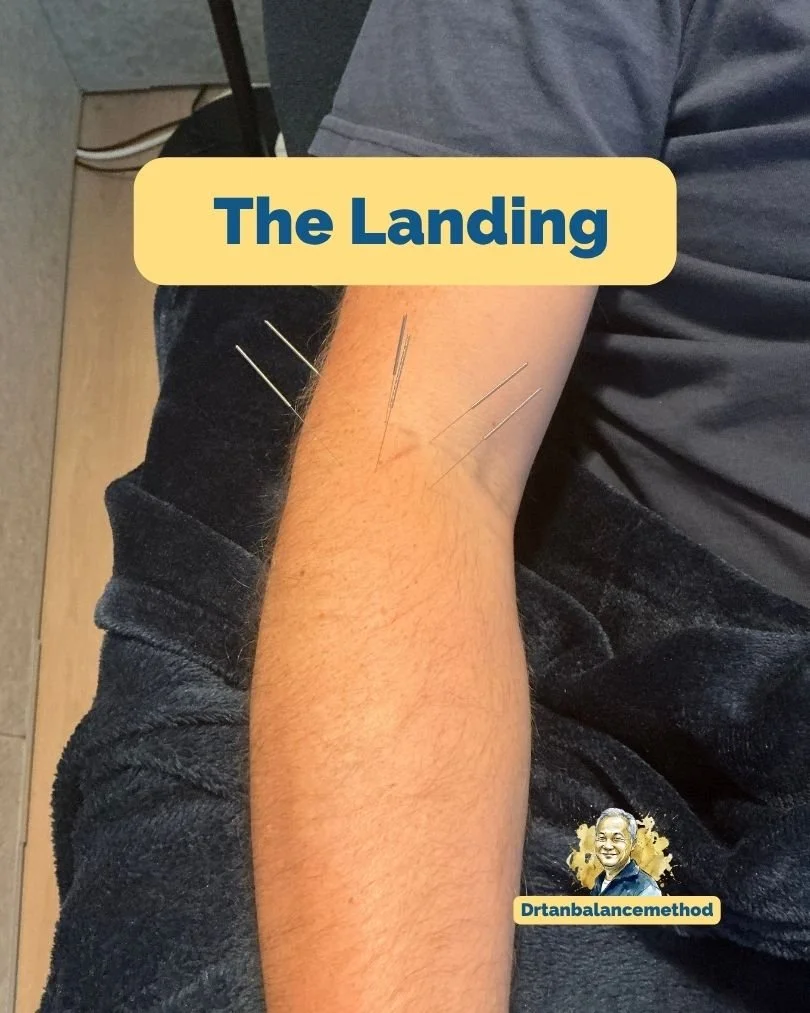
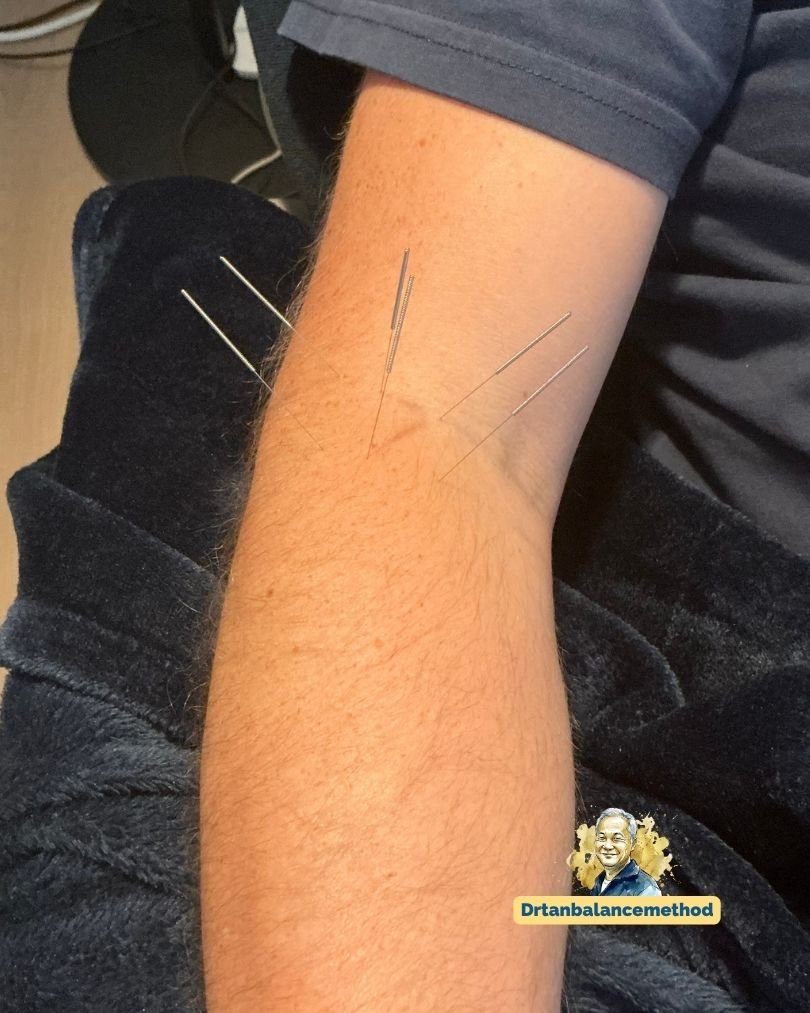
The knee mirrors the elbow. That central joint does not move, in mirror or in image, so a complaint sitting in the knee joint comes home at elbow level on the arm. Liver and Stomach both landed at LI 11, Spleen at LU 5, on the right arm, and we palpated for the ashi rather than aiming for textbook locations.
The knee did not present as three isolated points, so the arm was not treated as three either. Alongside LI 11 and LU 5 we needled in between, on the zone between the Large Intestine and Lung meridians.
That gives three zones on the arm, and each zone took two needles: one at the level of the knee joint, one slightly lower. The pain sometimes sits just below the joint rather than inside it, and below the knee means below the elbow. Six needles in total.
Then the part that decided the outcome: a medium deep complaint gets a medium deep needle. Same points, shallower insertion, and the treatment lands on a layer that is not the one hurting.
The joint let go as the needles went in. We had him walk the room. 6 out of 10 down to 2.
Outcome
Six needles. Within the session the knee loosened and the pain came down from 6 out of 10 to 2 out of 10, confirmed by walking on it before he left the room. That is the immediate result, and it is the only result this case reports.
Worth being precise about what that does and does not mean. A structure that gets loaded every training day is not settled by one treatment, however well the pain responds on the table. So he went home with one instruction alongside the needles: keep the load off that knee for now. Relief is not permission to go back to training, and an athlete who reads it that way will be back with the same knee and a worse number.
The Insight: A Complaint Has Three Axes, Not Two
We are precise about the first two axes because they are visible. Which meridian, and where along it. Everything in our training rewards that precision, and this case would have looked complete after Step 1 without a single word about depth.
But the third axis exists whether or not you ask about it, and asking is the only way to get it. Is it on the surface? Is it deep inside? A needle placed at exactly the right point and the wrong depth is a needle in the wrong place. Match the depth, and the same point does something else entirely.
This is also the reading that keeps sports complaints honest. The knee that hurts only after training, that stays sore for days, that feels like it lives inside the joint rather than on it, is telling you where to aim on that third axis before you have palpated anything.
What to Watch For With Depth Cases
1. Mapping in two dimensions and stopping there
Meridian and level feel like a finished diagnosis because they fill the page. Add one question to the intake and the picture changes: how deep does it sit? A patient can almost always answer it, and they are rarely wrong.
2. Needling everything at your habitual depth
Most of us have a default insertion we reach for without thinking about it. That default is fine for the complaints it happens to match and quietly wrong for everything else. Let the complaint set the depth, not the habit.
3. Reading the relief as a green light
A knee that goes from 6 to 2 and walks comfortably feels ready to be used again, and the patient will tell you so. The tissue is not on that timeline. Say the load instruction out loud before they leave, or the next session starts from a worse place than this one.
Apply This in Your Practice
Add one question to your intake. Ask whether the complaint sits on the surface or deep inside. It takes five seconds, the patient answers it easily, and it changes what you do with your hands.
Let depth change the angle, not only the millimetres. Going deeper means needling closer to perpendicular; a shallow, angled insertion cannot reach an ache inside a joint no matter how long you leave it there.
Palpate first, then needle. The ashi decides the exact spot at LI 11 and LU 5. The map narrows the search; your fingers finish it.
Treat the zone, not only the point. A complaint that spreads across meridians is answered by treating in between them as well, and a complaint that drifts just below a joint is answered slightly below the corresponding joint on the balancing limb. The projection holds for the area, not only for the point number.
Send athletes home with a load instruction. With a jumping sport the treatment room is the easy part. What happens at the next training decides whether the result holds, so make the unloading period explicit rather than implied.
Quick Reference: This Case
- Left knee, jumper's knee → LIV 8.3, ST 35, SP 9.5 · the ache sits inside the joint, medium deep
- Local Balance · LIV → LI by System 2 · ST → LI by System 1 · SP → LU by System 1
- Opposite side, right arm · knee mirrors elbow → LI 11, LU 5, and in between, ashi-led
- Three zones, two needles each: joint level and slightly lower · six needles, all medium deep
- 6/10 → 2/10 within the session
- Home instruction: unload the knee temporarily
Note: Patient details have been adapted from comparable cases in our clinic to protect privacy. This post is for educational purposes only — for acupuncturists and interested professionals. Not treatment advice or a substitute for professional consultation.
Every System, Every Projection, Every Pattern at Your Treatment Table
Start with the free chapter and see how the reference works in the clinic.
Foundation · 600+ pages
Balance Method Notebook
The complete Local and Global Balance reference, hand-drawn for the treatment table.
Specialization · 500+ pages
Meridian Conversion Notebook
Beyond pathway treatment: calm the Shen, balance hormones, work with depression, addiction and insomnia.
Free chapter · Straight to your inbox
Next Steps
This case applies foundational concepts from our pillar guides. To go deeper:
For the diagnostic foundation: how to diagnose the sick meridian
For the full knee overview: Knee Pain and the Balance Method
For the six systems framework: the 6 Systems explained
For projection and opposite-side logic: Mirroring and Imaging in the Balance Method
For point selection technique: how to find the ashi point
For a knee that moved during the session: our lateral leg and knee case study
For the complete matrix reference: the matrix PDF you can print for the treatment table
To discuss cases with colleagues worldwide: Practitioner Community
New to the terminology? See the Balance Method Glossary for every core term in one place.
