
Why Global Balance Treats the Cause, Not Just the Symptom
A patient walks into our clinic with a blocked nose. We read it as mainly a Large Intestine problem, with a little Stomach around the sinus, and we needle distally on the Large Intestine and the Lung. Within minutes the nose begins to clear. Sometimes it unblocks, blocks again, swaps from one side to the other, and then finally settles. The patient is delighted, and rightly so. We got a result, fast, without ever touching the nose.
And yet, if we stop there, we have treated only half of the problem. A result is not always a cure, and understanding why is the whole reason the method gives us a second gear called global balance.
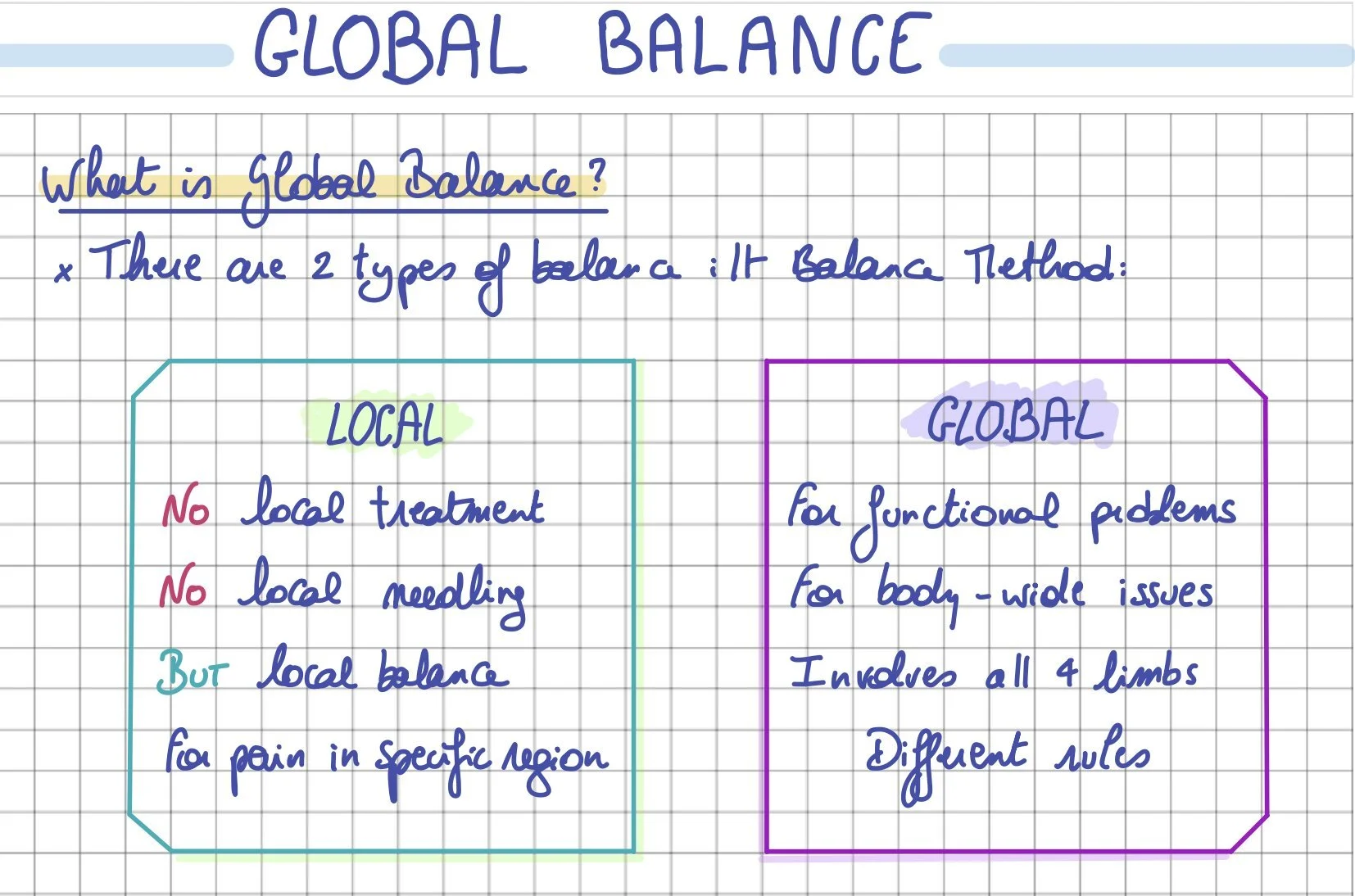
Image from the Balance method notebook from Laurence & Olivier
First, a word that trips people up
Before we go further, one piece of vocabulary matters, because it causes endless confusion. When we say local balance, we do not mean local needling. We are not putting needles into the blocked nose. We are still treating at a distance, on balancing meridians, exactly as the method always does.
Local refers to the scope of the problem we are addressing, not to where the needles go. A local balance treats one clearly located problem. A global balance treats the whole body. Neither of them needles the painful spot. Keep that straight and the rest of this falls into place.
The blocked nose: a result is not a cure
Back to that nose. When we needle the Large Intestine and the Lung, we relieve the blockage. The passage opens, the pressure drops, the patient breathes. That is real, and it is worth having. But what have we actually treated? We have treated the expression of the problem, the symptom as it shows up at that one place.
What we have not touched is whatever put it there: the underlying allergy that keeps expressing at the nose, or the dip in immunity that let the body catch the cold in the first place. Those sit behind the symptom, and a local balance leaves them exactly where they were. So the nose clears today, the result is genuine, but it does not necessarily last, and the patient may be back sooner than either of you would like. Treating only the local expression, as Dr. Tan put it, is like treating the bruise from a punch while ignoring the fist.
Why we treat all four limbs
This is where global balance earns its place. When we treat across all four limbs, we are no longer chasing the expression at the nose. We are addressing the functioning behind it, the underlying dysfunction the symptom was pointing to. The nose was the messenger. Global balance answers the message.
That is why we bother with the extra needles even when the Large Intestine and the Lung have already given us a result. A local balance settles the surface. A global balance reaches for the cause, so the change has a chance to hold rather than fade by next week.
There is an honest trade-off in this, and it is worth naming. The more general a treatment becomes, the less sharply it focuses on any one spot. Gain the power to balance a whole system, and you give up a little of the precision you had when you aimed at a single sick area. As Dr. Tan liked to say, life is fair: you cannot have everything at once. Which is exactly why the choice between local and global is a choice, made fresh for each patient, and never a fixed rule.
When to reach for global
So when is a problem global rather than local? Two situations. The first is a functional or internal disorder, where it is the body's functioning that has gone wrong: respiration, digestion, circulation, and the like. The second is pain that is everywhere, or that rotates, a shoulder one day, the knees and elbows the next, the whole back after that. Both point past a single location to something more systemic.
And if you are not sure which it is? That is fine. The patient will not explode. Do what seems best in the moment and adjust at the next visit. Most patients, even those with an internal problem, still have some local expression you can find simply by asking, and that expression is often where your global logic begins.
The Short Version
★Local balance is not local needling. Both treat at a distance; local addresses one located problem, global the whole body.
★A local balance relieves the symptom's expression. It does not always reach the cause.
★A global balance treats the underlying functional dysfunction, so a result is more likely to hold.
★The trade-off: general reach costs some local precision. Choose per patient.
★Reach for global with functional or internal disorders, or with pain that is everywhere or rotating.
Next steps
To go deeper on the local-versus-global decision:
The full decision, side by side: Global vs Local Balance.
Why a global balance reaches deeper than a local one: Why Global Balance Treats the Cause.
Keep the full map beside you: the Balance Method Matrix.
New to the terminology? See the Balance Method Glossary for every core term in one place.
Go Deeper · The Notebooks
Get the First Chapter of Both Notebooks — Free
Every projection, pattern, and conversion — hand-drawn for your treatment table.
Foundation · 600+ pages
Balance Method Notebook
Local & Global Balance, fully mapped.
Specialization · 500+ pages
Meridian Conversion Notebook
Function, Shen, and emotional disorders.
Instant download · No signup · balancemethodnotebook.com/free-chapter
Note: This post is for educational purposes only — for acupuncturists and interested professionals. It is not treatment advice or a substitute for professional consultation.
