
How to Treat Knee Pain After Squats with Dr. Tan's Balance Method: A Bone-for-Bone Case Study
What do you do when eight weeks of rest change nothing at all? This case is about letting the tissue pick the system instead of letting the system pick the tissue: read what the pain actually sits on, choose the pairing that lands you on the same structure, and needle at the depth that structure sits.
A 26-year-old man comes to our clinic with knee pain after squats — left side, eight weeks old, and unchanged by eight weeks of rest. He does calisthenics in the park, bought a training programme in an app, and worked hard on his single-leg squats. He rates the knee 6 out of 10 on an average day. Let's map it.
The word knee sends most practitioners straight to the joint. Ask this patient to point, and the finger lands below it — on the attachment just under the joint line, on the inner side, where the shinbone is bone and nothing else. That single detail decided the whole treatment, because it ruled out every balancing option that would have landed on tendon.
Patient Profile
| Patient | 26-year-old man, recreational calisthenics |
| Complaint | Left knee pain on the inner side, at the attachment just below the joint line |
| Trigger | Single-leg squats from an online training app, trained hard and trained often |
| Meridians involved | Liver (LIV) and Spleen (SP), left |
| Tissue | Bone, and superficial — the shinbone lies directly under the skin here |
| Pain level | 6 out of 10 on an average day |
| Approach | Local Balance — System 3 for both meridians |
| Treatment side | Right knee throughout — opposite side, direct mirror |
Why Knee Pain After Squats Is a Bone-for-Bone Case
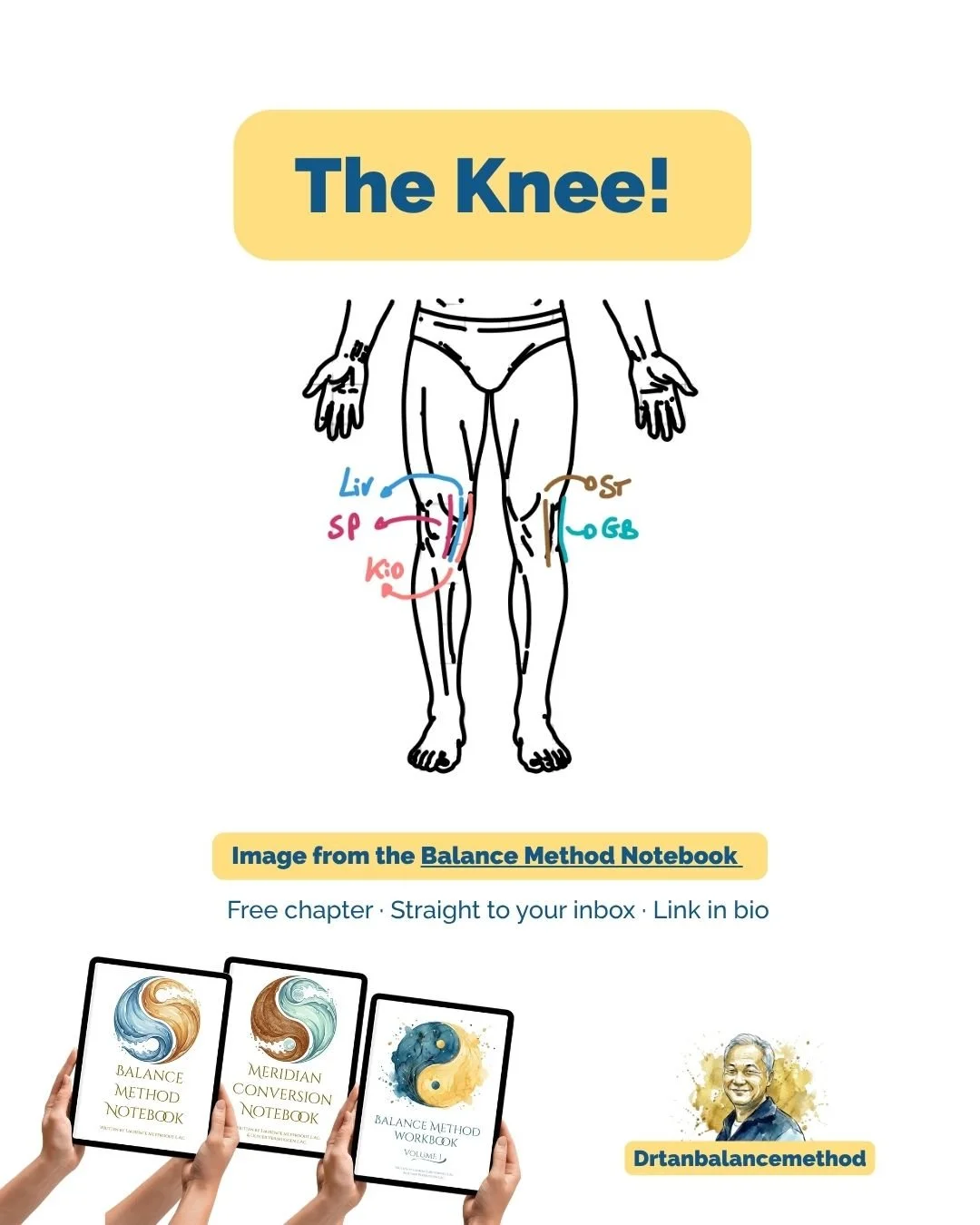
The knee carries every leg meridian there is, and the full map of that joint is worth having in your head before you touch anything. But this complaint did not sit in the joint. It sat a little lower, on the inner side, where Liver runs along the flat face of the shinbone and Spleen runs in the soft groove just behind it. He pointed at both.
Here's the temptation: knee means joint, joint means the elbow, so mirror it to the elbow and start palpating. It won't work well here. At elbow level the balancing meridians give you tendon and soft tissue, and this pain sat on bone. Get the system right and the tissue wrong, and the needle lands in the correct place doing the wrong job.
There is a second temptation, and it is quieter. Rest had already failed. Eight weeks of doing nothing is a long trial, and when a patient arrives after one, it is easy to assume the problem must be bigger than it looks — a global picture, a depletion, something systemic. It wasn't. The load history was clear, the sick meridian diagnosis was clean, and the reason rest failed is simply that rest is not a treatment. Nothing had ever reached the structure that was hurt.
The Treatment
Step 1: Map the pain
Left knee, inner side, and not in the joint. The pain sat on the attachment just below the joint line, at Dr. Tan's LIV 8.3 and at SP 9.3. Palpate there and you are on bone — not on muscle, not on tendon. That is the Liver and Spleen crossing at the knee, read by tissue rather than by memory: bone is Liver, the soft groove behind the bone is Spleen.
The depth reading matters as much as the location. This is bone, but it is not deep bone. The shinbone sits directly under the skin at that level, so the structure to be matched is superficial and hard at the same time. Two meridians, one tissue, 6 out of 10 on an average day.
Step 2: Pick the systems
Local Balance, and System 3 for both meridians. Liver balances to Gallbladder (GB), Spleen balances to Stomach (ST) — the internal-external pairs most practitioners already learned in school under a different name. System 3 needles the opposite side.
Here is why it was chosen rather than fallen into. System 3 never swaps hand for foot. A hand meridian balances a hand meridian, a foot meridian balances a foot meridian. Both of our sick meridians are foot meridians, so both balancing meridians are foot meridians too, and the projection stays inside the leg: knee for knee, opposite side, direct mirror. Joint level answers joint level. Bone answers bone.
That is Anatomical Structural Similarity doing the choosing. Any of the other systems would have sent the treatment to the arm, where the same joint level offers a different tissue. System 3 was the one pairing that let the needle meet the same structure the pain was sitting on, and it happened to cover both sick meridians at once.
Step 3: Needle
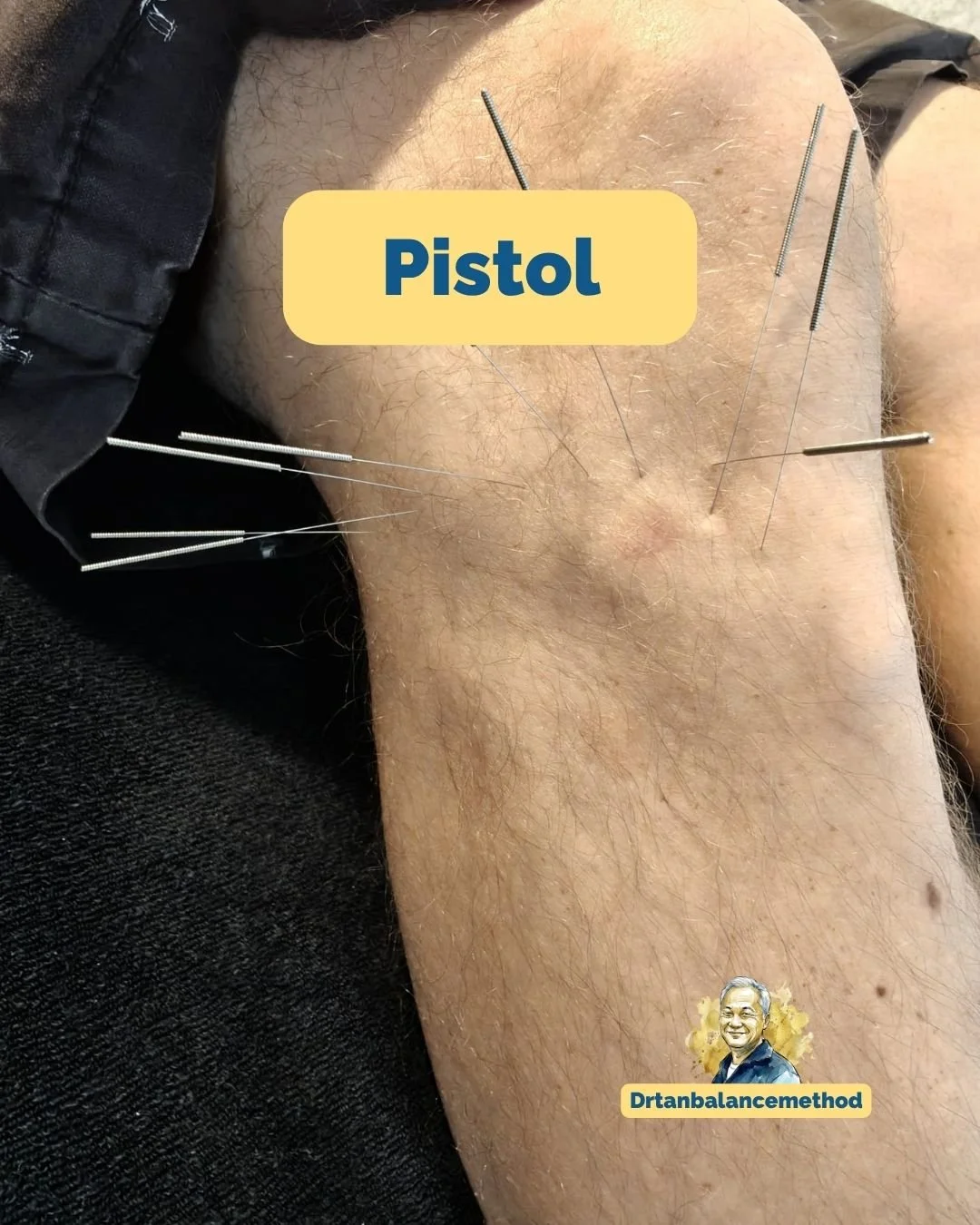
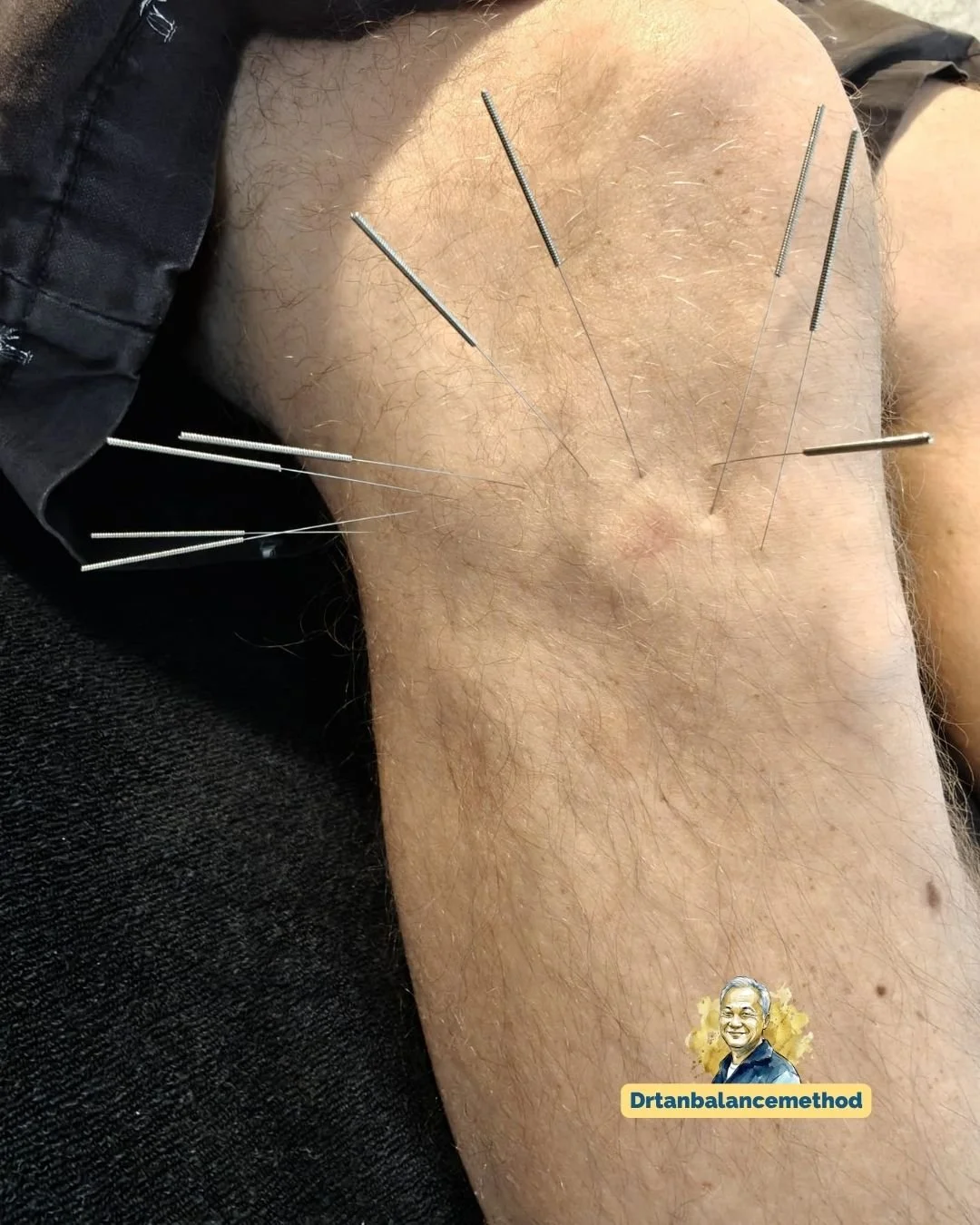
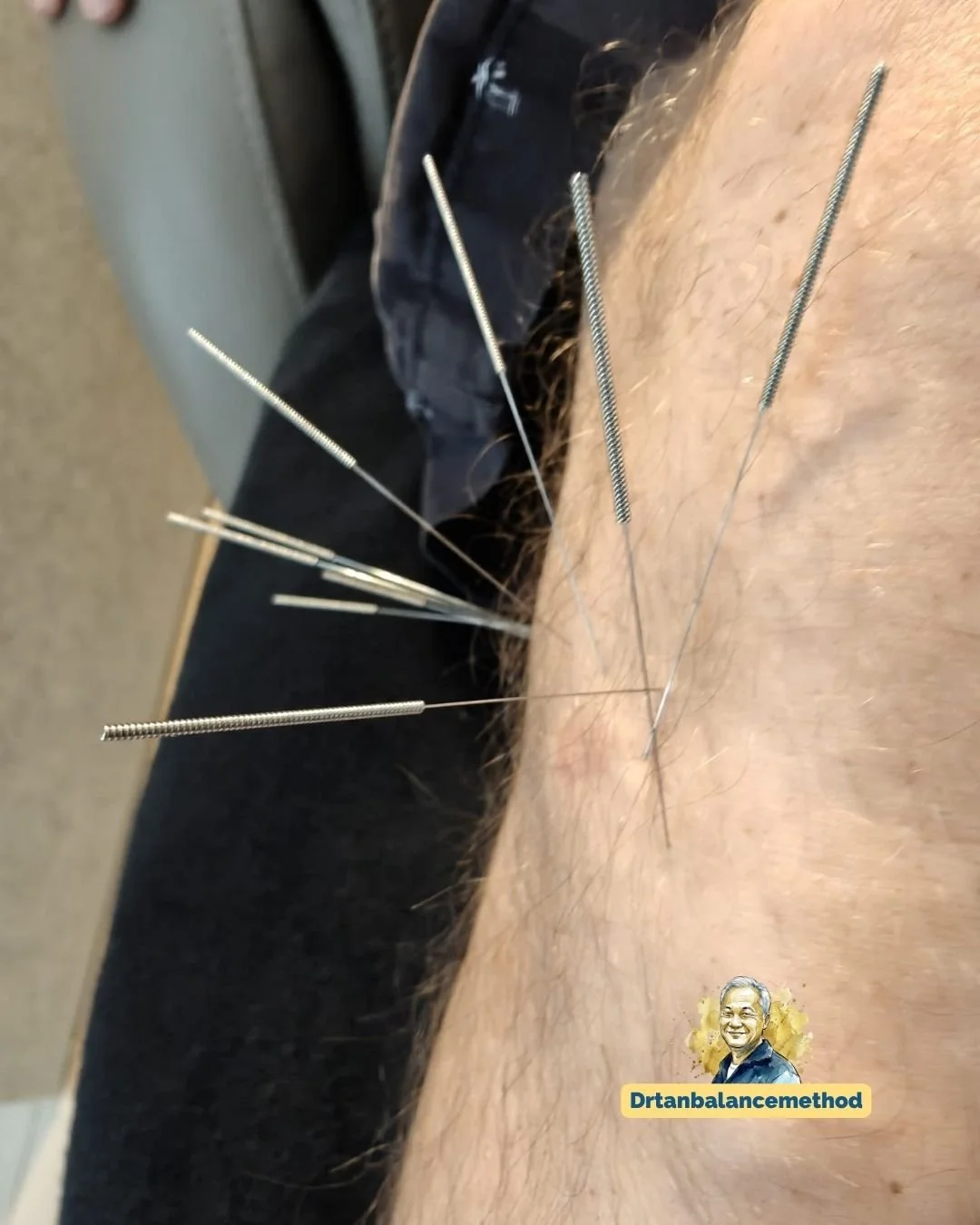
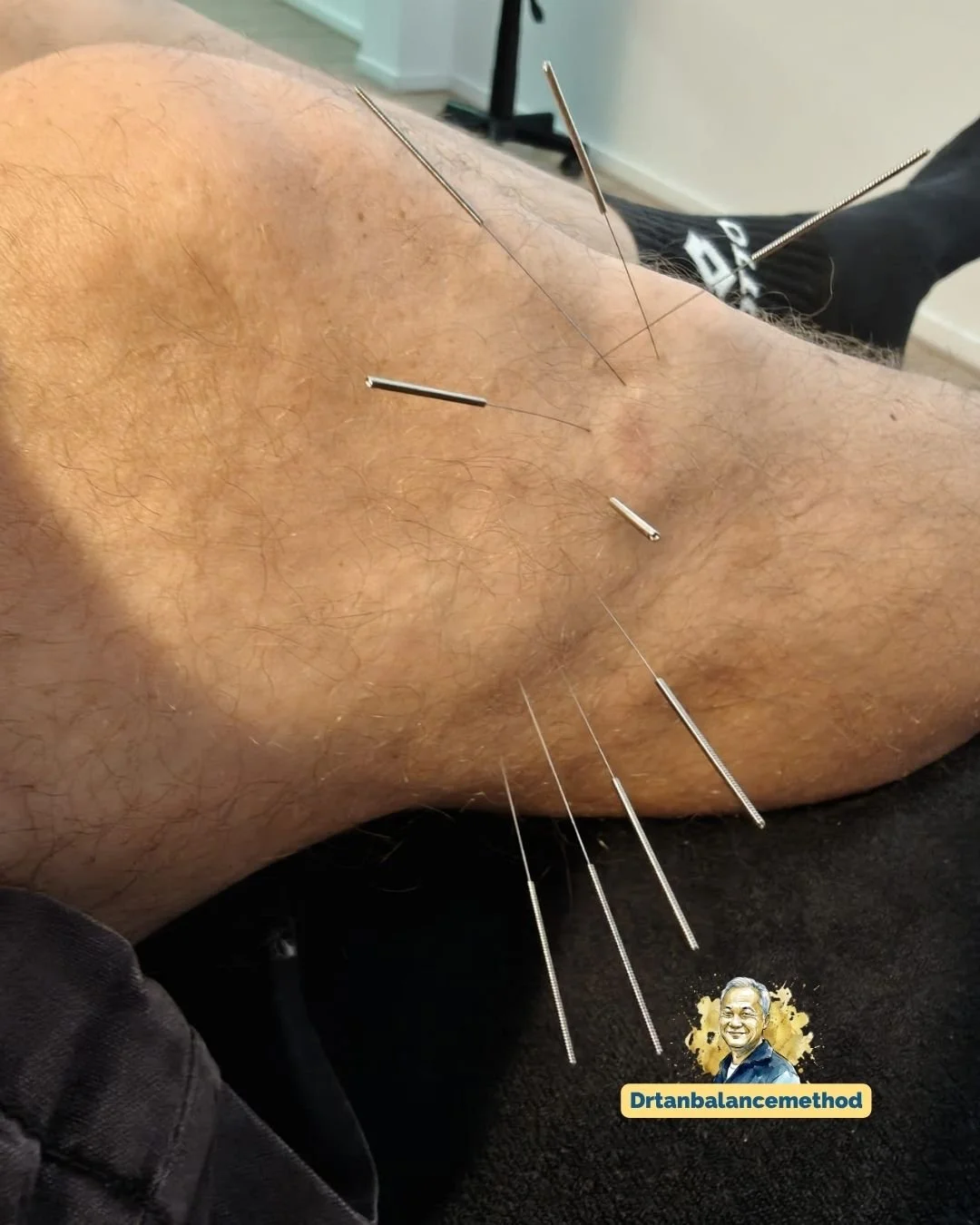
Right knee. GB 33.6 for the Liver, ST 35.4 for the Spleen. The Yin side on the left became the Yang side on the right, medial became lateral, same joint, other leg.
Then the stretch between them. The two balancing points sit at either end of a run of bone on the lateral knee, and the sick side was not a point either — it was an attachment with length. So we palpated the whole line from GB 33.6 across to ST 35.4 and needled every spot that gave an ashi reaction. Nine needles in total, the two named points and the reactive spots in between.
Insertion followed the reading from Step 1: superficial, straight down, until the needle met bone. When the complaint is a bone complaint, the needle has to reach bone — that is not a stylistic preference, it is the structure match completing itself. And because the bone lies just under the surface at that level, reaching it costs almost no depth.
Outcome
The first sign arrived the next morning. He got out of bed noticeably less stiff and less bothered, and by his own account he had already started thinking about the knee less. That is a useful first-session marker even without a number attached to it: not the pain score, but how much room the complaint still takes up in the day.
From there the knee came down to 2 out of 10 over the course of the treatments, and was fully clear after seven sessions.
Those are two results, not one, and they are worth reporting separately. Eight weeks of rest had changed nothing at all; one session changed a morning. But an eight-week-old overload complaint in a young, fit patient still needed a series, and rounding the whole case into a single dramatic number would describe neither half of it.
The last part of the outcome had nothing to do with needles. We asked him to rebuild slowly, and to get someone to supervise the return to loading rather than following the app again. The complaint arrived through a training decision, and it would come back through the same route.
The Insight: The Tissue Picks the System
Structure matching is usually taught as a rescue. You run the system, you palpate the balancing point, you feel tendon where the pain is bone, and you switch. That is the right instinct and it saves a lot of treatments.
This case ran the other way round. The tissue was read in Step 1, before any system was on the table, and the reading eliminated most of the options before they were considered. Bone, superficial, below the joint line, on two foot meridians. Only two systems (3 and 6) keeps a foot meridian on a foot meridian, and those system puts you on the opposite knee, at the same joint level, on bone. The choice was made by the anatomy and confirmed by the matrix, not the other way around.
There is a practical consequence. When you read the tissue first, the matrix stops being a list of options to try and becomes a filter. Two sick meridians, one structural requirement, one system that satisfies it — and a treatment plan that took longer to justify than to execute.
What to Watch For With Bone-for-Bone Cases
1. Reading "knee" as the joint
The complaint was below the joint line, not in it, and that one centimetre changes the meridian, the tissue and the system. Ask for one finger, then palpate what is under it. A patient who says knee and a patient who points at the shinbone attachment are describing two different treatments.
2. Matching the meridian but not the depth
Bone does not automatically mean deep. Where the shinbone is subcutaneous, the correct needle is superficial and still reaches bone. Treating every bone complaint as a deep complaint adds discomfort without adding a match, and it is the same error as treating every superficial complaint as a soft-tissue one.
3. Assuming failed rest means a bigger picture
Eight weeks of rest that changed nothing looks like evidence of something systemic. Usually it is evidence of an overloaded structure that was never treated. Check the load history and the tissue before you widen the frame — the decision between Local and Global Balance deserves a reason, not a mood.
Apply This in Your Practice
Palpate the tissue before you open the matrix. Bone, tendon, muscle, joint — that answer narrows your system list before you have looked at a single pairing. On the inner lower leg it also settles the meridian for you: the flat face of the shinbone is Liver, the soft groove behind it is Spleen, and the muscle behind that is Kidney.
Remember which systems keep you in the same limb. System 3 (and 6) balances hand with hand and foot with foot. When a leg complaint needs a leg-shaped answer — same joint, same tissue, same level — that is the pairing to reach for, and it works on the opposite side.
Let one system cover more than one sick meridian when it can. Liver and Spleen both had a System 3 partner waiting on the opposite knee, at either end of the same run of bone. Two sick meridians, one projection, one palpated line. Check for that overlap before you build a second strategy on top of the first.
Send the athlete back with a plan, not just a clear knee. An overload complaint has a training decision behind it. A gradual, supervised return is part of the treatment result, because the same programme that produced the complaint is still sitting on the patient's phone.
Quick Reference: This Case
- Left knee, inner side, below the joint line → Liver at Dr. Tan's LIV 8.3 and Spleen at SP 9.3 · bone · superficial · 6/10
- Eight weeks of rest before the first session · no change
- Local Balance · System 3 for both — LIV to GB, SP to ST · opposite side
- Direct mirror, knee for knee → GB 33.6 and ST 35.4 on the right knee
- Palpated the line of bone from GB 33.6 across to ST 35.4 · needled every ashi reaction · 9 needles in total
- Superficial insertion down to bone — bone complaint, bone contact
- After session 1 → less stiffness and less discomfort on getting up the next morning
- 6/10 → 2/10 over the series · fully clear after 7 sessions
- Gradual, supervised return to loading as part of the result
Note: Patient details have been adapted from comparable cases in our clinic to protect privacy. This post is for educational purposes only — for acupuncturists and interested professionals. Not treatment advice or a substitute for professional consultation.
Every System, Every Projection, Every Pattern at Your Treatment Table
Start with the free chapter and see how the reference works in the clinic.
Foundation · 600+ pages
Balance Method Notebook
The complete Local and Global Balance reference, hand-drawn for the treatment table.
Specialization · 500+ pages
Meridian Conversion Notebook
Beyond pathway treatment: calm the Shen, balance hormones, work with depression, addiction and insomnia.
Free chapter · Straight to your inbox
Next Steps
This case applies foundational concepts from our pillar guides. To go deeper:
For the full six-meridian map of the joint and when to use the opposite knee: Knee Pain and the Balance Method
For the systems behind Step 2: the 6 Systems explained
For the one-finger reading that opened this case: how to diagnose the sick meridian
For the projection logic behind knee for knee: Mirroring and Imaging in the Balance Method
For a knee treated from the arm instead, with two systems in one session: our lateral leg and knee case study
For finding the reactive spot once the tissue is known: how to find the ashi point
For every sick meridian and its balancing options in one place: the complete matrix as a printable PDF chart
To discuss cases with colleagues worldwide: the Practitioner Community
New to the terminology? See the Balance Method Glossary for every core term in one place.
