
Christian Saint-Pierre spent almost ten years looking for something a French author had described but never explained: true acupuncture, where the left treats the right and yin treats yang. He found the instructions in a small book his wife brought home from student clinic — Dr. Richard Tan's Acupuncture 1, 2, 3 — and read it in half an hour. One workshop and one very telling evening with friends later, his clinic practised nothing but Balance Method acupuncture. What he learned along the way answers two questions most practitioners run into sooner or later: how do you make the method stick, and what comes after the pain protocols everyone starts with? We're glad to introduce him as an official Balance Method ambassador, and the conversation Laurence had with him is one of the clearest maps of the whole method we've recorded.
Who is Christian Saint-Pierre?
Christian Saint-Pierre is a registered acupuncturist based in Nova Scotia, Canada. His path started in his teens, treating sports injuries with Chinese massage and herbal ointments during his Wing Chun Kung Fu training, and he still trains and teaches Kung Fu today. Since meeting Dr. Tan, he has built his practice around a single method:
- →Trained at the Academy of Classical Oriental Sciences in Nelson, BC, and certified as an acupuncturist in 2005.
- →Nearly five years of study with Dr. Tan from 2010, covering acupuncture, FengShui, BaZi and QiGong.
- →Director of continuing education for the Acupuncture & Traditional Chinese Medicine Association of Nova Scotia (ACTCMANS) and faculty at the Autumn Institute of Health. Previously taught at the Academy of Acupuncture in San Diego and the International Academy of Traditional Chinese Medicine in Ottawa.
- →Certified BaZi consultant and YiJing practitioner, practising with his wife Julie at Access Acupuncture in Dartmouth.
You can find his clinic at accessacupuncture.ca and his faculty profile at the Autumn Institute of Health.
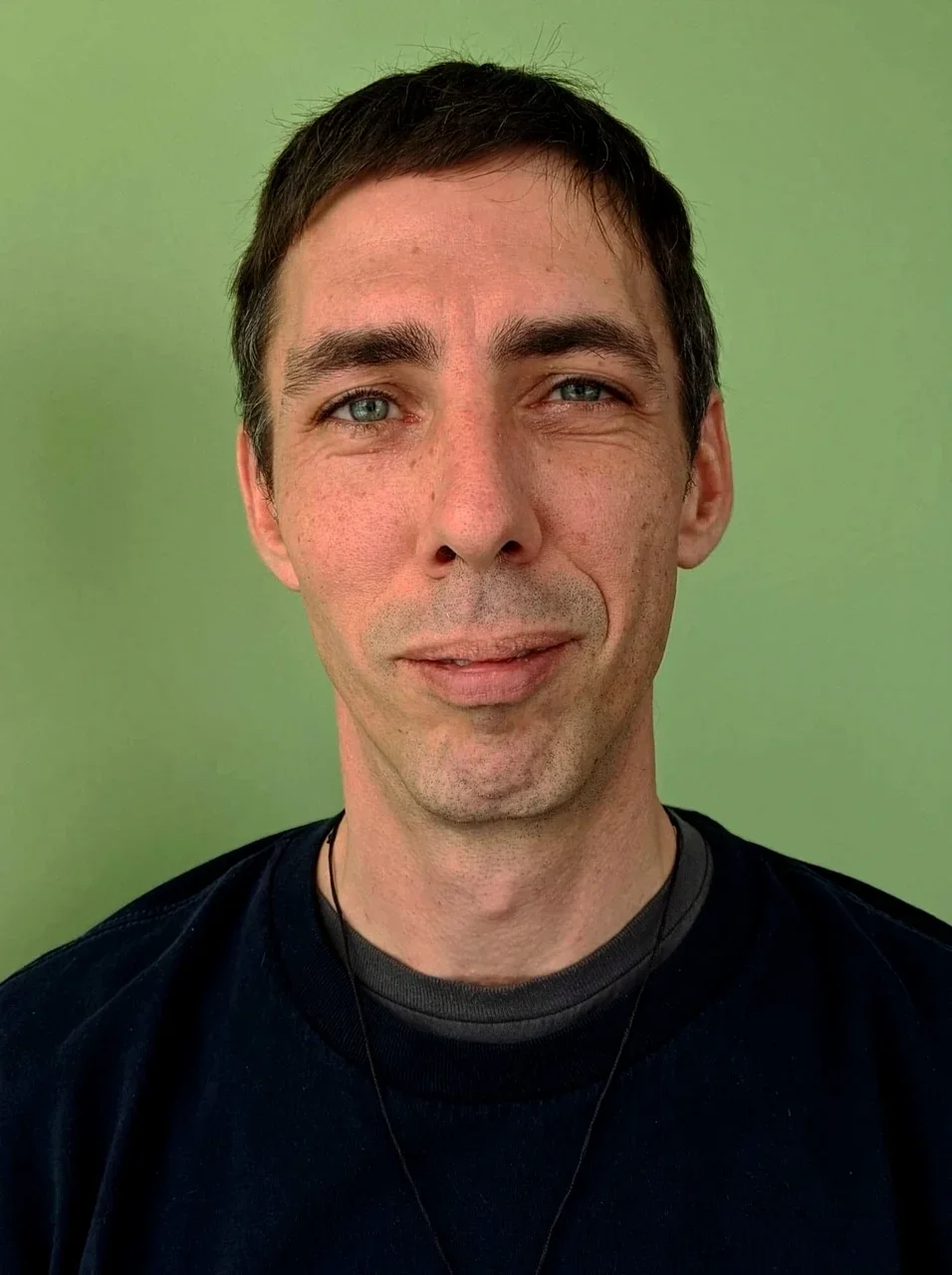
Christian Saint-Pierre, acupuncturist and Balance Method ambassador
Ten years looking for true acupuncture
It didn't start with Dr. Tan. It started in school, with a chapter in George Soulié de Morant's L'Acupuncture chinoise that ranks acupuncture from the primitive kind (it hurts here, so you needle here) up to what he called true acupuncture: the left treats the right, the top treats the bottom, yin treats yang.
That top rung matched the Daoist cosmology Christian already knew, and he would later go on to study pre-Maoist acupuncture, chrono-acupuncture and Daoist medicine as well. “This makes sense in terms of balance,” he remembers thinking. “All right. How do I do that?” Soulié de Morant never said.
The answer was that little copy of Acupuncture 1, 2, 3, passed around student clinic until Julie brought it home. “Once I realized what I had in my hands, I was shaking.” By the time Julie came back, he was bouncing off the walls. “I've been looking for this for almost a decade.”
For his birthday, Julie gave him a Dr. Tan workshop in Toronto, and he would only go if she came along. There he watched Dr. Tan treat, and one of the people he treated was Julie, who had a chronic, stabbing intercostal pain just under the breast. Dr. Tan followed the basic one, two, three and used a single needle. “The look of shock on her face when the pain disappeared sealed the deal for me.”
The potluck that changed his clinic
Back then, Christian and Julie practised TCM-style point prescription. Every two weeks they hosted what they called an acupuncture potluck: friends, family, good food, and small treatments in exchange for donations. And the feedback never changed. How's your shoulder? Still hurts, but I feel so relaxed. Your headache? Better. Still there, but better.
After Toronto, they ran the next potluck as a test and told nobody. Patients can't tell TCM from Japanese acupuncture from what Christian cheerfully calls “voodoo” anyway. And the Balance Method, he points out, is absolutely Chinese medicine. They simply used it.
“I kid you not, case by case, every single time the response was the same.” My shoulder feels amazing. My stomach pain is completely gone. What did you do? Christian and Julie looked at each other and knew: this is what we're doing now.
What was Dr. Tan really simplifying?
Laurence asked what Dr. Tan was protecting his students from when he kept making things simpler. Christian pushed back on the premise. In his view, Dr. Tan took nothing away. What he protected people from was disorganised information. He looked at the relationships between ideas and between layers of theory, and built a model you could learn quickly and use after a single workshop. “He was trying to make the explanation or the curriculum simpler,” Christian says, “but he was definitely not trying to make the medicine simpler.”
So the method grew the way a model grows. You start at first principles, add a little, simplify it, and add again. Dr. Tan often said the Balance Method was incomplete. He wanted to bring BaZi into the treatments, and he kept reading the classics for pieces that might fit. If something stayed out, it was because he hadn't yet found where that puzzle piece belonged. “We still have some work to do,” Laurence said. “Oh, yes, we do.”
When the textbook patient never shows up
Every patient starts the same way for Christian: one, two, three. Which meridian is disordered, which part of it, at what tissue depth. Then which meridians balance it, and which mirrors or images will work best. For musculoskeletal problems, and for conditions in the collaterals like a runny nose or a toothache, that's the whole approach.
But the case he chose shows why a modern patient is rarely a textbook patient. A woman in her sixties, after surgery, radiation and chemotherapy for breast cancer, with peripheral neuropathy in her feet. With TCM, they weren't really getting anywhere. With the Balance Method, he worked in steps. Scalp points on the foot image behind the ears, and when she walked again it wasn't burning anymore, though it still felt like walking on cardboard. Then points in the ball of the hand, imaging the ball of the foot. He started with one hand, and sure enough, it was the opposite foot that changed. “Wow, I feel so much more in that foot now.” Then the other hand, and she felt more again. It's one patient's story from Christian's clinic, and he walks through it step by step in the conversation above.
The point he stresses most is the loop: treat, test, treat, test, until the patient has at least 50% improvement before you let them rest. Problems involving deficiency are notoriously slow to respond, even with the Balance Method. That's exactly why you persevere.
Pop Balance Method is only level one
What most people hear about is what Christian calls pop Balance Method: the distal approach to pain. It's absolutely part of the method. “But it's kindergarten, it's level one. It's where we all start every time with every patient.”
Within the original body of knowledge Dr. Tan shared, there are also methods for zang fu disorders, five element imbalances and seasonal conditions. When a patient doesn't respond, Christian runs a mental flow chart. If it isn't local, perhaps it's zang fu, and then he reaches for the meridian conversion approach. If it isn't that either, it may be seasonal, and after that five element. With experience the layers blend, so a shoulder that comes with insomnia and constipation (obviously a messy case, in his words) can be addressed as one person, in one treatment.
How do you actually learn the Balance Method?
Some practitioners will think it's easy for Christian to say all this, having learned from Dr. Tan himself. His answer is practical, and it starts before you touch a needle: read Acupuncture 1, 2, 3 if you can still find it, and at any Balance Method workshop, take your own notes. Dr. Tan handed out almost nothing — a diagram of mirroring and imaging, a table of points on the lines of the hexagrams, the balance matrix — because he believed you understand what you write down yourself. Christian pointed to Laurence as the example: her own notes, in her own structure, became the Balance Method Notebook.
1. Rewrite your cheat sheet every day
After his first workshop, Christian wrote out the Balance Method matrix every day in clinic: which hexagrams belong to which meridians, which points sit on which lines. Day one was copying. Day two, half from memory. By the end of the week he no longer needed his notes. Next to it, the basic strategy: find the sick meridian, find the balancing meridian, find the point. “You're not rewriting your whole notebook. You're just writing a cheat sheet and you rewrite it every day.” If the matrix is new to you, our free Balance Method matrix PDF makes a good first sheet.
Laurence admitted she has rewritten her own notes something like a thousand times, and still finds her old versions too thin. “You add all the time,” Christian said.
2. Practise the method, not a mix
No cupping, then tuina, then a local point, then a bit of Balance Method. Put the rest away for now and learn when it works, when it doesn't, and why. Setting things aside doesn't mean abandoning them. Dr. Tan never wanted anyone to abandon TCM. But the order matters. “If you're learning TCM or if you're learning the Balance Method and thinking of it as an addition to your therapeutic style, you're not going to get results.” Used as the foundation, it becomes the logic behind every choice, from dampness and wind to excess and deficiency. “But do you know when and do you know why?” Then you can reach back into your TCM archive, because now you know how to add it.
3. Right meridian, right depth, obtain Qi
Choose an appropriate balancing meridian, then needle to the depth of the problem: skin for skin, muscle for muscle, tendon for tendon, bone for bone. A tendon you touch rather than pierce; a bone problem means reaching the bone, which he promises is not as scary as it sounds. Then obtain Qi, and never leave the needle unstimulated. Do that, and “you'll be pleasantly surprised.” Magic, Laurence suggested. “Well, almost.”
Mirroring and imaging get better as you go. Christian is a fan of the larger images, what Dr. Tan called the puppet show, which he finds more precise. The smaller ones he keeps as little extras, ornaments, as he puts it. As Laurence put it, the large images do the heavy work.
His message to you
We asked what he'd be doing today if that book had never reached him. Probably still muddling through, he said, trying to work out true acupuncture on his own. He was already experimenting with the internal-external meridian pairs, which the Balance Method labels System 3, but in his words it was “super rudimentary.” Or he might have left Chinese medicine altogether.
His story about the French book gave Laurence goosebumps. Maybe, she suggested, he would have worked it out himself and brought the method out on his own. Christian stayed modest: “I would never claim that I would have succeeded.” Looking back, what he feels is how lucky and how grateful he is that he read that book when he did.
He got to follow Dr. Tan around “like some sort of strange groupie,” and what stayed with him was the plain humility behind the charisma. Dr. Tan was systematising Chinese medicine so that everyone could understand it, because he wanted people to be better acupuncturists. Bring Dr. Tan an idea, explain how it fits, and he'd tell you to go and test it, then come back and tell him what you found.
In Acupuncture 1, 2, 3, as Christian recalls it, Dr. Tan wrote that he was offering a brick in the hope that we would return with a piece of jade.
“The brick is the foundation. That's where you have to start.”
— Christian Saint-Pierre
Start with the system and the principles. Internalise them — it isn't that hard. Set your other knowledge and your preconceived notions aside, just for a moment. “And once you understand, then when you start adding your previous knowledge or your other knowledge back in, you will see how it makes that brick shine.”
Frequently Asked Questions
Who is Christian Saint-Pierre?
Christian Saint-Pierre is a Canadian registered acupuncturist and an official Balance Method ambassador. He studied with Dr. Tan for nearly five years from 2010, holds the highest level of Balance Method certification, and is a certified BaZi consultant and YiJing practitioner. He is director of continuing education for the Acupuncture & Traditional Chinese Medicine Association of Nova Scotia (ACTCMANS), teaches at the Autumn Institute of Health, and practises at Access Acupuncture in Dartmouth, Nova Scotia. You can find his clinic at accessacupuncture.ca.
Does the Balance Method replace TCM?
Not in Christian's view. The Balance Method is Chinese medicine, and Dr. Tan never wanted anyone to abandon TCM. Christian's advice is to learn the Balance Method first, as the foundation, and then bring your TCM knowledge back in. By then you understand when and why to use it. Our introduction explains how the Balance Method differs from TCM acupuncture.
How did Christian learn the Balance Method matrix?
He used repetition. Every day he wrote out by hand which hexagrams belong to which meridians and which points sit on which lines, together with the basic one, two, three strategy, until he could write the whole sheet without checking his notes. It took him about a week. If you want to try it, start from our printable matrix (PDF).
What comes after the basic Balance Method?
The distal approach to pain is what Christian calls level one. Dr. Tan's original work also includes methods for zang fu disorders, known as the meridian conversion approach, and for five element imbalances and seasonal conditions. When a patient doesn't respond to local balancing, Christian moves through these layers with a mental flow chart, and with experience combines them within a single treatment.
Go deeper with Christian
Christian has worked with this method for more than fifteen years, and he still teaches it to practitioners in Nova Scotia. If this conversation gave you something to work with, that's where to find him and his clinic → accessacupuncture.ca
