
Adi Fromm on Dr. Tan's Balance Method: Becoming Your Own Master
Some practitioners inherit a method. A few help decide how it gets handed on at all. Adi Fromm belongs firmly in the second group. He learned the Balance Method directly from Dr. Tan, hosted him in Israel many times, and in 2013 the two of them founded the Israeli Tan Center together. He holds Dr. Tan's Gold Certificate — and, as it turns out, he's the reason the Gold Certificate exists. What followed was a four-year college programme with a thousand students, years of work inside hospitals, and twenty-two years with this method across fifteen or sixteen countries. We're proud to introduce him as our second official Balance Method ambassador, and the conversation Laurence had with him went places we hadn't planned for.
Who is Adi Fromm?
Adi Fromm is an acupuncturist, teacher, and author based in Israel. He started learning the Balance Method because of a clinical problem he ran into himself, and from the very beginning it was clear to everyone around him that he'd end up teaching it. Over more than two decades, he has built a body of work around a single method:
- →Official consul to an oncology hospital in Hainan, China, combining Chinese and Western medicine.
- →Co-founder of the Israeli Tan Center in 2013, established together with Dr. Tan himself, and holder of Dr. Tan's Gold Certificate.
- →Dean of the School of Chinese Medicine at Reidman College — a four-year programme with roughly 1,000 students and over 4,200 hours.
- →Twenty-two years of Balance Method practice and teaching across fifteen to sixteen countries, alongside hospital work from orthopaedics to oncology.
You can find his work and his teaching schedule at Healthy Seminars.
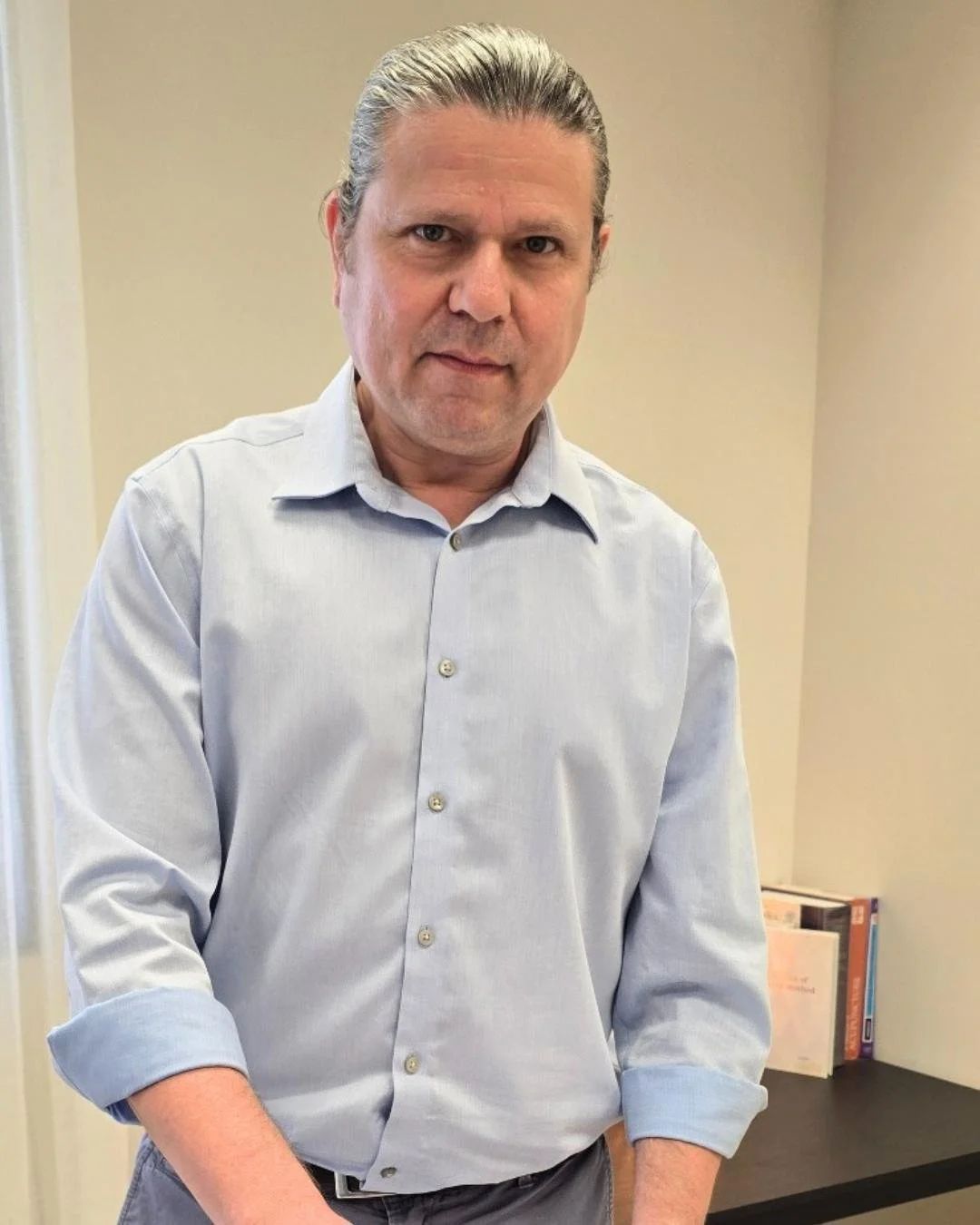
Adi Fromm, the second official Balance Method ambassador.
The evening that made the Gold Certificate
Around 2011, Dr. Tan was staying with Adi in Tel Aviv and started talking about his legacy. Adi was chairman of the Israeli association at the time, and he didn't give his teacher the comfortable answer.
“You can't really prevent people from teaching your method,” he told him. And beyond the legal problem, he didn't think it would be good if you could. “If you want things to grow, you can't over-control them. It's like creating a bonsai tree. It won't give you fruits.” People learn from you, they teach it, they use it — that's the point. The one thing you genuinely don't want is for them to misrepresent it.
So he offered a fix, borrowed openly from how other lineages handle it: name your official teachers. Everyone else can still teach, and people will simply know they're not official. That's it. That suggestion became the silver and gold member system, with gold as the official teacher of the method and silver as the step toward it. “That was the original idea,” Adi says — and most practitioners today have no idea. Dr. Tan didn't live long enough to establish it.
He's honest about what happens when you go the other way. Over-control it and people don't stop; they rename it. “Instead of Balance Method, I will call it the harmony method. And then what? What can they say — that in the harmony method, Stomach doesn't balance Spleen?” The system survives. The name doesn't. And with the name goes the man — which is the one outcome Adi still finds genuinely sad, because Dr. Tan deserved better than to be quietly edited out of his own work.
Which is what makes the story worth telling. A teacher at the height of his reputation asked the question out loud, and then took his own student's answer seriously enough to act on it. The gold and silver certificates exist because he listened.
The man behind the method
We asked what surprised him about Dr. Tan, and he didn't reach for a technique. “There was no gap between the generosity of his teaching and the generosity of him as a person,” he said. Generous with his knowledge. Generous with his jokes. Generous with his energy. Generous with his money. Adi reaches for the Confucian word for it — ren, which he translates as benevolence — and says Dr. Tan was visibly striving for exactly that.
At seminars they'd tell people they were welcome to join the two of them at the break, but please, no Chinese medicine — he needs to rest. It took about three minutes. He loved the profession that much.
And he never looked down on anyone, which Adi points out is not the norm. He's studied with many masters, Chinese and Western, and says most of them leave you with the sense that you'll never reach their level, that something is being held back for later. Dr. Tan looked at you person to person, eye to eye, heart to heart, and told you that in four years you'd be where he is. “His outside was his inside.”
Minutes before this interview started, a colleague in Nigeria texted Adi to thank him for a protocol that had helped a patient with a sinus infection. “You shouldn't thank me, you should thank Dr. Tan, because this is him resonating through me to Nigeria.” And then, because Adi is Adi: “If it was mine, I would take credit for it. I'm not a modest person.”
He puts the whole thing through a line from the Tao Te Ching that he loves — that to die without being lost is to go on living. You do something on this planet that keeps resonating after you're gone. Plant a tree. Grow vegetables. Have kids. Practice Chinese medicine. Dr. Tan passed away, Adi says, but he isn't lost. And he was a happy man: he loved life, loved eating, loved a party.
Three ways of learning
Every student asks the same question. The Spleen can be balanced by the Lung. It can also be balanced by the Stomach. How do I choose?
From the stage, Dr. Tan's answer was the simple one — keep it simple, anatomical structure, similarity — which, being Dr. Tan, he'd deliver as the line that you always have to KISS ASS. In private, he told Adi the fuller truth: you can tell from the pulse, from the abdomen, by palpating. But say that from the stage and you've handed people back a complicated method. They watch you palpate and think, he's a great practitioner, he's a great teacher, but I can't do that.
The entire point was that you can. In Dr. Tan's own words, quoted back to us: “I'm giving you principles to become your own master.” And if you get it wrong, basically nothing happens. “There's no Balance Method police going to come knocking at your door.” It didn't work, you use the Lung, it works, and next treatment you start with the Lung. That's it.
What separates people, he says, is following up your own work. Dr. Tan was a Confucianist by nature, and Adi frames the whole thing the way Confucius did. There are three ways of learning.
1. Copying — the easiest way
He taught it, you take it into your clinic tomorrow. Everyone starts here, and there's nothing wrong with it.
2. Experience — the bitterest way
“You learn from your success. You learn from your failures. This is how you become good.” Nobody sells you a seminar on this part, and it's where most of the growth actually happens.
3. Insight — the noblest way
You bring something into the world that wasn't here before. But be honest about the clock: “If you do three treatments and you have an insight, that's not an insight. That's an intuition.”
His own example is phantom limb pain, which he sat with in clinic for years before anything arrived — and when it did, it turned into an idea that's now the subject of ongoing research. He walks through the whole thing on camera. The point he wants you to take is the timeline, not the technique: insights are earned slowly, and that's good news, because it means they're available to anyone willing to stay curious for long enough.
The next layer: what to study when you're already good
We asked where the next layer sits for practitioners who are already good, and he didn't hesitate. “Our main problem is diagnosis. That's the challenge we have to overcome.”
Orthopaedics is easy, because it's where everyone's basic training lives and you get to ask where it hurts. For diarrhoea you'd never ask where it is. That jump — out of orthopaedics, into internal medicine — is the wall.
The second half of his answer is the ambitious one. “You must always study more. It's not that a two-day seminar or a four-day seminar is the whole study.” Two days of 1-2-3, two days of Global Balance, two days of conversion, then a year of silence. One of the programmes he built with Dr. Tan at the Israeli Tan Center ran as a year-long internship, every week, precisely because people get much better when the next piece arrives while the last one is still warm.
And the studying he means isn't more Balance Method. “You also need to understand Chinese medicine much better. You also need to understand the meridian system much better.” The primary channels are only one layer of it, and he has a concrete clinical example — one specific joint where two channel systems overlap, and where knowing which one you're actually treating is the difference between a treatment that lands and one that doesn't. He walks through it properly in the conversation above, and it's the part we'd watch twice.
He brought that insight to Dr. Tan directly, and says he was really happy with it. It opened into one of those behind-the-scenes conversations where the two of them laid the whole network out together — every channel system side by side. Every technique in Chinese medicine takes years, he points out; in China you study Gua Sha for years, not for one afternoon. The short version is Dr. Tan's answer: the primary channels are the everyday function, and if they run properly they look after the rest. “He would take super complicated ideas and say, I'm going to make it simplified. It's not going to be perfect, but at least you will be able to help 80% of the people.”
Why the hard cases are the bigger win
Adi has spent years in hospital wards, so the stories come easily. A young man after a car accident with pressure on C6, moving his shoulders but dropping everything he held. Inflammatory or mechanical? Nobody knew, and surgery might make it worse. The doctor who called Adi in cheerfully announced to the head of the department that he was about to help. Wonderful, he thought — we're getting thrown out of here. So he kept it simple: C6 is around here, he found a very sensitive Ashi point, put in three needles, and asked the man whether he could feel them. The man raised his hand to answer. The doctors said wow. Adi says he was every bit as surprised as they were, then came to his senses and gave them something useful: this is inflammation, not mechanical pressure, the steroids will work.
And then he says the thing we keep coming back to — the one that takes the pressure off every practitioner reading this.
“Don't indulge yourself on the miracle.”
— Adi Fromm
“Everybody loves talking about the miracles. We should also talk about the hard cases that people needed twenty, thirty treatments to get better. This is actually much more common.” Twenty-eight years of post-herpetic pain that took him around forty treatments before the patient felt much better. “I think this is an even bigger accomplishment than the miracles.”
The number he wants in your head: a chronic condition needs roughly ten weeks, twice or three times a week. That's what you'll normally see, and there's nothing wrong with your hands if that's what you're seeing. A frozen shoulder still has to heal, so the pain comes back and you treat again. Arthritis of the knee involves real physical damage. A scratch on your skin takes a week or two to close, he says, more at his age. Why would a joint be faster? And it isn't a Balance Method thing — TCM, Yamamoto, Japanese styles, Master Tung, all of them quietly run twenty or thirty treatments.
It's why he states exactly how many treatments it took every time he writes a case up. “When you read case studies online, you always imagine they just did it one treatment or two treatment. And it's never one treatment or two treatment.” Which leaves him somewhere generous: “It's okay to fail. You become better if you fail. Actually, the best cases are the ones you fail at in the beginning and then you change something. These are the ones you learn the most from.”
His message to you
We closed by asking Adi what he'd say to himself twenty-five years ago, just starting out. “Don't hold back on your dreams.” This profession took him around the world, and at the start he couldn't have imagined anything close to it. But he means it forward, not backward: “Just like I'm standing on Dr. Tan's shoulder, you need to stand on my shoulder. You need to be better.”
Before that, two things he wanted every practitioner to hear. Keep palpating — the abdomen, the pulse, the channels — even when you don't understand what you're feeling yet. Dr. Tan once told him there's no wiry pulse, only the master's wiry pulse; go to a different master and that same pulse isn't wiry at all. So feel it and name it. Call it wiry, call it Johanna. It's your Johanna, and once it reliably tells you what to do, it's yours and nobody can take it from you. And: “Always think about the patient as one of your teachers. You help him to feel better. He helps you to become a better practitioner.”
Then he laughed, because younger Adi would have ignored every word of it. Who is this weird old person, he doesn't know what I feel. His own students do exactly the same. Years later they ask him why he never told them, and he says: “I did. You just didn't hear it.”
Frequently Asked Questions
Who is Adi Fromm?
Adi Fromm is an Israeli acupuncturist, teacher, and author who learned the Balance Method directly from Dr. Tan and holds his Gold Certificate. He co-founded the Israeli Tan Center in 2013, is dean of the School of Chinese Medicine at Reidman College, and serves as official consul to an oncology hospital in Hainan, China. He's our second official Balance Method ambassador, and he has taught the method in fifteen to sixteen countries.
What is the Balance Method?
The Balance Method is a meridian-based system of acupuncture developed by Dr. Tan. Rather than treating isolated points, it works with the meridian network and balanced structures to address pain and functional complaints, often with change felt in the same session. If you're new to it, our introduction to the Balance Method covers the essentials.
How many Balance Method treatments does a chronic condition need?
In Adi's clinical experience, around ten weeks at two to three sessions a week — not one or two visits. He's explicit that the fast results shown in demonstrations aren't the benchmark, and that this is true of every acupuncture style, not just the Balance Method. It's why he insists on stating the real number of treatments whenever he presents a case.
What is Dr. Tan's Gold Certificate?
The Gold Certificate marks an official teacher of the Balance Method, with the Silver Certificate as the step toward it. According to Adi, the idea came out of a conversation he had with Dr. Tan in Tel Aviv around 2011: rather than trying to stop people teaching the method, name the teachers you trust, and everyone else is simply known not to be official. Dr. Tan didn't live long enough to fully establish it.
Go deeper with Adi
Adi has spent more than two decades practicing and teaching this method, in fifteen or sixteen countries so far. If this conversation gave you something to work with, his seminars take it much further → healthyseminars.com/bio/adi-fromm
