
What do you do when the joint pain moves faster than you can map it? This case is about covering the whole territory instead of chasing the latest joint: read the shape of the complaint, reach all twelve meridians with Dr. Tan's 12 Magical Points, and put a joint point in every group.
A 50-year-old man comes to our clinic with rheumatoid arthritis pain in both hands, both feet and both knees. The diagnosis is only a few months old, but the pain had been considerable for a while before he came to us. No swelling, no redness, and no medication yet: his rheumatologist preferred to wait. The pain does not stay put. It moves from joint to joint. Let's map it.
When a patient arrives with a diagnosis like this, you are tempted to treat the diagnosis. Don't. Rheumatoid arthritis is the name of the condition. It does not tell you which meridians to needle. The map does, and here the map ran from the knuckles of both hands to both knees.
Patient Profile
| Patient | 50-year-old man |
| Diagnosis | Rheumatoid arthritis, early in the course of the condition |
| Complaint | Joint pain in the knuckles of both hands, the toe joints and ankles of both feet, and both knees, with pain running from the ankles up into the legs |
| Pattern | The pain moves from joint to joint |
| Meridians involved | All twelve, on both sides |
| Approach | Global Balance — Dr. Tan's Strategy of Twelve Magical Points, with joint points in every group |
| Before treatment | Considerable pain for months; no swelling or redness; no medication yet, as his rheumatologist preferred to wait |
| Sessions | Twice a week for four weeks, then weekly, then every two weeks, with the gaps growing from there |
Why Rheumatoid Arthritis Pain Is a 12 Magical Points Case
Here's the temptation: treat the joint that hurts today. Map it, balance it, mirror it, and deal with the next joint when it shows up. It won't keep up. A pain that moves from joint to joint is always one step ahead of a treatment aimed at one joint.
A few painful joints would be a different case. Mirror joint to joint, the way our knee pain guide does it, and you are done. This one had a different shape: many joints, both sides, and no centre. Run Step 1 on that picture and the answer is not one meridian or two. It is all twelve.
One complaint, one meridian, one treating meridian. That wasn't this. When every meridian is involved along its whole length, the question in Step 2 is no longer which system balances which meridian. It is which strategy reaches all twelve at once. That is what Dr. Tan's Strategy of Twelve Magical Points was built for.
Our guide to the strategy explains the structure and deliberately leaves the point lists out. This case does the opposite: one patient, one build, and every group with its projection on the table.
The Treatment
Step 1: Map the pain
On both sides, every time. The knuckles of both hands. The toe joints and the ankles of both feet, with pain running from the ankles up into the legs. And both knees.
The map itself was not the difficulty. The difficulty was that it did not hold still. The pain moved from joint to joint, so the diagnosis could not be a list of the joints that hurt on the day. It had to be the whole territory the pain moves through: hands, feet and knees, left and right.
Step 2: Pick the strategy
Global Balance, with Dr. Tan's Strategy of Twelve Magical Points, usually shortened to the 12 Magical Points. The strategy places ordinary points in four groups, from the fingertips and toes up to the elbows and knees, so that all twelve meridians are balanced along their whole pathway in one treatment.
For arthritis that runs from the smallest joints to the biggest, Dr. Tan's approach was to choose joint points in every group. That is the logic we followed. The borders between the groups are soft and can shift, so each group could sit on the joint that served this patient best.
One note if you have read our guide. It describes shifting the groups up the limb when both hands and both feet hurt. That is one option, not a rule. Here the groups stayed on the hand and the lower leg.
Step 3: Needle
These are the points we used for this patient. They are not a recipe to copy. What carries over to your own patients is the structure: four groups, a joint in each, and every point read through a projection.
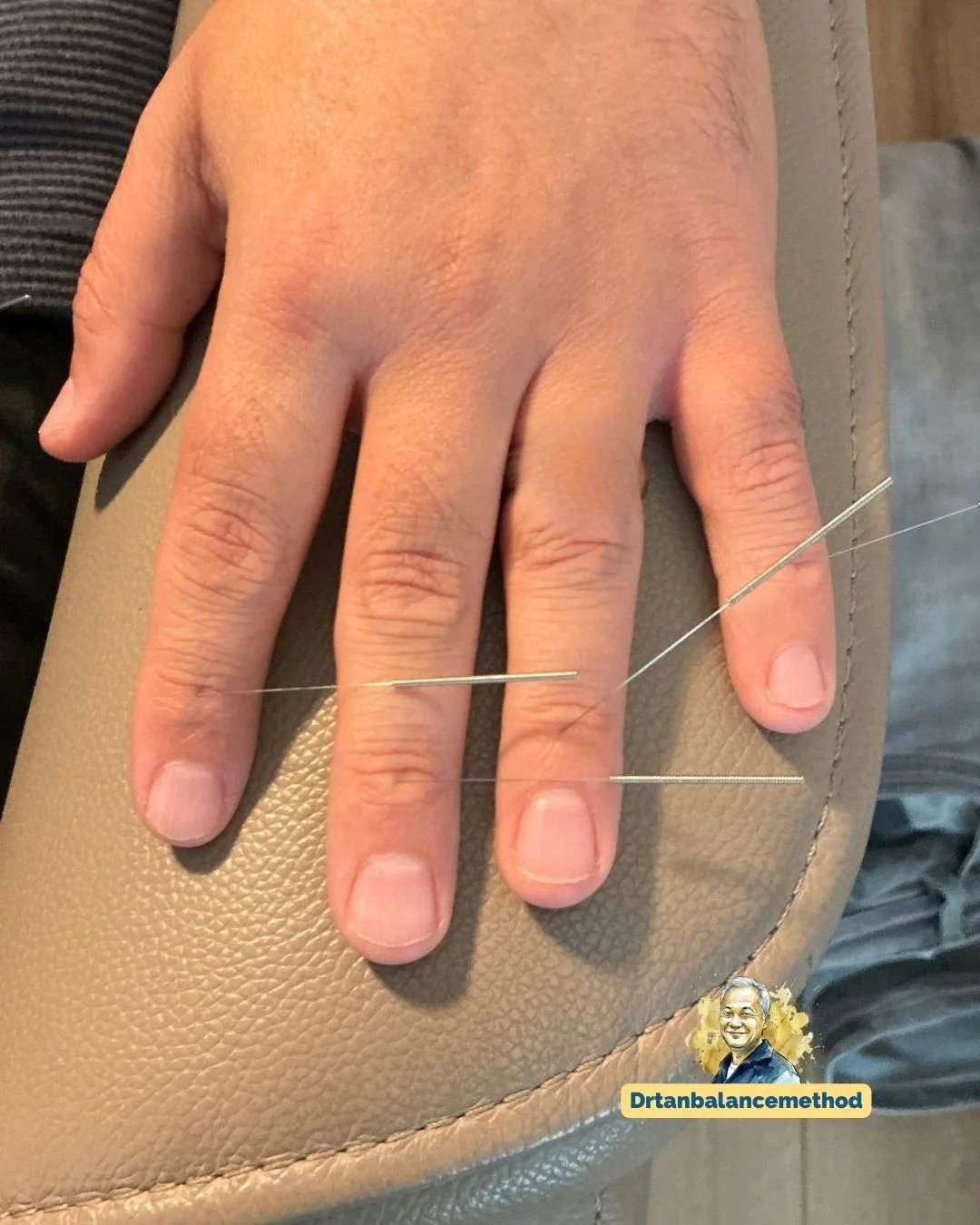
Group 1 went onto the fingers: a needle on the first phalangeal joint of all five fingers, the joint just above the nail. One location gave three readings. By reverse phalangeal image it answered the knuckles. By direct foot-on-hand phalangeal mirror it answered the toe joints. And by direct leg-finger mirror it answered the ankle: in that mirror the finger stands for the whole leg, with the knuckle as the hip, the middle joint as the knee and the first phalangeal joint as the ankle.
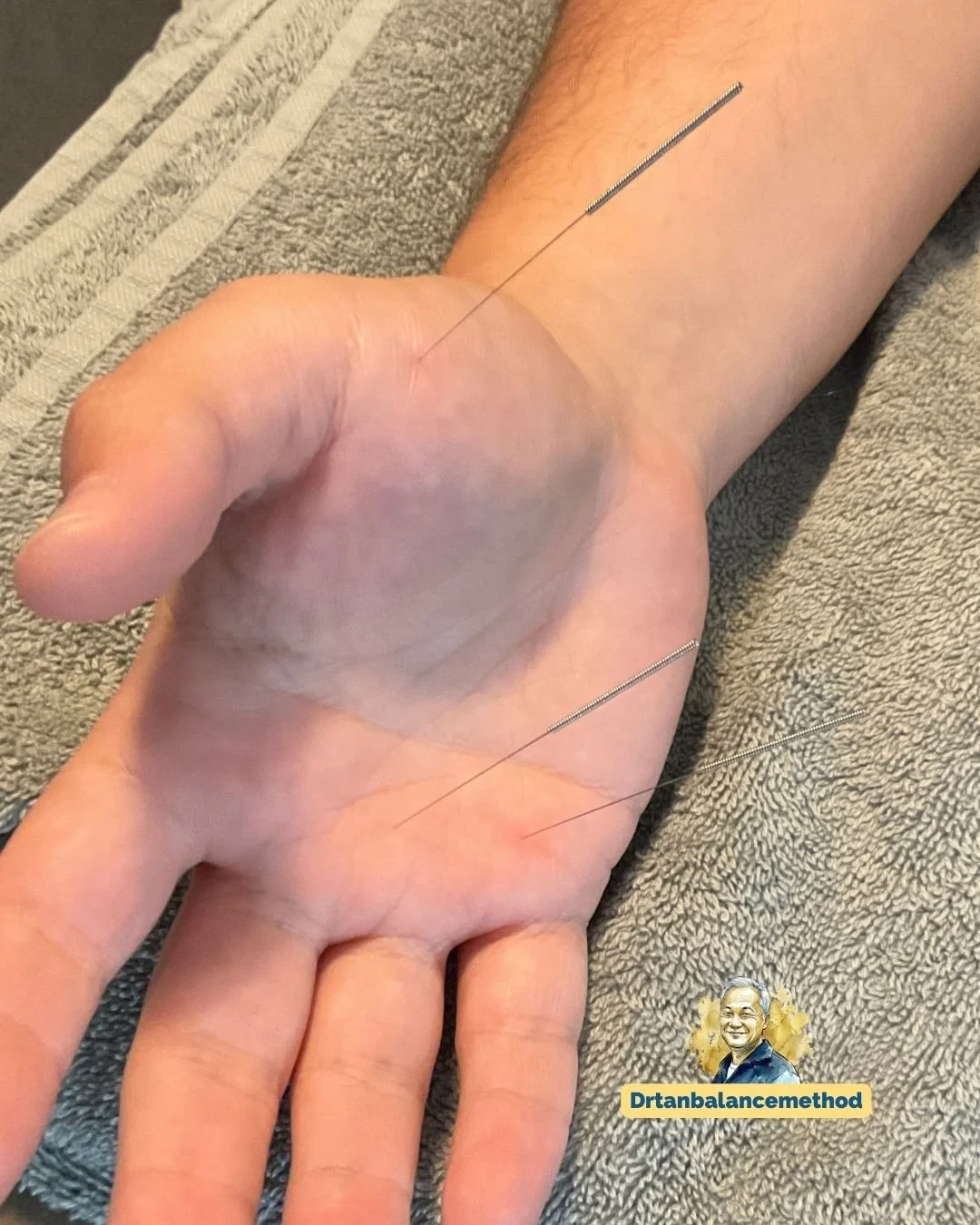
Group 2 went into the palm, just above the knuckles: HT 8, PC 8 and LU 10.2. In the direct mirror the hand stands for the foot, so this stretch of palm answered the joints of the feet. It took the knees along as well.
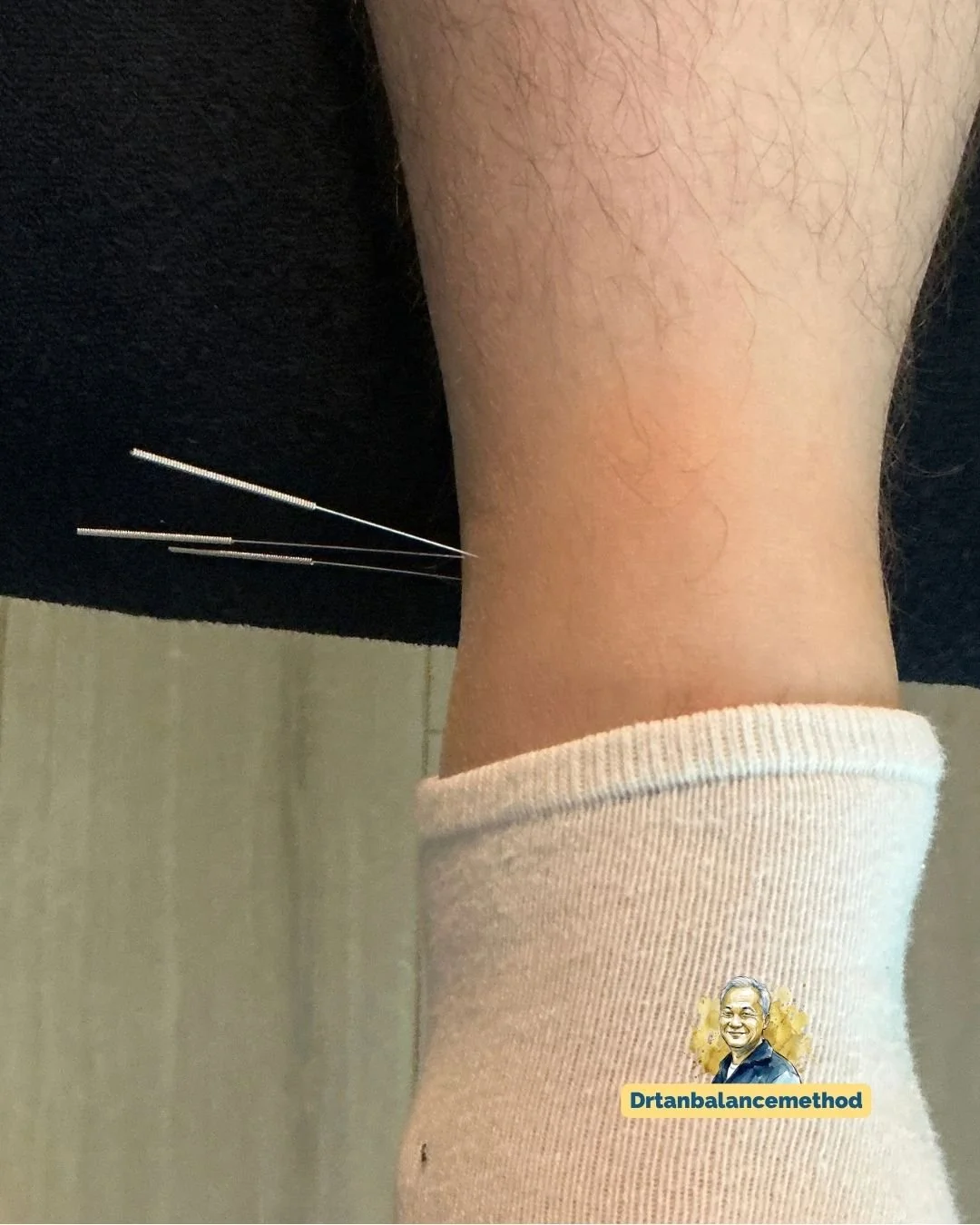
Group 3 sat just above the ankle: GB 39.5, UB 59.5 and ST 40.8, direct mirror, for the pain running from the ankles up into the legs.
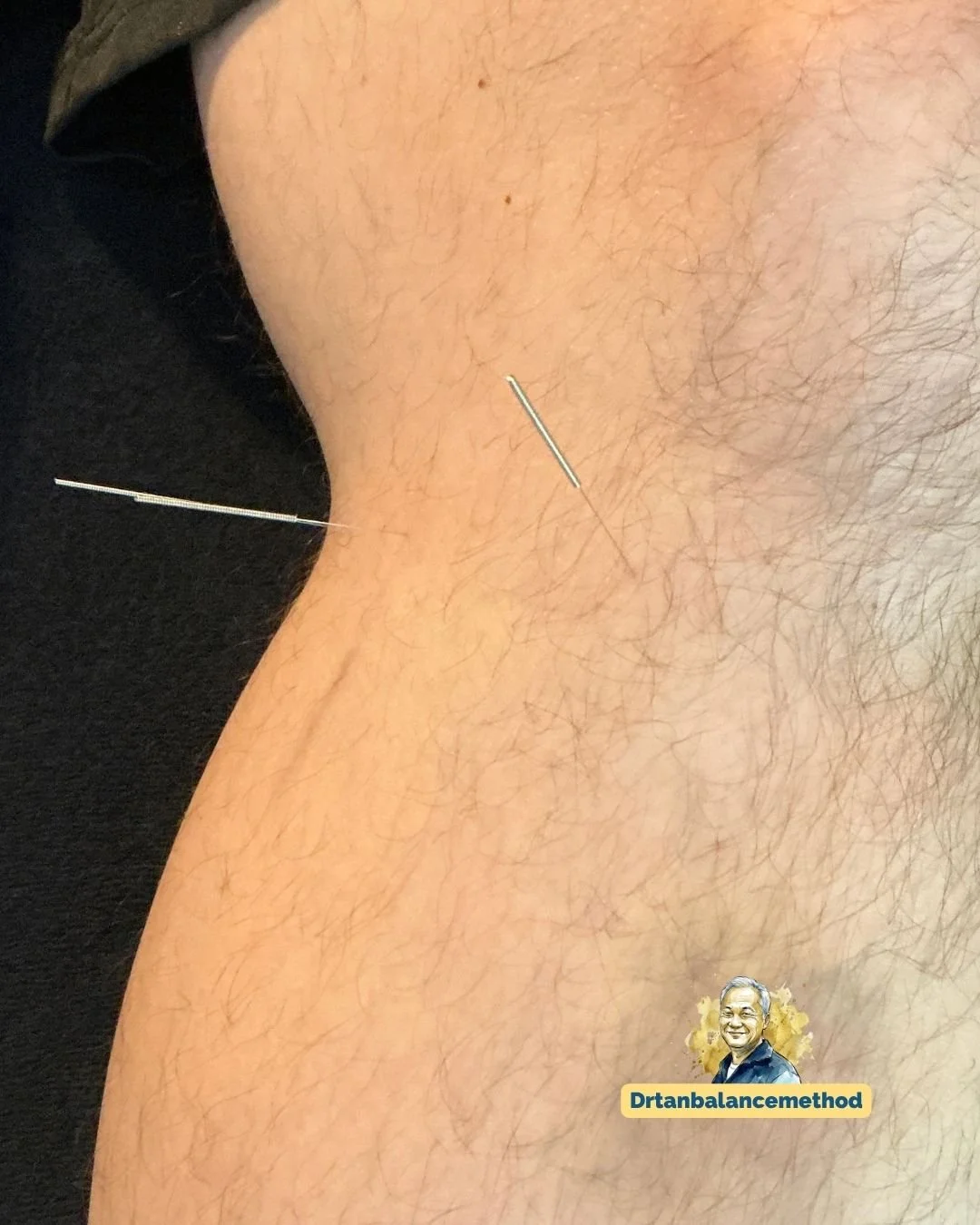
Group 4 was the knee: Kid 9.8, SP 9 and Dr. Tan's LIV 8, direct mirror, knee for knee.
Then the part that matters most for a pain that moves. Every session, Group 1 changed hands. That switches the pattern to its left-right version, so both sides were treated in turn and everything was covered from one session to the next. For the logic behind each projection, see Mirroring and Imaging in the Balance Method.

Outcome
We started at twice a week for four weeks. After four sessions the picture was stable. No more spikes. Less pain and less stiffness.
From there we spaced the treatments out: once a week for two weeks, then every two weeks for two sessions, and since then with more time between each visit. He is early in the course of an autoimmune condition, so stability is the outcome to look for, not a promise that the joints are clear for good. How far apart the sessions go is something we decide together with him, one step at a time.
The Insight: Four Groups, Every Joint
Joint points in every group look like local needling. They aren't, and this case shows why in practice. Three of the four groups reached well past the joint they sat on.
The finger joints just above the nails reached the knuckles, the toe joints and the ankle. The palm reached the feet and took the knees along. The points above the ankle reached the pain running up the legs. The knee answered the knee. Hands, feet, ankles and knees, on both sides, carried by four groups.
That is what the projections add to the structure. Without them, every joint the pain could move to would need a group of its own. With them, every joint the pain could move to was already under treatment, and switching the pattern from session to session kept it that way.
What to Watch For With Moving Joint Pain
1. Treating the label instead of the map
Acupuncture for rheumatoid arthritis does not start from the diagnosis. The label tells you nothing about which meridians to needle. Ask the patient to show you each joint, map it, and do your own Step 1. The sick meridian diagnosis decides the treatment, not the name on the referral.
2. Mapping only the joints that hurt today
When the pain moves, a single day's map is incomplete. The territory is every joint the pain travels through. Build the treatment on that, or the next session starts by chasing a joint that has already gone quiet.
3. Judging the result by one joint on one day
A moving pain will not tell you much on a single visit. Look at the pattern over the sessions instead: are the spikes gone, is the pain lower overall, is the stiffness easing? That is how this case was read, and it is the honest measure in a condition early in its course. For the cases where another strategy fits better, see our guide to the 12 Magical Points.
Apply This in Your Practice
Read the shape before the diagnosis. Many joints, both sides, pain that moves: that shape points to a whole-body strategy whatever the referral says. One clear joint points somewhere else.
Give every group a joint. In an arthritis pattern, choose joint points in each of the four groups and let the projections carry them. The groups can shift, so pick the joint that serves the patient.
Ask each point for more than one joint. Before you place a needle, check what else it can reach. Here one needle on each fingertip joint stood for the knuckles, the toe joints and the ankle.
Change hands every session. Moving Group 1 to the other hand switches the pattern to its left-right version. For a pain that moves, that is how both sides stay covered.
Start dense, then space out. Twice a week until the picture holds, then weekly, then every two weeks, and wider from there. In a condition early in its course, a stable result is a result. Let the gaps grow with the patient, not on a fixed calendar.
Quick Reference: This Case
- 50-year-old man · rheumatoid arthritis, early in the course · joint pain that moves
- Both sides · knuckles of both hands · toe joints and ankles, with pain running up the legs · both knees
- Global Balance · Dr. Tan's Strategy of Twelve Magical Points · joint points in every group
- Group 1 · first phalangeal joint of all five fingers, just above the nail → knuckles (reverse phalangeal image), toe joints (direct foot-on-hand phalangeal mirror), ankle (direct leg-finger mirror)
- Group 2 · palm, just above the knuckles · HT 8, PC 8, LU 10.2 → joints of the feet, and the knees along · direct mirror
- Group 3 · GB 39.5, UB 59.5, ST 40.8 → pain running from the ankles up the legs · direct mirror
- Group 4 · Kid 9.8, SP 9, Dr. Tan's LIV 8 → knees · direct mirror
- Group 1 changed hands every session → left-right version of the pattern, both sides covered in turn
- Twice a week for 4 weeks · stable after 4 sessions: no more spikes, less pain and stiffness · then weekly for 2 weeks, every 2 weeks for 2 sessions, and wider gaps since
Note: Patient details have been adapted from comparable cases in our clinic to protect privacy. This post is for educational purposes only — for acupuncturists and interested professionals. Not treatment advice or a substitute for professional consultation.
Every System, Every Projection, Every Pattern at Your Treatment Table
Start with the free chapter and see how the reference works in the clinic.
Foundation · 600+ pages
Balance Method Notebook
The complete Local and Global Balance reference, hand-drawn for the treatment table.
Specialization · 500+ pages
Meridian Conversion Notebook
Beyond pathway treatment: calm the Shen, balance hormones, work with depression, addiction and insomnia.
Practice · 800+ pages
Balance Method Workbook
Work the 56 cases yourself before you read the answer, one map and one treatment plan at a time.
Free chapter · Straight to your inbox
Next Steps
This case applies foundational concepts from our pillar guides. To go deeper:
For the full strategy behind this case, with the four groups and the spiral: Dr. Tan's Strategy of Twelve Magical Points
For the patterns themselves, in Dr. Tan's own book: our book recommendations
For why a whole-body picture calls for a Global Balance: Global vs Local Balance
For the projections that let one point reach several joints: Mirroring and Imaging in the Balance Method
When only a few joints hurt and mirroring joint to joint is enough: Knee Pain and the Balance Method
For pain that moves within a single session, and how to chase it: our lateral leg and knee case study
For every sick meridian and its balancing options in one place: the free matrix PDF with every balancing pair
To see Balance Method points needled step by step: the needling demonstrations
For more cases like this one and free needling demos from our practice, on Facebook, Instagram and YouTube: follow our community channels
New to the terminology? See the Balance Method Glossary for every core term in one place.
