
How to Treat Navel Pain with Dr. Tan's Balance Method: A Scalp Projection Case Study
What do you do when a patient's pain circles the navel but never sits in the center? This case is about reading the border instead of chasing the middle: let the ring name the meridians, mirror them onto their imaging partners, and treat the whole thing on the scalp — nowhere near where it hurts.
A 46-year-old woman walks into our clinic with sharp, stabbing pain around her navel. No fall, no strain, nothing that explains it. She rates it a 7 out of 10. One clean ring of pain drawn around the umbilicus, never the middle. Let's map it.
That one detail does the heavy lifting. A pain that traces a border isn't asking you to needle the center — it is naming the channels that run along it. Read the edge, and the two suspects step forward on their own: the Ren Mai and the Kidney.
Patient Profile
| Age | 46 |
| Sex | Female |
| Complaint | Sharp, stabbing pain around the navel |
| Onset | Spontaneous — no trauma or trigger |
| Key detail | Pain circles the umbilicus, never central |
| Pain at intake | 7/10 |
Why This Is a Scalp Projection Case
The navel sits on a crossroads. The Ren Mai runs the midline straight through it; the Kidney meridian flanks it on either side. So when pain settles here, those are the two channels to question first — and the shape of her pain pointed straight at them.
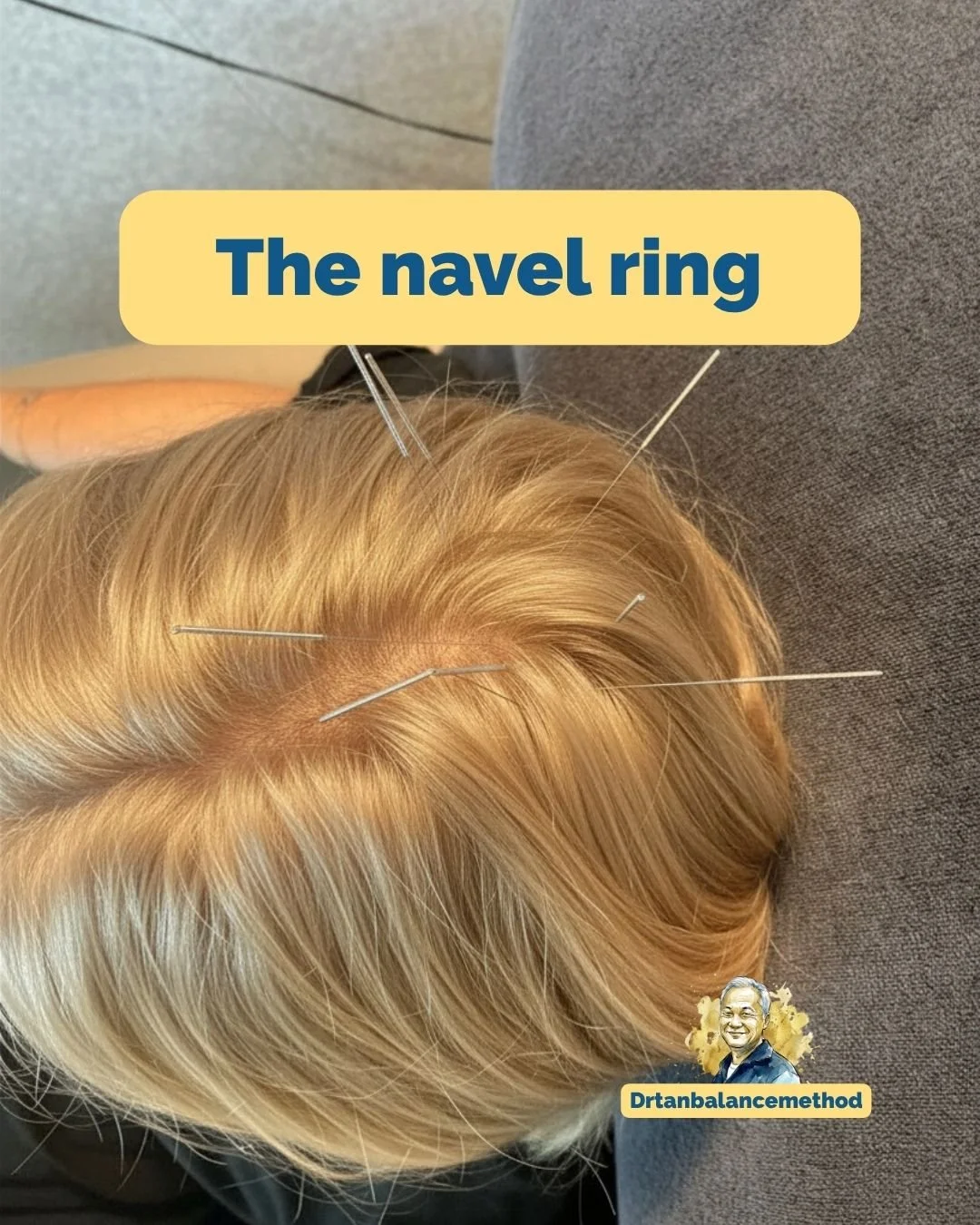
Here's the temptation: needle the navel itself. But there was nothing to chase in the middle — the pain lived on the rim, a ring with no center. A border like that implicates the channels running along it, not a single sore point. So we read the rim, then took the treatment somewhere else entirely: the scalp, where the whole abdomen projects around Du 20. Map the meridians, mirror them, treat them at a distance.
The Treatment
Step 1: Map the meridians
Start local, just to confirm the territory. Ren 7 and Ren 9 sit on the midline; Kid 15 to 17 run right alongside the navel. Two channels own this ground: the Ren Mai and the Kidney. That's your map.
Step 2: Pick the systems
Now mirror each one. The Ren Mai images to the Du Mai — that's System 1. The Kidney images to the Urinary Bladder — System 3. Two meridians in, two imaging partners out. You don't touch the abdomen at all; you treat their reflections.
Step 3: Needle
We took it to the scalp, where Du 20 maps the umbilicus itself. Around that point: Du 20.5, Du 19.5, UB 8, UB 7, and the points in between — each one located by Ashi palpation, not measured to a chart. Eight needles, ringing the scalp projection of the navel. Her pain dropped from 7 out of 10 to 2.5 before she was off the table. One pass.

Outcome
That 2.5 held. Over four sessions the pattern settled and then let go; she left for a holiday and afterwards told us it had been completely pain-free. She'll come back if it ever returns.
One human aside: a patient who reports her relief at an exact 2.5 — not a 2, not a 3 — is telling you something about temperament. Precise, ordered, measured to the half-point. We'll let the Metal element take the compliment.
The Insight: Read the Border, Not the Bullseye
Three words cracked this case open: around, not in. When pain draws a ring, it's pointing at the channels along the edge, not at the middle. Read the border first and the meridians name themselves — here, the Ren Mai and the Kidney. The imaging and the scalp projection just follow.
Build the habit: before you reach for a point, ask where the pain draws its edge. The shape of a complaint is often the diagnosis already.
What to Watch For With Scalp Projection Cases
1. Let the perimeter name the meridians
Map the edge before you pick a point. A ring around an area implicates the channels bordering it — chasing the center is how you miss.
2. Confirm every scalp point by palpation
The projection gives you the region; the Ashi gives you the point. On the scalp especially, palpate every location — don't measure it out.
3. Keep the system pairings clean
Ren Mai to Du Mai, Kidney to Urinary Bladder. The imaging only holds if the pairings are straight, so name them before you needle.
Apply This in Your Practice
Listen for the spatial detail. The single most useful thing this patient said was where the pain sat relative to the navel. Ask patients to draw the shape of their pain; the border often points straight at the meridians involved.
Trust the microsystem. You do not have to treat where the pain is. With a clean meridian map, a distal projection — here, the scalp around Du 20 — can resolve a complaint the patient feels in the abdomen.
Palpate, don't assume. Eight needles, each placed by feel. Letting palpation locate the points kept the treatment honest to the patient's body rather than to a chart.
Quick Reference: This Case
- Complaint: sharp pain around the navel, no trigger
- Meridians involved: Ren Mai, Kidney
- Imaging meridians: Du Mai (System 1), Urinary Bladder (System 3)
- Execution: scalp projection around Du 20 — Du 20.5, Du 19.5, UB 8, UB 7 + points in between; 8 needles, located by Ashi palpation
- Result: 7/10 → 2.5/10 immediately; resolved over 4 sessions
Note: Patient details have been adapted from comparable cases in our clinic to protect privacy. This post is for educational purposes only — for acupuncturists and interested professionals. Not treatment advice or a substitute for professional consultation.
Want the Complete Reference?
Every System, Every Projection, Every Pattern at Your Treatment Table
The Balance Method Notebook gives you the complete Local and Global Balance reference. The new Meridian Conversion specialization goes deeper: master the tools to calm the Shen, balance hormones, and treat depression, addiction, and insomnia. Every pattern, every gua structure, every conversion — mapped and hand-drawn for the treatment table.
Explore the Notebooks →balancemethodnotebook.com
Next Steps
This case builds on concepts from our pillar guides. To go deeper:
For the diagnostic foundation: how to diagnose the sick meridian
For the pairing logic: Mirroring & Imaging explained
For Local vs Global decisions: Global vs Local Balance
For point selection technique: how to find the ashi point
For the complete matrix reference: Balance Method Matrix
To discuss cases with colleagues worldwide: Practitioner Community
New to the terminology? See the Balance Method Glossary for every core term in one place.
