
When the Method Goes Home With the Patient: Dr. Laurent Turlin's Acupressure Cards
Every practitioner knows the question. The patient is sitting up, the pain has dropped from a seven to a two, and while they are putting their shoes back on they ask it almost casually: and what can I do myself until next week?
Most of us have a thin answer ready. Move a little. Drink water. Don't overload it. It is not wrong, but it is not much either — and we have always felt the gap between the precision of what we just did on the table and the vagueness of what we send home.
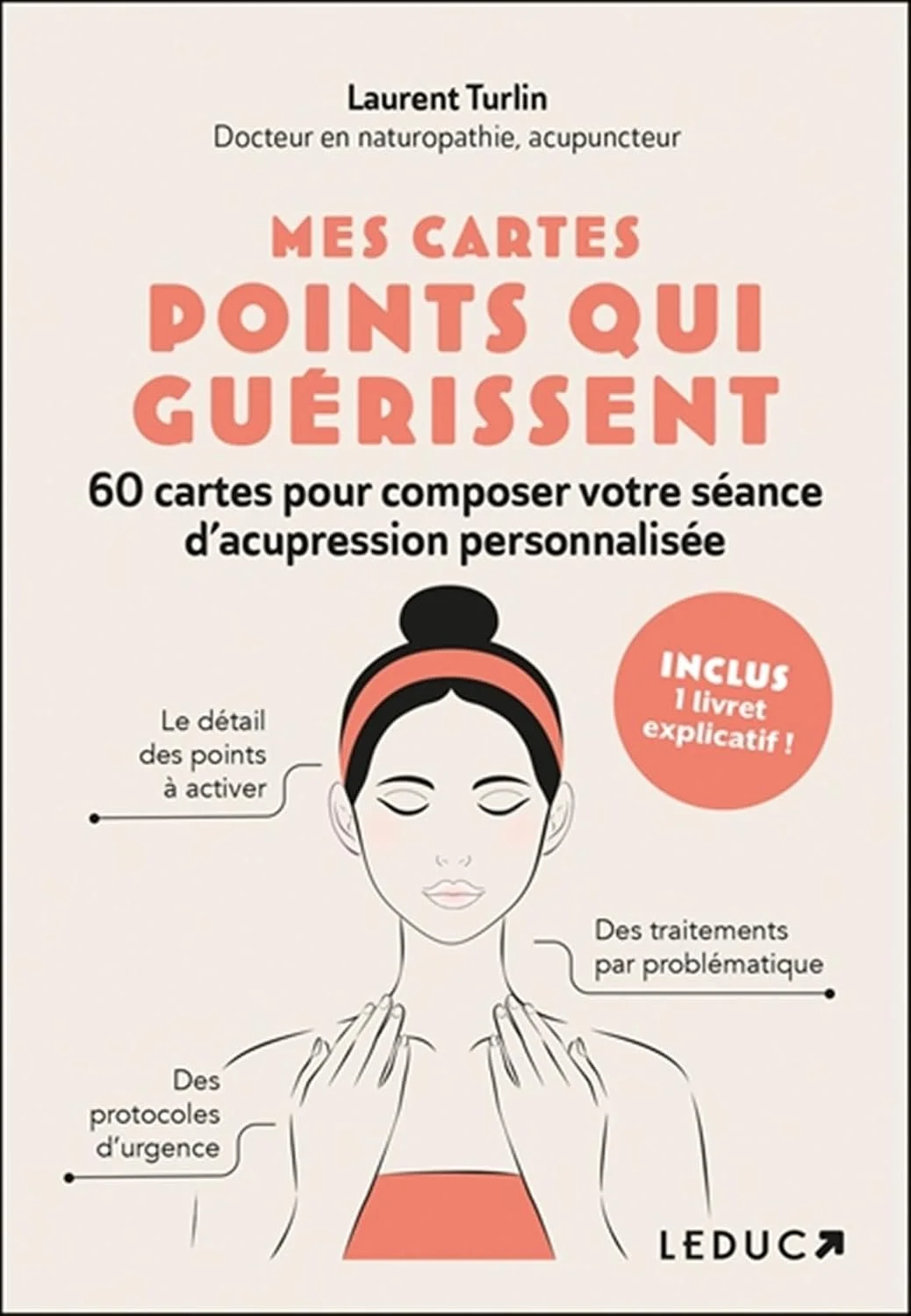
Then a box of cards landed on our desk. Sixty of them, made by Dr. Laurent Turlin — acupuncturist, doctor of naturopathy, and one of the ambassadors we spoke with for this platform. We have had it in our hands for a few weeks now, and it has been quietly useful. This is what we make of it, and more importantly, what it made us think about.
Why cards
He has written a dozen books on acupuncture and acupressure points, so we asked him plainly: why this form, this time?
Because he wanted to take the point out of the book. A card you pick up, he says. You set it down in front of you. You carry it with you. It turns a piece of knowledge into a gesture — elle transforme une connaissance en un geste.
The aim was to make a thousand-year-old medicine more reachable still: a need, a card, a point, one simple movement, without having to reread a whole chapter to find the one thing you need at that moment. And he had noticed something else along the way. Books can intimidate people. A book looks serious. Cards look more like a game.
In his books he explains a great deal — why a point works, how to find it, what logic it belongs to. With the cards he wanted something far more intuitive: choose one according to what you feel, keep it close, come back to the point several times during the day. A tool you use rather than a work you read. It is another way of passing acupressure on, he says: less theoretical, more everyday, almost playful, without giving up any of the precision of the gesture.
What is actually in the box
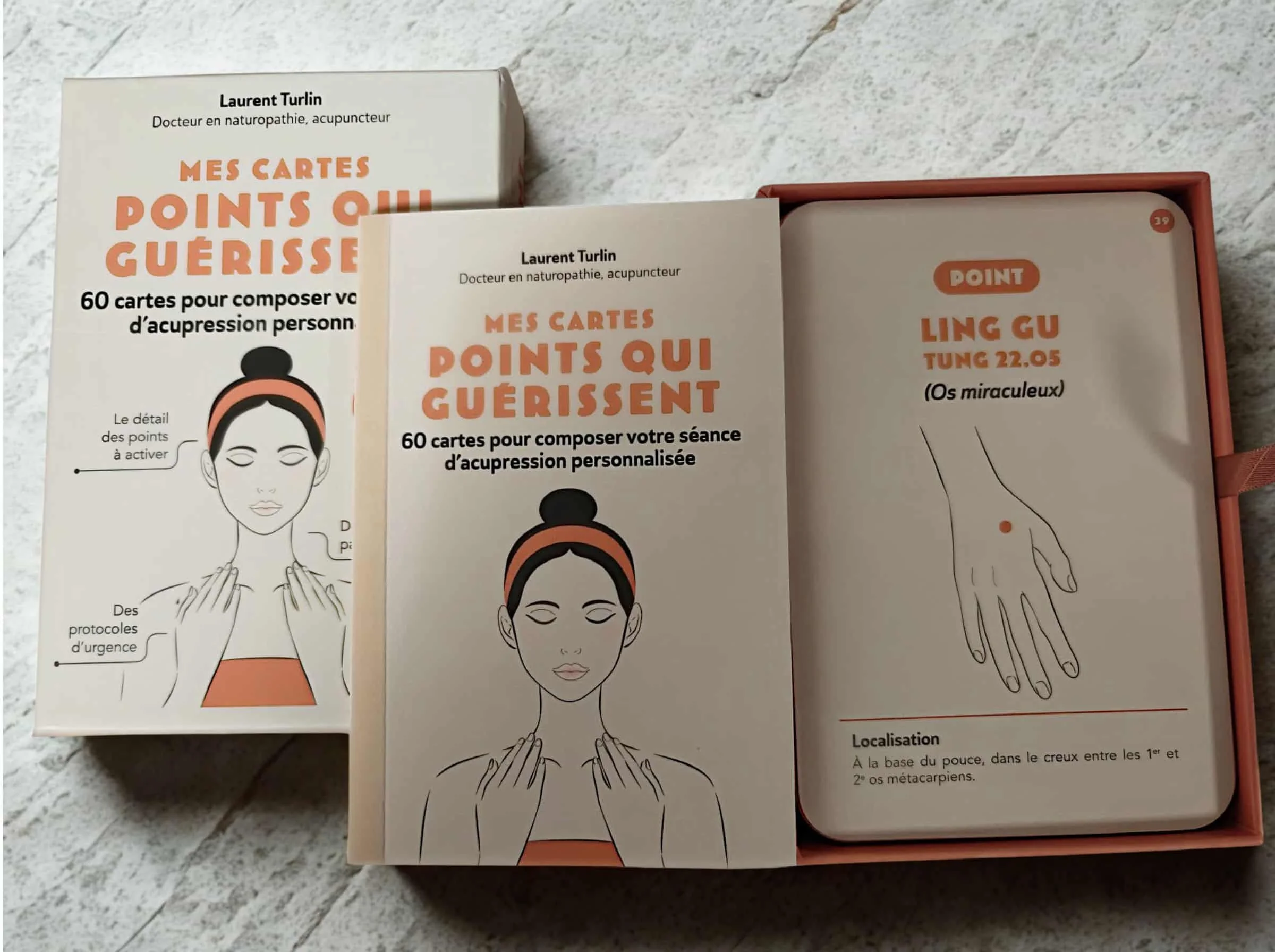
Sixty cards, and they are not sixty of the same thing. The set is deliberately built in three layers:
41 point cards. The principal acupressure points, each with its location and what it is used for. This is the vocabulary layer — one card, one point, one idea.
13 protocol cards. Combinations assembled around a specific complaint: sciatica, nervousness, and others in that register. This is where the deck stops being a glossary and starts being a session.
6 emergency sheets. Migraine, constipation, and the rest of the small crises that arrive at inconvenient hours. These are the cards that will actually get used, because they are the ones someone reaches for at the moment something hurts.
An 80-page booklet comes with it, explaining what acupressure is, what it can do, and how to work with it day to day. The deck is published by Leduc, co-authored with Alix Lefief-Delcourt, and appeared in June 2026. And the making of it is good. That matters more than it sounds.
The box is solid, the booklet has a reinforced edge, and the cards are properly laminated — built to be handled daily for years rather than to survive one enthusiastic week. Nothing here feels like a promotional insert. It is a well-made object in a box you would happily leave out on a table, which is precisely where it needs to end up.
What he hopes people do with it
Our third question was about the person who will never set foot in an acupuncturist's practice. What does he hope they do with this?
His answer opened with pleasure, curiosity and fun, in that order. First, that they discover they can become an actor in their own wellbeing through extremely simple gestures.
Then something more concrete. He wants the cards to live: to come out of the box, one on somebody's bedside table, another on a desk, someone gradually learning to locate a few points and to use them naturally through the day. If a person who will never consult an acupuncturist learns five or ten points from this deck and keeps them for life, then as far as he is concerned the box has done its job completely.
And perhaps, along the way, they will have discovered that acupuncture is not only a technique you receive. It is also a culture of prevention, and of paying attention to yourself.
The card he reaches for most
We asked him which card he uses most himself. He did not hesitate: Ling Gu.
It is one of the emblematic points of Master Tung's acupuncture, and just as emblematic in Dr. Tan's Balance Method — which is part of why the answer stayed with us. He is particularly fond of it, he told us, for the sheer power and range of what it does. In the Tung tradition certain points carry that remarkable capacity to act at a distance and to hold very wide indications, and Ling Gu is probably one of the finest examples of it.
He reaches for it constantly in his own practice, partly because it illustrates what still fascinates him about this medicine: an extremely precise point can have an action that reaches far beyond the area where it sits. And that, he says, is what he hopes these cards pass on — that behind one small point on the body there can hide a tool of astonishing richness. Derriere un petit point sur le corps peut se cacher un outil d'une etonnante richesse.
Where it meets the Balance Method
That answer is also the shortest route into what a practitioner sees on opening this box. You will recognise a great deal of it straight away. Many of these are the points we reach for ourselves every week — the ones Dr. Tan worked with, and several that anyone who has spent time with Master Tung's system will know on sight. These points have been shared property in Chinese medicine for a very long time. What distinguishes one school from another was never which points exist; it is how you decide which one to use.
Here, that decision is made classically: complaint, point, place to press. Dr. Turlin knows both ways of working and chose the one his reader can follow without a training behind them.
And that is what kept us turning the cards over. Because our own reasoning was never bound to the needle either. When we match structure to structure — a point for a point, a line for a line, an area for an area — we are doing geometry and meridian logic, not metallurgy. Swap the needle for a thumb and the reasoning holds. What changes is the dose, the depth, and the time it takes.
Which opens a door we have not used nearly enough. The thing a patient can carry home is not our technique — it is our logic, in its small, portable version. One point, in the right place, for the right reason, chosen the way we would choose it standing at the table.
Dr. Tan's own instruction was to share everything, keep nothing, and help everyone. A deck of cards on someone's kitchen table is a fairly literal reading of that.
What stayed with us
It is a lovely object, made with obvious care, and it does something very little material in our field manages: it puts an action in someone's hands rather than information about their body.
It is in French, and it is made for the kitchen table rather than the treatment table. That is the brief, and the brief is met beautifully. Your clinical reference stays exactly where it is — this one is for the person walking out the door.
The idea behind it travels perfectly well: something small in the patient's hands, chosen by you, for the week between sessions. We came away wanting to make our own version of it. That is probably the highest thing you can say about a colleague's work.
If the idea of one well-chosen point interests you, the free Balance Method matrix PDF lays out the six systems on a single sheet, and every term we have used here is defined in the Balance Method Glossary. We also sat down with Dr. Turlin for a longer conversation about his route into this work — you can read that ambassador interview.
The deck at a glance
Mes cartes points qui guerissent
Authors: Dr. Laurent Turlin, Ph.D., with Alix Lefief-Delcourt
Publisher: Leduc
Format: 60 cards, 100 x 150 mm — 41 point cards, 13 protocol cards, 6 emergency sheets — plus an 80-page explanatory booklet
Language: French
Published: 18 June 2026 · EAN 9791028538347
Where to find it: From the publisher and on Amazon
Publisher's page at Editions Leduc →Frequently asked questions
Will I recognise the points?
A great many of them, yes. These are largely the shared points of Chinese medicine — the ones Dr. Tan worked with, a number that overlap with Master Tung's, and plenty we use ourselves every week. What is different here is the arrangement: the cards are organised classically, by complaint, rather than by system. Shared vocabulary, a different way of choosing.
Do I need to read French?
Yes — the cards and the booklet are in French. Dr. Turlin works in Paris and wrote it for a French readership.
How does it sit alongside treatment?
As continuity. It gives people something to do with their own hands between sessions, which for a great many everyday complaints is genuinely useful and, just as importantly, keeps them engaged with their own recovery. Dr. Turlin is clear that it works alongside proper care rather than instead of it.
Where can I find the cards?
They are published by Editions Leduc and listed on the publisher's own page, and also carried by Amazon. Published 18 June 2026, EAN 9791028538347.
