
Instant Pain Relief with Balance Method Acupuncture by Kris Oosting: An Honest Book Review for Practitioners
There is a particular kind of book that changes how a clinic runs. Not the one you read once and shelve, but the one that stays open on the desk — spine cracked, sticky notes fanning out of the top edge, a coffee ring somewhere near the index. For a growing number of Balance Method practitioners, that book is Kris Oosting’s Instant Pain Relief with Balance Method Acupuncture. We wanted to tell you why.
We recently sat down with Kris for a long conversation — his route from classical Chinese medicine into Dr. Tan’s work, the teachers he honours, and the mindset that carried him through the early years. You can read that ambassador interview here. This review is the other half of the story. Not the man — the book.
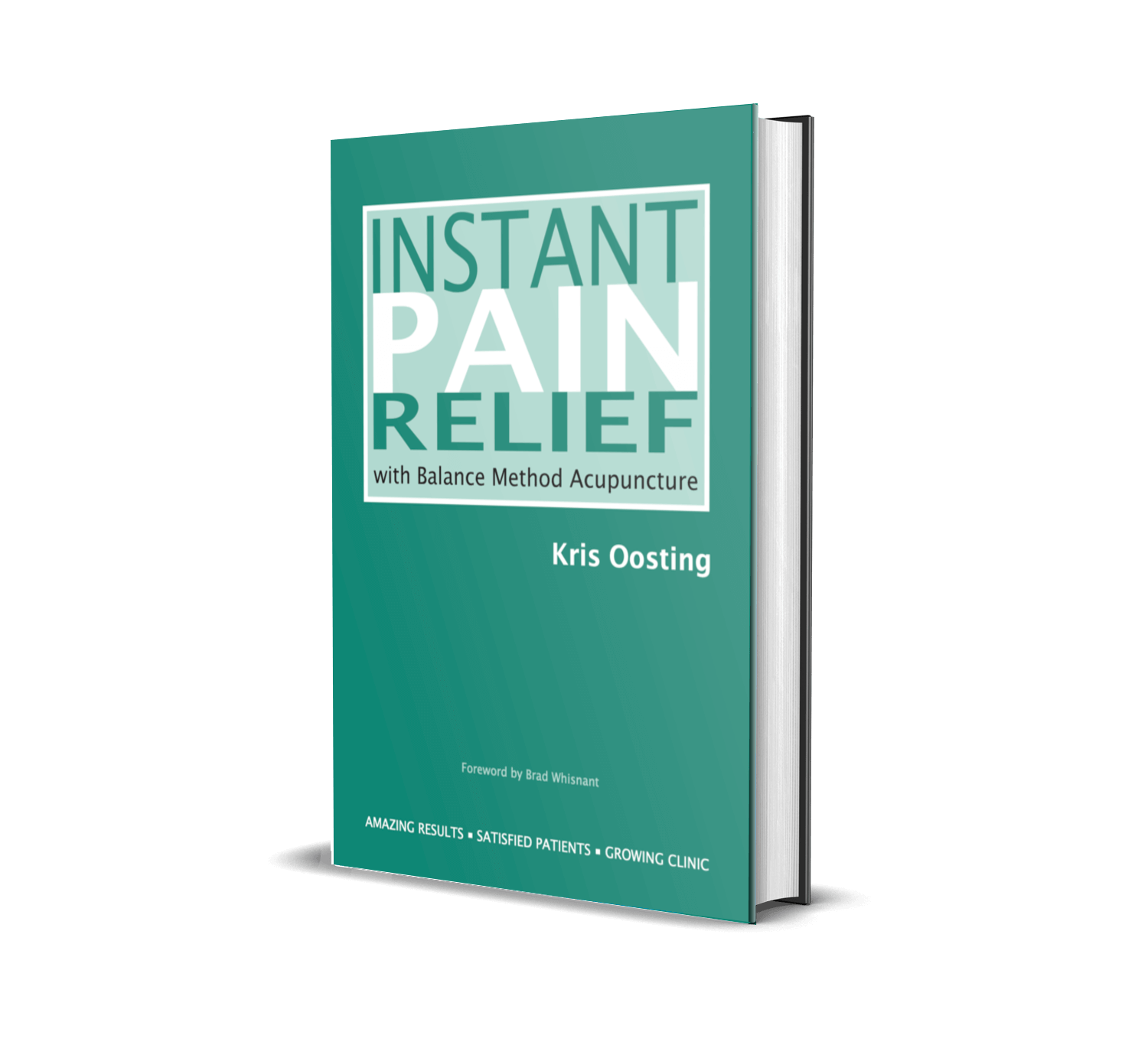
Instant Pain Relief with Balance Method Acupuncture by Kris Oosting.
What the book actually is
Instant Pain Relief is a 736-page hardcover, illustrated in full colour throughout — which matters in a method this visual, where a clear diagram can land faster than a page of text. Some of the book’s artwork is the work of Kris’s wife, Jean Chin — beautiful pieces like her Blue-Green Dragon of the East that give the book its character and make it a pleasure to hold, not only a reference to consult. That heft is not padding. It is roughly a decade of clinical work, research and teaching notes, distilled into one reference. Kris published it himself, through his own imprint — which is partly why it could run to 736 full-colour pages exactly as he wanted, with no commercial publisher trimming it down. It opens with a foreword by Brad Whisnant. He wrote the first version for his own students, and you can feel that origin on every page: it teaches the way a good instructor teaches, in front of a table, with a patient waiting.
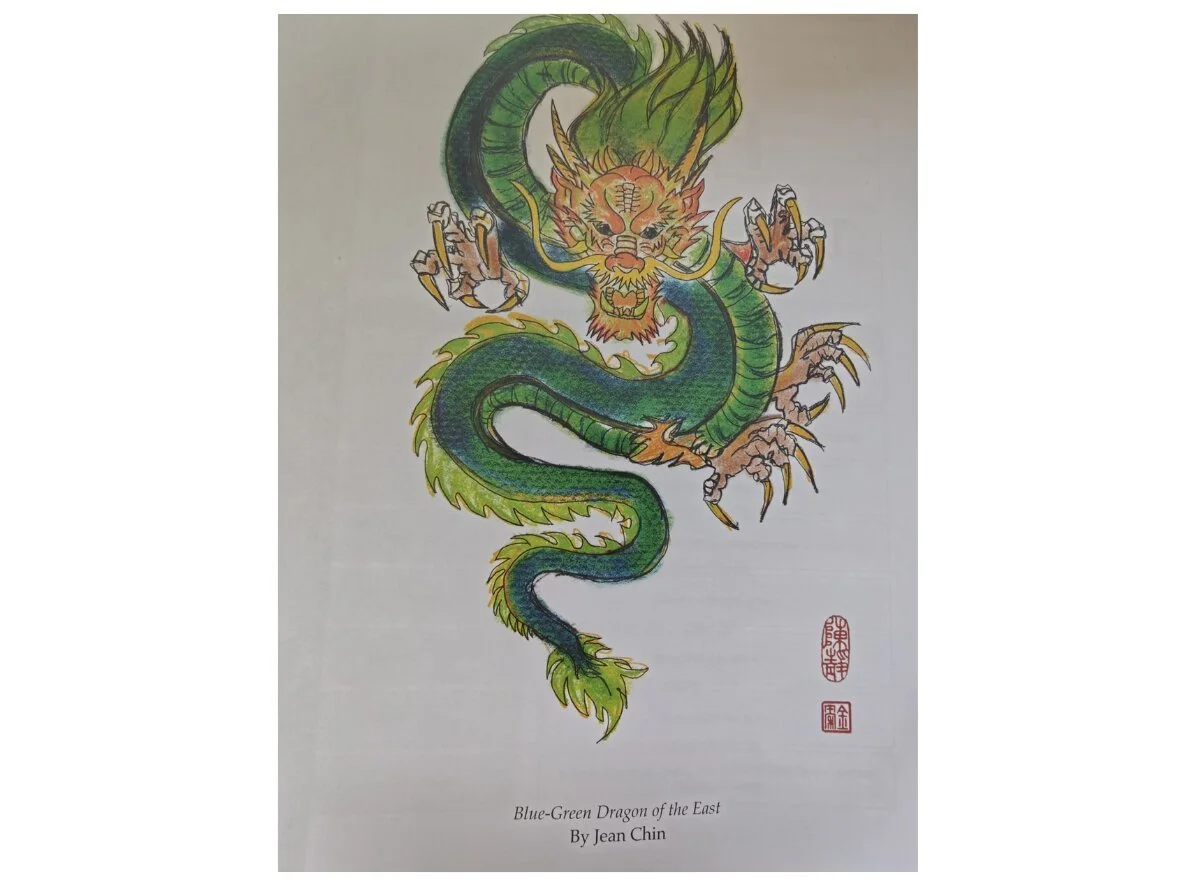
Blue-Green Dragon of the East — one of the illustrations by Jean Chin.
What sets it apart from most Balance Method literature is that it spends its time on the why. Plenty of books hand you a matrix and a point prescription. This one walks you back through the reasoning — the classical foundation underneath the structure — so that when a case does not fit the template, you still know what to do. That depth is earned: Kris has worked as an acupuncturist and herbalist since 2003 and spent years inside the classical texts, from the Nei Jing to the Shang Han Lun. It shows. For a method whose whole strength is logic, this is the difference between memorising and understanding.
There is a line from Confucius that Kris keeps close, and it explains the whole book in a breath: show a student one corner, and if they cannot come back with the other three, the lesson stops. Instant Pain Relief is built to help you find the other three — not to hand you answers, but to make the reasoning your own.
How it extends the method
Dr. Tan wanted the Balance Method to keep growing. He wanted practitioners to add to it, to test it, to push it forward rather than freeze it in place. Instant Pain Relief takes that invitation seriously. Alongside the classical framework, the book introduces tools Kris developed over years of practice: the Balance Wheel, the OBS Balance Matrix, an Extended Balance Matrix covering nine systems, a set of Balance Networks, and what he calls Hidden Global Balance Structures.
We will not teach those here — they are his contribution and they deserve to be learned from the source. What matters for a review is this: they are not decoration. They are working answers to the cases that used to leave you stuck, and they are the reason the book reads as a living extension of Dr. Tan’s system rather than a summary of it.
The pages practitioners keep returning to
Ask Kris which pages matter most to him and he does not hesitate: pages 412 to 416, a chest and breathing protocol he first called the Happy Chest protocol. He has leaned on it for years — the kind of result patients notice inside a single session, in how they breathe and how much air they seem to suddenly have. He points to it, and to two of his own additions in Chapters 10 and 12, as the sections that have helped not only his own practice but the practices of many who learned from him.
We are not going to reproduce those protocols — that is exactly the material the book exists to deliver. But it is worth naming, because it tells you something about the author: the sections he is proudest of are not the clever ones, they are the ones that keep working.
Why Kris wrote it
The mission behind the book is simple, and Kris states it plainly: to give people with chronic pain and discomfort their lives back in a safe, affordable and easy way. The book is how he scales that mission. A technique that lives in one clinic helps one clinic’s patients; a technique written down clearly helps everyone who reads it.
Ask him what he is proudest of and it is not the page count or the reach. It is what the reach means — that practitioners across the world can now treat their patients better because of what is on these pages. That, he says, is the real gift.
That instinct — pass it on, keep nothing back — runs straight back to his teacher. It is held in a saying he keeps close:
日为师,终身为父 (yī rì wéi shī, zhōngshēn wéi fù) — “a teacher for a day is a father for life.” We talked with Kris about exactly that lineage, and what he carries forward from Dr. Tan, in our ambassador interview.
Who it is for — and our honest take
Here is our honest impression, with the book in our hands: it is sturdy and beautifully made, printed on good paper — the kind of volume you keep for a career, not a season. What struck us most is the depth. The information is exhaustive and the study behind it is serious; it reads like a labour of love, a genuine masterpiece, with years and care poured into every part.
Make no mistake about what it is, though: a reference and a study book, one you work through slowly and keep returning to, not something you read once and shelve. We would hand it to anyone who wants to go deep into the Balance Method — practitioners who want the theory behind everything, and who want to understand, and in time master, the reasoning underneath the method rather than only the point prescriptions. If you want a slim first introduction, one of the shorter foundation texts will serve you better to start; this is the volume you grow into.
Kris frames the book as something that saves the reader years of trial and error, and we think that framing is fair. Ten years of someone else’s clinical mistakes, already made and already solved, is a genuine shortcut — and every hour it saves you is an hour that goes back to your patients. Practitioners consistently report the same thing: more confidence, cleaner reasoning, better results with the chronic cases that used to resist everything.
If you want to see how it sits next to the rest of the canon — Dr. Tan’s own texts, and the other practitioner works we recommend — our full Balance Method reading guide maps them all out by level and purpose. And if you are still finding your feet in the core system, our free Balance Method matrix is a good place to orient yourself before a book this deep.
One practical note before you decide: this is Kris’s newest and most complete book. His earlier two volumes, released in 2020 and 2021, are both sold out — which makes Instant Pain Relief the definitive current edition, and the one to reach for.
The book at a glance
Title: Instant Pain Relief with Balance Method Acupuncture
Author: Kris Oosting
Foreword by: Brad Whisnant
Format: Hardcover · 736 pages · 600+ full-colour illustrations
Best for: Working Balance Method practitioners who want depth and a complete desk reference
Reach: Read by practitioners in dozens of countries
Frequently asked questions
Is Instant Pain Relief suitable for beginners?
It works at every level, but it rewards practitioners who already have some Balance Method footing. Complete newcomers often start with a shorter foundation text, then move into this one as their main working reference. Its depth is a feature, not a barrier — it simply means there is a lot to grow into.
How is it different from Dr. Tan’s own books?
Dr. Tan’s texts are the essential foundation. Kris’s book builds on that foundation, going deeper into the reasoning behind the matrices and adding his own tools and structures developed over a decade of practice. Think of it as an extension of the system rather than a replacement for the source.
Where can I buy it?
Directly from Kris Oosting’s online store. It is a hardcover, so it ships internationally rather than downloading — worth planning for if you want it on the desk by a particular week.
Is it worth the investment?
For a practicing Balance Method acupuncturist, we think so. A comprehensive reference you use daily pays for itself quickly — in cleaner reasoning, in confidence with difficult cases, and in the time you no longer spend rediscovering what someone else already worked out.
